How Sea Lampreys Nearly Destroyed the Great Lakes
In the 1930s, fishers in the Great Lakes noticed an unusual marine creature with suction-like mouths and sharp teeth. In the following decades, this fish would go on to decimate the lake trout and many other species of fish in the lake, causing immense damage both to the habitat of the Great Lakes and to the massive fishing industry. These creatures are an invasive species known as sea lampreys, which nearly destroyed the Great Lakes.
What are sea lampreys?

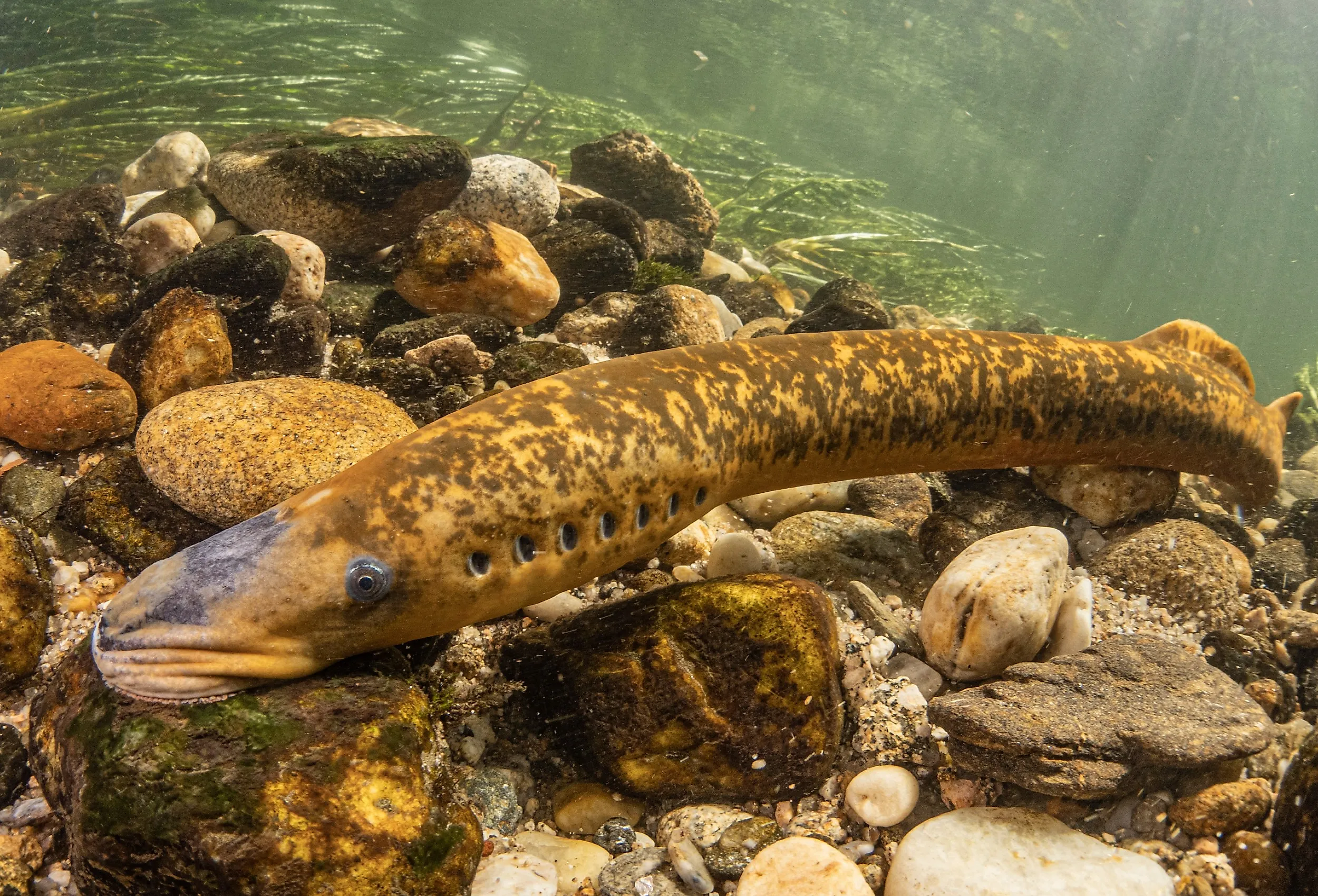
Sea lampreys (Petromyzon marinus) are a species of fish that lives in the Atlantic Ocean. These fish grow to be 14 to 24 inches long and tend to be dark brown or black. They are at times mistaken for eels due to their long body shapes. In addition, they lack the bony structure of other fish, and their bodies are made of cartilage, similar to sharks. They breathe through their gills, which sit between their mouth and eyes, and they have no gill covers.
The genus name Petromyzon comes from Greek and means sucker of stone, with marinus being Latin for of the sea. The term sucker is a good description of the sea lampreys, as they have a disc-shaped mouth with suction cup-like qualities. Inside this mouth is a line of sharp teeth, which it can use to tear into the bodies of fish and drain their blood.
Sea lampreys are strong creatures, able to move large rocks with their mouths to build nests. They build these nests near spots with other young lampreys. One sea lamprey can give birth to 100,000 eggs. Of these, around 10% survive, adding 10,000 sea lampreys to the population.
Sea lampreys do not target humans, as they exclusively go after cold-blooded creatures, although they may occasionally latch onto a human swimmer out of curiosity or to go to a different location.
How did they get into the lakes?

Sea lampreys originally lived in the Atlantic Ocean near the coastline but were unable to enter the Great Lakes due to the flow of the water from the west to the east and the natural barrier of Niagara Falls. However, human activity created a route for sea lampreys to invade.
The first route was created in 1825 with the Erie Canal, which connected Lake Erie and the St. Lawrence River. This route opened up direct ocean trade from the Atlantic Coast to Lake Erie. This route was later expanded through the Welland Canal, which was first built in 1829 to bypass the Niagara Falls and connect Lake Erie and Ontario. The Welland Canal would go through several changes until 1919, which allowed water to move unidirectionally from Lake Ontario to Lake Erie.
With these passageways, the sea lampreys moved from Lake Ontario into Lake Erie, and then expanded in other waterways across to the other Great Lakes. In some instances, they even latched onto inland ships and journeyed to the western Great Lakes. During the 1930s, fishermen began reporting that these sea lampreys were everywhere in the Great Lakes and were causing a lot of damage.
It is worth noting that some researchers have proposed alternative explanations for the sea lamprey's entry into the Great Lakes. One researcher, Randy L. Eschenroder, has argued that sea lampreys were native to Lake Ontario and were previously rarely seen due to the cold waters being unsuitable for them, but the environmental damage caused by human activity made the water more suitable for sea lampreys. What is not under debate is that the sea lampreys have caused massive damage to the Great Lakes' ecology.
What damage did they cause?

A sea lamprey can kill a huge number of fish, with a single one destroying up to 40 pounds of fish over its months-long parasitic feeding stage. They are parasites that latch onto cold-water fish, slowly draining their blood and killing them. Sea lampreys are considered an invasive species as they have no natural predators in the Great Lakes, and can rapidly reproduce and feed on fish.
Researchers have noted that fish usually die either from the loss of fluids from the lamprey attack or due to infections from the wound.
These sea lampreys caused immense damage to the native fish populations, which were noticed by the commercial fishing operations, which relied on large lake trout as their primary means of income. In Lake Superior, lake trout catches fell from 4.5 million pounds to 368,000 pounds in 1961, while in Lake Huron and Lake Michigan, trout populations virtually disappeared during the late 1940s and early 1950s. Due to these huge losses, the fishing season was shut down in 1962.
The losses were more than just economic, as these fish deaths impacted the ecological diversity of the Great Lakes, as sea lampreys outcompeted other creatures for resources. Sea lampreys targeted other fish as well, such as white sucker, longnose sucker, redhorse, yellow perch, rainbow trout, channel catfish, and other carp. They played a significant role in the extinction of longjaw cisco, deepwater cisco, and blackfin cisco in the Great Lakes.
These sea lampreys proved useful for another invasive species: the alewife, which entered the Great Lakes from the Atlantic Ocean. As sea lampreys had killed so many of the predators, alewife populations also significantly rose in the Great Lakes. State fish agencies attempted to introduce salmon as an alternative to trout, but these two fell prey to sea lampreys.
How were they controlled?
With the economic and ecological impact of these sea lampreys, this issue impacted not just individual regions or states, but the entire nations of the U.S. and Canada.
Initial efforts included electrical and mechanical barriers. In the mid-to-late 1950s, scientists at the Hammond Bay Biological Station in Michigan, working under the U.S. Fish and Wildlife Service, were tasked with finding a lampricide that could kill lampreys during their larval stage. After testing thousands of compounds, they identified one under the name TFM, first applied in the Great Lakes in 1958. This poison would prove highly effective at killing and controlling the sea lamprey population, and the binational Great Lakes Fishery Commission, formed in the mid-1950s, coordinated the wider control program.
Authorities primarily treat tributaries where larval sea lampreys live. TFM targets the energy metabolism of these larvae, killing them before they develop teeth. Another chemical commonly used alongside TFM is Bayluscide, which is cheaper than TFM and is used in slow-moving or stationary waters.
Other efforts are used to reduce lampreys' ability to reach spawning areas in the first place. Larvae require gravel or soft areas to burrow into, so barriers are utilized to block adults from jumping over and reaching spawning areas. These barriers are made low enough to accommodate jumping fish but high enough to keep sea lampreys out.
These barriers are often combined with traps that are built downstream of barriers and can capture sea lampreys as they move into or out of tributaries. In some cases, these can trap up to 40% of adults from a tributary.
The continued work to control sea lampreys

Although these efforts have dramatically reduced sea lampreys, it still requires a good deal of investment to keep those sea lampreys still alive in check. In the early 1990s, estimates showed that the U.S. and Canada spent $8 million annually on sea lamprey control and $12 million to restore lake trout.
The Great Lakes fishery continues to treat waters with TFM and is working on other methods to control sea lampreys, such as pheromones and alarm cues that come from dead lampreys to gradually lure sea lampreys into traps or areas that are suitable and inexpensive for TFM treatment.
The long-term impact of sea lampreys also requires careful management, such as that of alewives. Authorities introduced Pacific salmon that could feed on alewives, which helped reduce their population. However, with declining alewife populations in Lake Huron, now Pacific salmon are under threat. All of these factors make managing the Great Lakes a difficult task.
Although the efforts to control sea lampreys have been successful, more work is required to both control the population still in the Great Lakes and to manage the ecology and health of the Great Lakes.