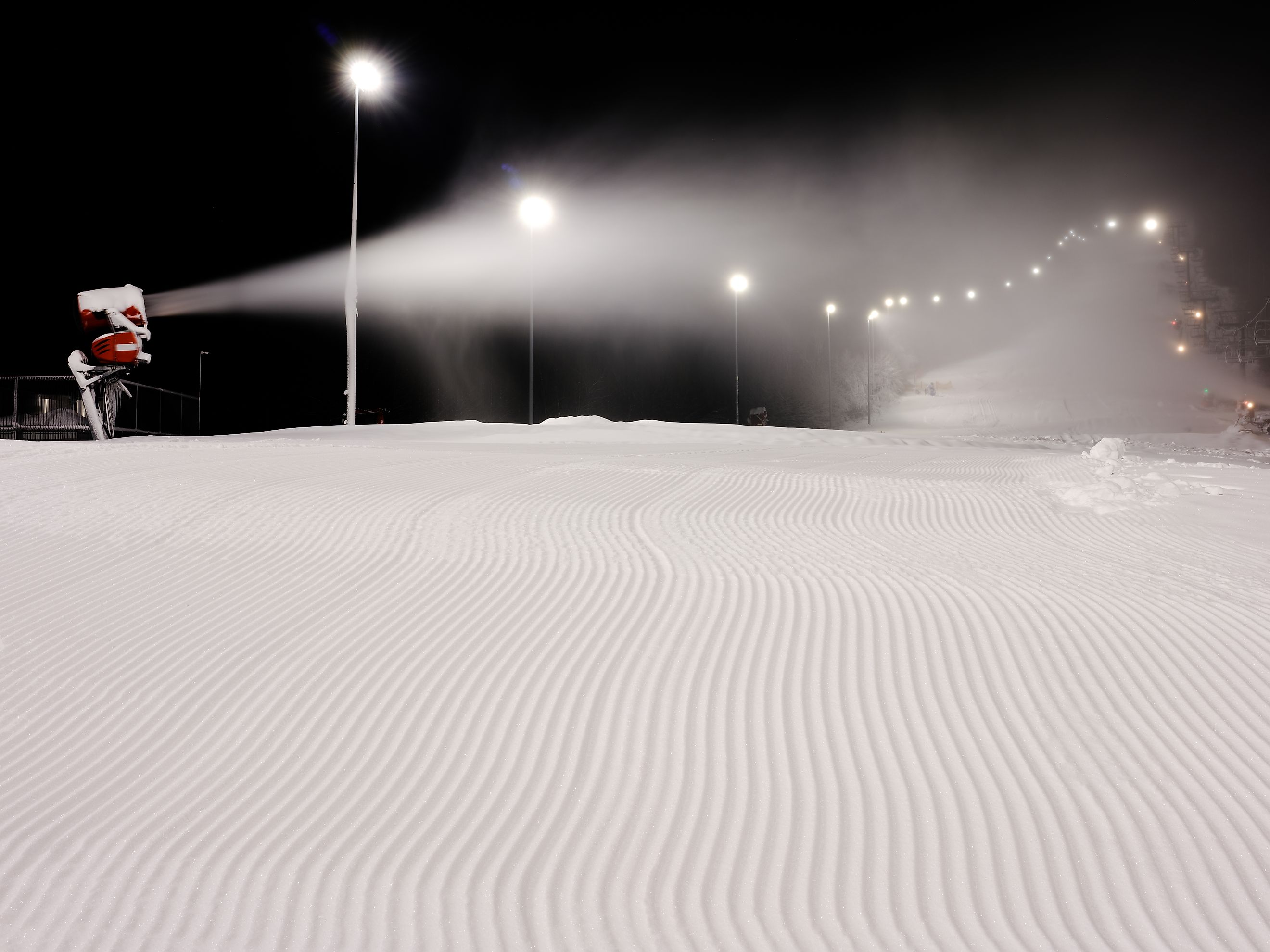
How Much Water It Takes To Make Snow For One Ski Resort
Covering a single acre of mountain with one foot of machine-made snow takes somewhere between 180,000 and 300,000 gallons of water. An acre is about the size of a football field. A foot of snow is not enough to open a run.
Scale that up and the numbers get strange quickly. Most large East Coast ski areas get through around 250 million gallons in a season, and the industry has spent years arguing, with some justification, that almost all of it comes back.
The Conversion Rate

The working unit is the acre-foot of snow, meaning one acre covered a foot deep. Estimates for how much water that takes range from about 180,000 gallons at the efficient end to roughly 300,000 at the conservative one, depending on snow density, air temperature, humidity, and how much is lost to the wind on the way down.
For reference, an acre-foot of water is 325,851 gallons. So making snow is a reasonably good deal volumetrically: you get more snow than the water you put in, because snow is mostly air.
What ruins the arithmetic is coverage. A foot of snow does not bury rocks, stumps, or the shrubbery that resorts prune back precisely so they can open on a thin base. Two feet is a more realistic working depth, which doubles every figure below.
What One Resort Actually Uses

Palisades Tahoe reports using 50 to 70 million gallons a year, which it says covers about 60 acres of terrain in a foot and a half of snow. Seventy million gallons is roughly what 50 American families use in a year.
At the other end of the scale, Loveland in Colorado averages around 34 million gallons annually, which works out to about 51 Olympic swimming pools. Vail Resorts reported 150 million gallons in one season to cover 317 acres, most of it pumped from underground.
Large eastern resorts run higher because they have to. Snowshoe Mountain in West Virginia operates around 500 snow guns, and Sunday River in Maine can push roughly 11,000 gallons a minute through its system. At that flow rate a resort could theoretically produce an acre-foot of snow in under half an hour, though in practice the water is spread across many guns and several trails at once.
Most Of It Comes Back

This is the industry's central and broadly accurate defence. Snowmaking is largely non-consumptive. The water is taken from a stream or reservoir in November, sits on a hillside for four months, and runs back into the same watershed in April. Vail Resorts calls the mountains cold storage, which is a fair description.
The usual figure is that about 80 percent returns. The missing fifth goes to evaporation and sublimation, the latter being snow turning directly to vapour without melting first, which happens constantly on a sunny slope at altitude.
Where the water starts matters. Surface water returns to the surface. Groundwater does not go back underground on any useful timescale, and losses from aquifer-sourced snowmaking can run higher, which is a real consideration for resorts pumping from wells rather than rivers.
It Is A Rounding Error, Statewide

Every snowmaking operation in Colorado combined uses around 2.2 billion gallons a year. That sounds enormous until you set it against everything else the state diverts, where it amounts to about 0.05 percent. Agriculture takes roughly 85 percent.
In Utah the proportion is similar, under a tenth of one percent of diverted water. So on a state ledger, snowmaking barely registers, and anyone presenting it as a major driver of western water scarcity is reaching.
The counterargument from watershed scientists is narrower and harder to dismiss: in a basin that is already short, every diversion is contested, and timing matters. Snowmaking takes water in late autumn, when streams are often at their lowest.
The Energy Is The Bigger Bill

Pushing water uphill and compressing air to atomise it is expensive. One study of ten American ski areas put snowmaking at about 18 percent of a resort's total energy use on average, and some estimates for individual operations run far higher, with two-thirds of a mountain's power going into it during a build-up.
A single fan gun might run a 32-horsepower electric motor, throwing droplets 30 microns across sixty feet into the air so they freeze before landing. Resorts operate hundreds of them simultaneously.
So the honest accounting is that snowmaking borrows water and spends electricity. The water largely returns. The kilowatt-hours do not.
What Machine Snow Cannot Replace

Researchers at UC Berkeley put the share of western water that originates as mountain snowpack at about 75 percent. Machine snow does not add to that, because it is made from water already counted in the system. Moving water from a reservoir to a hillside and back again is storage, not supply.
Resorts are also junior water rights holders in most western states, which means that in a genuine shortage they are near the back of the queue. The snow guns stop before the farms do.
Which leaves snowmaking roughly where the numbers put it: a significant expense for a resort, a trivial line on a state water budget, a real pressure on a specific stream in a specific month, and no substitute whatsoever for a winter that actually snows.