The Largest Freshwater Lakes in the World by Volume
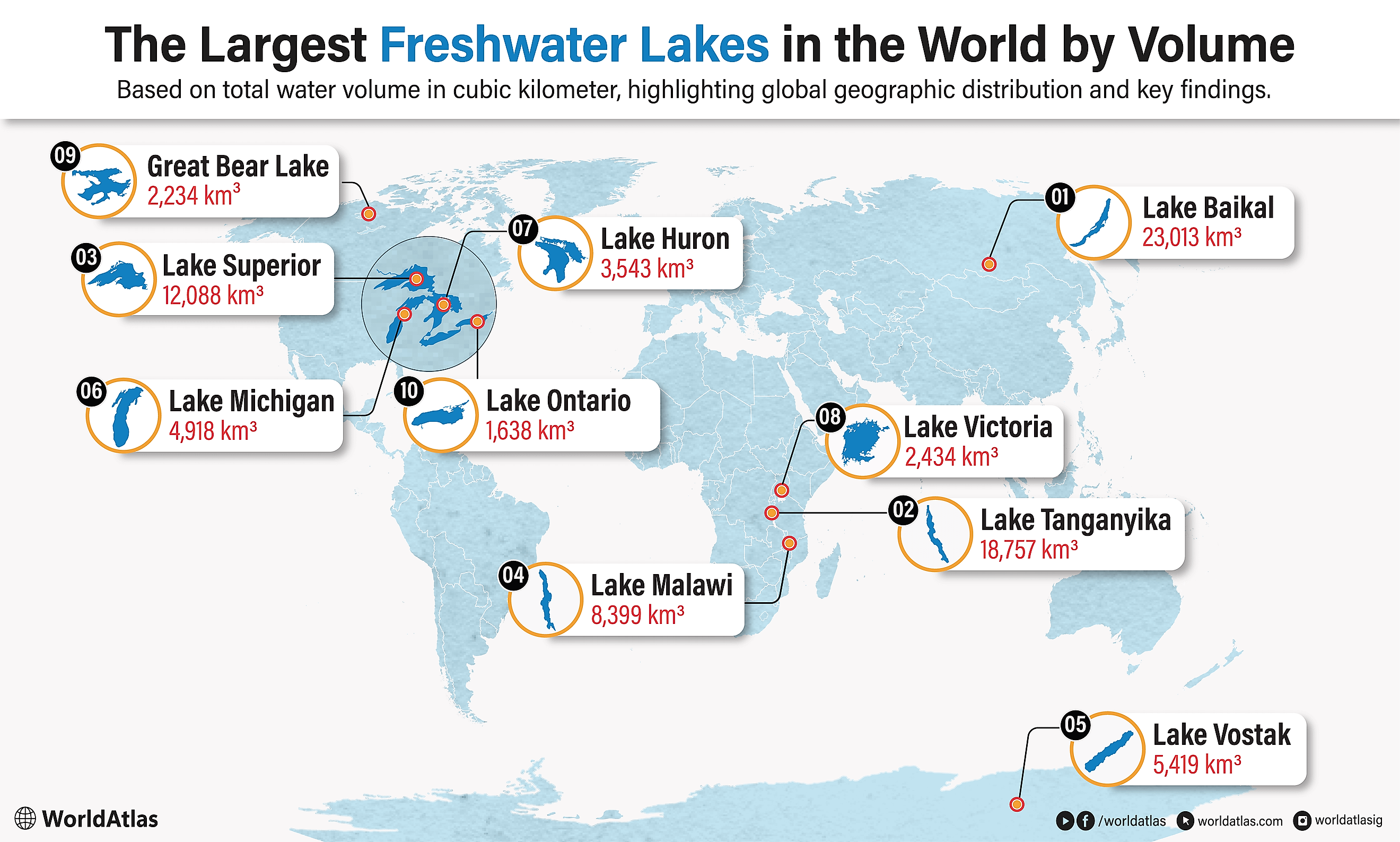
One Siberian lake holds a fifth of all the liquid fresh water on Earth's surface. That lake is Baikal, and it tops a list ranked purely by the water each basin holds. Volume rewards depth, so a deep rift lake can outrank a much broader one. The rankings pull in giants from four continents, including four of the five Great Lakes. Some of these basins filled when glaciers pulled back around 10,000 years ago. Others opened along continental rifts tens of millions of years earlier. One sits sealed beneath more than two miles of Antarctic ice. Here are the 10 largest freshwater lakes in the world by water volume.
The Largest Freshwater Lakes in the World by Volume
| Rank | Lake (Country) | Volume in km3 (mi3) |
|---|---|---|
| 1 | Lake Baikal (Russia) | 23,013 (5,521) |
| 2 | Lake Tanganyika (Democratic Republic of the Congo, Burundi, Tanzania, Zambia) | 18,757 (4,500) |
| 3 | Lake Superior (United States, Canada) | 12,088 (2,900) |
| 4 | Lake Malawi (Malawi, Mozambique, Tanzania) | 8,399 (2,015) |
| 5 | Lake Vostok (Antarctica) | 5,419 (1,300) |
| 6 | Lake Michigan (United States) | 4,918 (1,180) |
| 7 | Lake Huron (United States, Canada) | 3,543 (850) |
| 8 | Lake Victoria (Uganda, Tanzania, Kenya) | 2,434 (584) |
| 9 | Great Bear Lake (Canada) | 2,234 (536) |
| 10 | Lake Ontario (Canada, United States) | 1,638 (393) |
1. Lake Baikal, Russia - 23,013 km3 (5,521 mi3)

Located in southeastern Siberia in Russia, Lake Baikal has a water volume of 5,521 cubic miles, making it the largest freshwater lake by volume in the world. For context, this is around the same volume as all of the Great Lakes combined and accounts for 22% of all freshwater in the world.
Lake Baikal stretches for 395 miles and is the oldest and deepest freshwater lake on Earth, with an estimated age of 20 to 25 million years and a maximum depth of 5,315 feet. This lake gained this depth as the result of plate tectonics, where two plates moved apart, forming a continental rift. The lake is unlike other freshwater lakes as it has no sign of glacial ice sheets, and it contains crystallizing solids called gas hydrates. It is fed by more than 300 rivers, and only the Angara River drains it.
2. Lake Tanganyika, Tanzania - 18,757 km3 (4,500 mi3)

Lake Tanganyika is the largest of the African Great Lakes when it comes to water volume at 4,500 cubic miles, accounting for 16% of the world's freshwater supply. It borders the Democratic Republic of the Congo, Burundi, Tanzania, and Zambia through its 410-mile length, making it the longest freshwater lake in the world.
The lake sits at a relatively high elevation of 2,526 feet above sea level and is known for having a maximum depth of 4,820 feet. Its basin is home to more than 10 million people, with fishing yielding around 200,000 tons of fish annually. Its deep waters have provided refuge for aquatic species during dry periods. Around 86% of the cichlids in the lake are endemic to it. The lake is ancient, formed around 9 to 12 million years ago by a continental rift.
3. Lake Superior, United States - 12,088 km3 (2,900 mi3)

Lake Superior earns its name by being the third-largest freshwater lake in the world by water volume at 2,900 cubic miles. One commonly noted fact is that there's enough water in this lake to cover the entirety of North and South America with one foot of water. By surface area, it's the largest freshwater lake in the world at 31,700 square miles.
The lake has a shoreline on Minnesota, Wisconsin, the Upper Peninsula of Michigan, and the Canadian province of Ontario, which accounts for around 444,000 U.S. residents and 229,000 Canadians. The lake is the least developed of the Great Lakes, and is the coldest, with surface temperatures around 55 degrees Fahrenheit even during the summer due to its depth. It has a maximum depth of 1,333 feet, making it the deepest of the Great Lakes.
4. Lake Malawi, Malawi - 8,399 km3 (2,015 mi3)
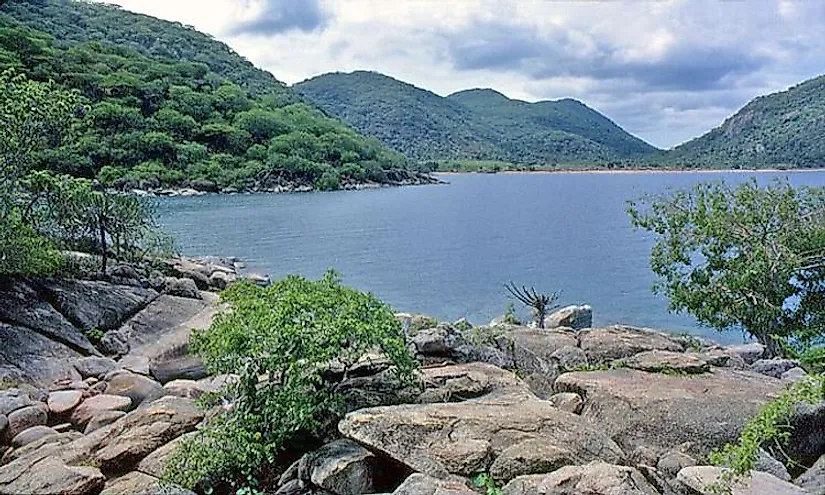
Lake Malawi is the second largest of the African Great Lakes by water volume, at an estimated 2,015 cubic miles. Most of its shoreline sits in the country of Malawi, although it also borders Mozambique and Tanzania to the east. Scientists believe this lake was formed 2 million years ago as a result of volcanic activity.
The lake is fed by rainfall along with the Ruhuhu, Rukur, Songwe, Dwangwa, Cobue, Bua, and Lilongwe Rivers. The land around Lake Malawi varies from the steep rocky cliffs of the Livingston Mountains in the north, with more sandy bays and plains to the south. Its most impressive feature is its biological diversity, with up to 1,000 fish species found within it, including species of cichlids which are only found in Lake Malawi.
5. Lake Vostok, Antarctica - 5,419 km3 (1,300 mi3)
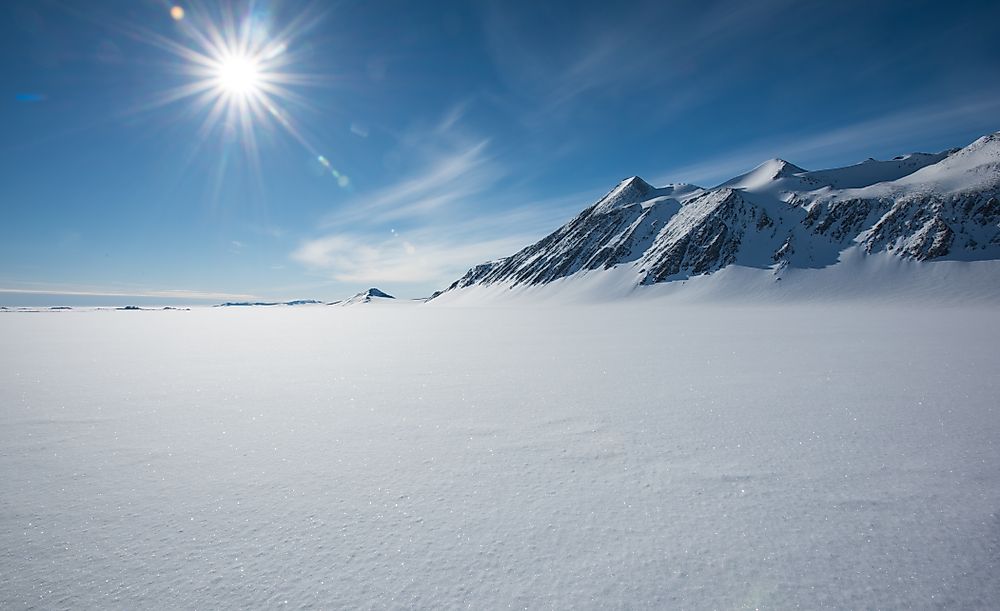
Lake Vostok is located in a region of the world with no permanent human settlement: the continent of Antarctica. This lake contains 1,300 cubic miles of water, but it sits entirely beneath the East Antarctic Ice Sheet, which is 2.5 miles below Russia's Vostok Station (which is where it gets its name).
This lake was first discovered in the 1990s through seismic and radar surveys. A Russian drilling project reached the lake in February 2012, drilling through the ice until it reached the lake's freshwater. One theory as to how this lake formed was volcanic activity that melted the ice and formed the lake. The lake maintains its liquid form due to heat from the Earth's interior. Scientists believe that organisms that live in this lake have adapted to both low nutrients and energy levels and evolved in an entirely different way than the rest of the Earth.
6. Lake Michigan, United States - 4,918 km3 (1,180 mi3)

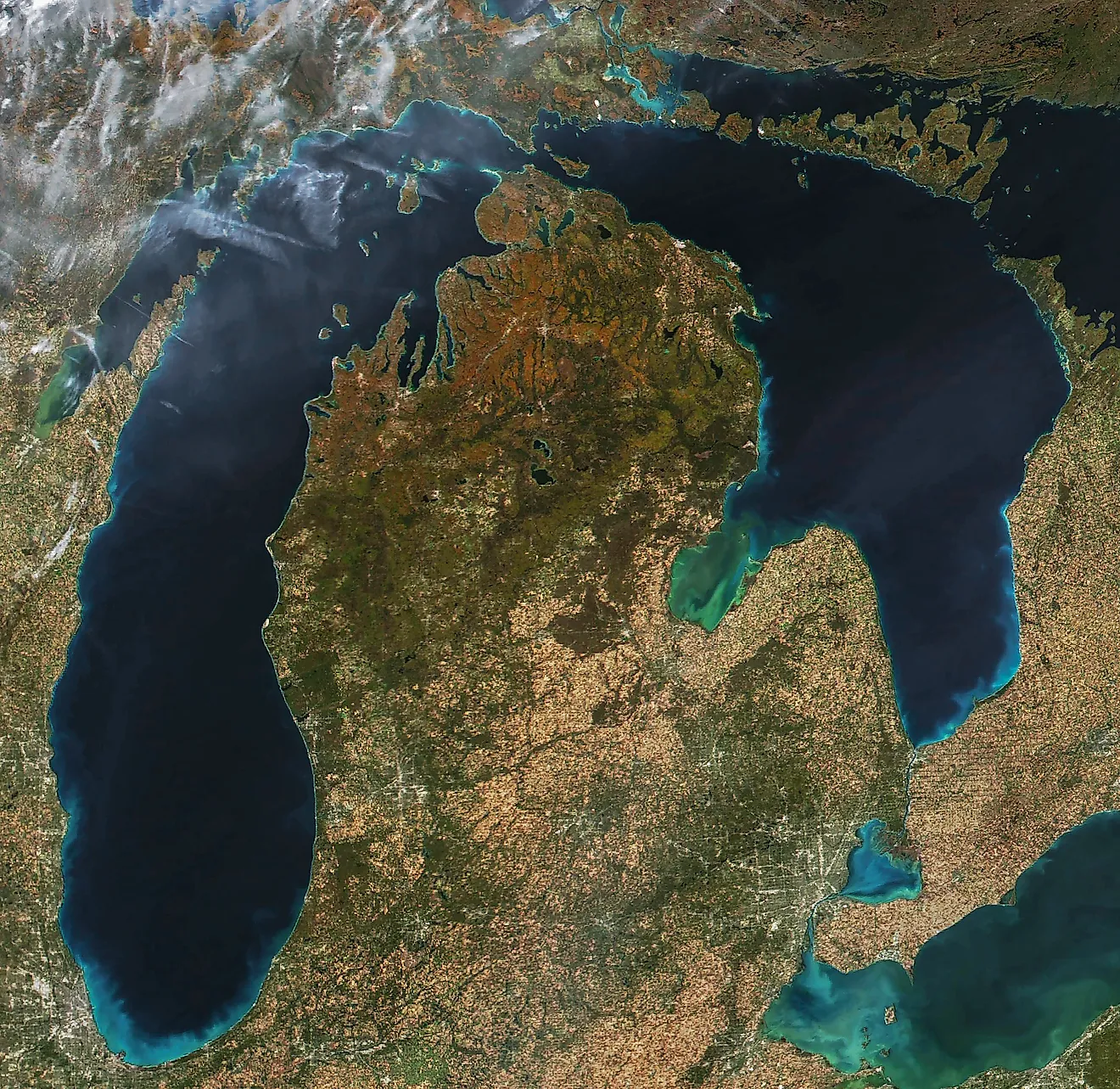
Lake Michigan is the second largest of the Great Lakes by both water surface area at 22,300 square miles and water volume at 1,180 cubic miles. Its shoreline is 1,640 miles, which supports a population of more than 12 million people. Unlike the other Great Lakes, Lake Michigan is entirely contained within the United States, with shorelines in Michigan, Wisconsin, Illinois, and Indiana.
The lake drains into Lake Huron via the Straits of Mackinac, and its basin is home to many urban centers, including Chicago, Milwaukee, and Green Bay. One of its most noteworthy habitats is its freshwater dunes, including at the Indiana Dunes National Park, with Mount Baldy being the tallest of the dunes there at 120 feet.
7. Lake Huron, United States - 3,543 km3 (850 mi3)

When compared to the other Great Lakes, Lake Huron is the third largest by water volume at 850 cubic miles. Like the other Great Lakes, it was formed at the end of the last ice age around 10,000 years ago when the glaciers retreated.
The lake is connected to Lake Michigan through the Straits of Mackinac, and it has the longest shoreline of the Great Lakes at 3,827 miles, which stretches across both peninsulas of Michigan and the Canadian province of Ontario. One of its biggest features is Manitoulin Island, the largest freshwater island at 1,068 square miles. This island even has more than 100 lakes contained within its boundaries. Another unusual landmark in the lake is the alvar habitats, limestone plains with very little vegetation that sit on its northern shores.
8. Lake Victoria, Uganda - 2,434 km3 (584 mi3)

Lake Victoria has a water volume of 584 cubic miles and is shared between three African nations: Uganda to the North, Tanzania to the South, and Kenya to the east. It is the largest of the African Great Lakes by surface area, with a total of 26,564 square miles. It is fed by several rivers, including the Kagera, Katonga, Sio, and Mara, while water flows out of the lake into the Nile River.
The Lake's larger basin is home to around 40 million people, which has a rapidly growing population of 3.5% per year. It is also the world's largest tropical lake, with much of its water coming from rainfall. Fishing is one of the biggest industries in the lake, producing 1 million tons of fish annually.
9. Great Bear Lake, Canada - 2,234 km3 (536 mi3)

Located in the Northwest Territories of Canada, Great Bear Lake has a water volume of 536 cubic miles. The name is thought to have come from the phrase Sahtu, which translates to bear waters. The lake is located in an isolated part of Canada, with a relatively small population of around 800 people, including the indigenous Sahtu and Deline peoples.
The lake consists of five "arms" which contain lake trout and Arctic grayling fish. The trout here can grow to massive sizes, with some fishers catching trout weighing up to 84 pounds. Part of the lake lies within the Arctic Circle and supports environments ranging from boreal forests to tundra. The lake is deeper than Lake Superior, with a maximum depth of 1,463 feet.
10. Lake Ontario, Canada - 1,638 km3 (393 mi3)

Lake Ontario is the second smallest of the Great Lakes by water volume at 393 cubic miles and the smallest by surface area at 7,340 square miles. It sits on the border between Ontario and New York, with the city of Toronto being the largest city on its shores. Its watershed population consists of 9 million people, and it provides drinking water, transportation, and recreation to all of those people and those who come to visit.
Lake Ontario is a very important lake in the overall Great Lakes system as it is directly connected to the Atlantic Ocean through the Saint Lawrence River, and it is fed by Lake Erie via the Niagara River. This water goes over the massive Niagara Falls before entering Lake Ontario. This freshwater lake also contains an archipelago of more than 1,800 islands known as the Thousand Islands.
The importance of conserving these lakes
All of these lakes play an important role in the lives and livelihoods of those who live near them, even the ones with lower populations, such as Lake Baikal or Great Bear Lake. They also provide natural habitats for many animals and organisms that wouldn't survive outside of these lakes. But these lakes can and are threatened by pollution, overfishing, invasive species, and other threats. Constant supervision and proactive measures are necessary to ensure the continual survival of these lakes, both for humans and the animals who rely on them for drinking water, industry, and recreation.