How Many Tons Of Cargo Cross The Great Lakes In A Year
The Lake Carriers' Association reports that US-flag Great Lakes freighters carried 71.3 million tons of cargo in 2025. The same organization describes the fleet as able to move more than 90 million tons annually. Both numbers are correct, because one is what actually moved and the other is capacity. Neither includes Canadian or international vessels, which is why the honest answer to this question needs three figures rather than one.
Seventy-One Million Tons In 2025

The most recent full-year figure for the American fleet is a decline.
US-flag lakers carried 71.3 million tons in 2025, an 8.9 percent decrease on the previous year and 8.1 percent below the fleet's five-year average.
Every commodity fell except salt, which rose 4.1 percent. It was not a good year by any measure the association tracks.
Iron Ore Is More Than Half Of It

One cargo dominates the American fleet's work to a degree that surprises people.
Iron ore accounted for 39.1 million tons in 2025, down 10.8 percent on the year, and that single commodity is more than half of everything US-flag vessels carried.
Limestone came second at 20.1 million tons, down 4.7 percent. Coal fell 12 percent to 6.5 million.
Grain Is Almost Nothing

The commodity most people associate with the Midwest barely registers on American lakers.
Grain shipments on US-flag vessels came to 271,357 tons in 2025. Against 39.1 million tons of iron ore, that is a rounding error.
Grain does move on the lakes in volume, but it travels on Canadian and international vessels through the Seaway rather than on American lakers.
The 2024 Figure Was Revised

Anyone citing a 2024 total should know that two different numbers circulated.
An early Lake Carriers' release gave 2024 at 76.3 million tons, a 6.3 percent decrease. The association's own year-in-review put it at 78.2 million tons, a 3.9 percent decrease. Iron ore for the same year appears as both 42 million and 43.9 million tons.
The higher figures are the revised ones. It is a reminder that early-year totals get restated.
The Five-Year Average Is 77.5 Million

A single year is a poor guide to the trade, and the association publishes the context.
Across the recent reporting period the US-flag fleet averaged about 77.5 million tons a year, with individual years running from 70.0 million at the low end to 81.8 million at the high.
So 71.3 million in 2025 is near the bottom of a decade's range rather than a new normal.
Sixty-Eight Million Through The Soo

A different way to count the trade is to measure what passes through its narrowest point.
In 2024, 68.1 million tons moved through the Soo Locks across more than 6,000 passages. The Poe Lock handled 95.1 percent of that tonnage, because it is the only chamber large enough for thousand-foot vessels.
That figure captures everything crossing between Lake Superior and the lower lakes, American and Canadian alike.
The Connecting Channels Carry More

Army Corps figures for the waterways between the lakes give yet another set of totals.
The St Marys River averaged 46.372 million tons a year between 2019 and 2023, third in the Corps' ranking of connecting channels. The St Clair and Detroit river system averaged 43.676 million tons, fourth.
These overlap with each other and with the Soo figure, since the same cargo is counted at each point it passes.
The Welland Adds Twenty-Seven Million

Traffic between Lake Erie and Lake Ontario is counted separately and in metric tonnes.
The Welland Canal recorded 3,230 vessel transits carrying 26.942 million metric tonnes. About 22.415 million tonnes moved toward Lake Ontario against 4.527 million heading for Lake Erie, which shows how lopsided the trade is.
Grain accounted for 10.240 million tonnes of that, the commodity almost absent from the American fleet's totals.
Only About A Hundred Ships Do It

The tonnage is moved by a remarkably small fleet.
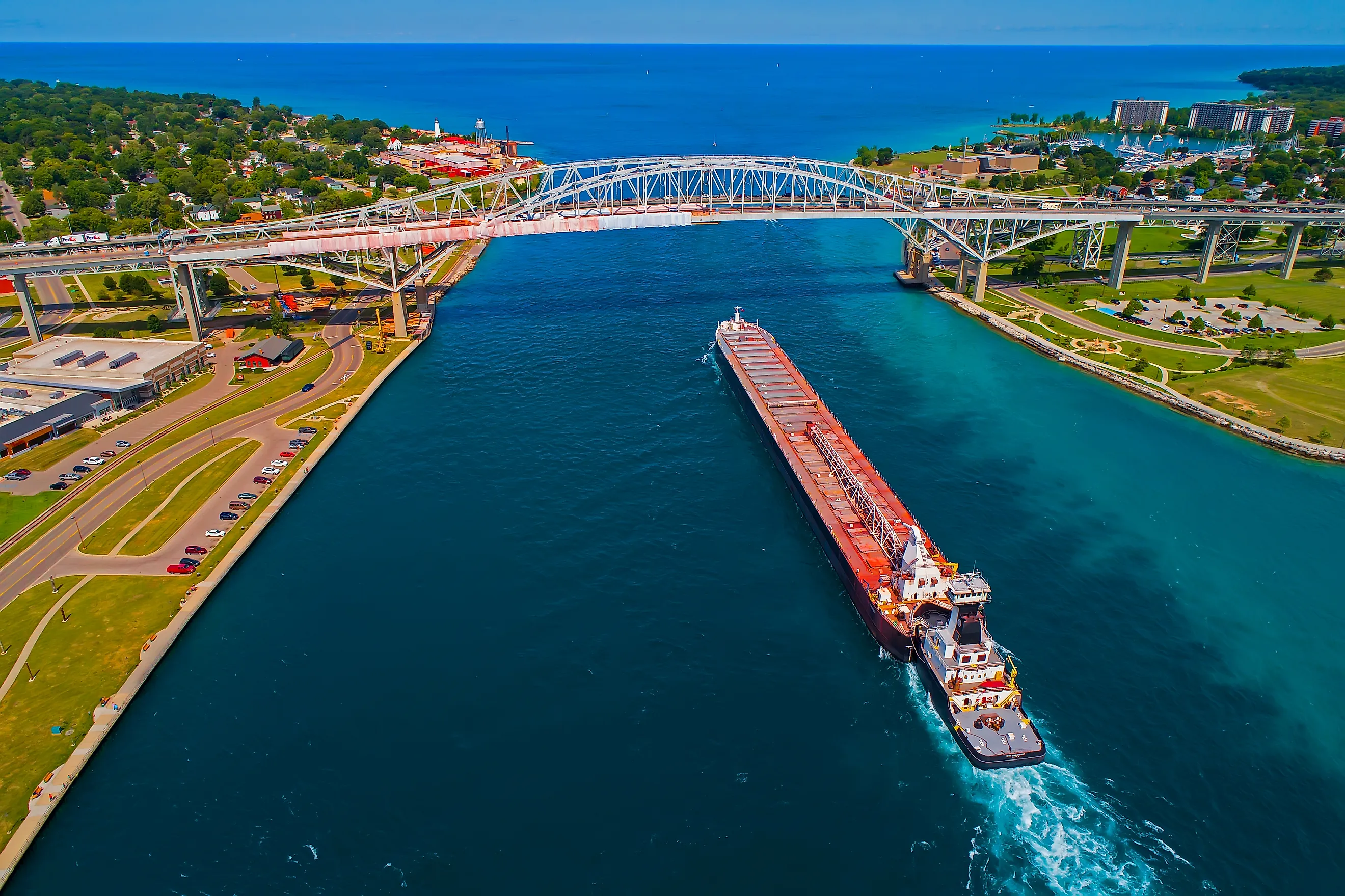
Around 100 lake freighters still work the Great Lakes, and the Lake Carriers' Association represents 43 US-flag commercial cargo vessels including tug-and-barge units.
Interlake alone planned more than 700 lake crossings and over 20 million tons of cargo for the 2026 season with a fleet of 11 vessels.
Ten Weeks Of The Year Nothing Moves

Any annual figure for this trade is compressed into part of a year.
The Soo Locks close in mid-January and reopen in late March, so the whole tonnage is carried across roughly 42 weeks rather than 52.
That is why mills stockpile ore before the shutdown and why the number of trips a single vessel makes matters as much as its capacity.
Capacity Is Not Cargo

The 90-million-ton figure that appears on the association's own site needs reading carefully.
Lake Carriers' describes the fleet it has represented since 1880 as one that can move more than 90 million tons of cargo annually. That is what the ships are capable of carrying, not what they carried.
Actual tonnage has not approached it in recent years. The gap between 71.3 million and 90 million is idle capacity rather than a counting discrepancy.
The Short Answer

US-flag lakers carried 71.3 million tons in 2025 against a five-year average near 77.5 million, with iron ore alone making up 39.1 million of it. Measured at the Soo Locks instead, 68.1 million tons passed through in 2024, and the Welland Canal added 26.9 million metric tonnes between Erie and Ontario.
The figure to treat with care is 90 million tons, which the trade association uses to describe what its fleet can carry rather than what it does. Around 100 ships move all of it, in 42 weeks, because the locks are shut for the other ten.