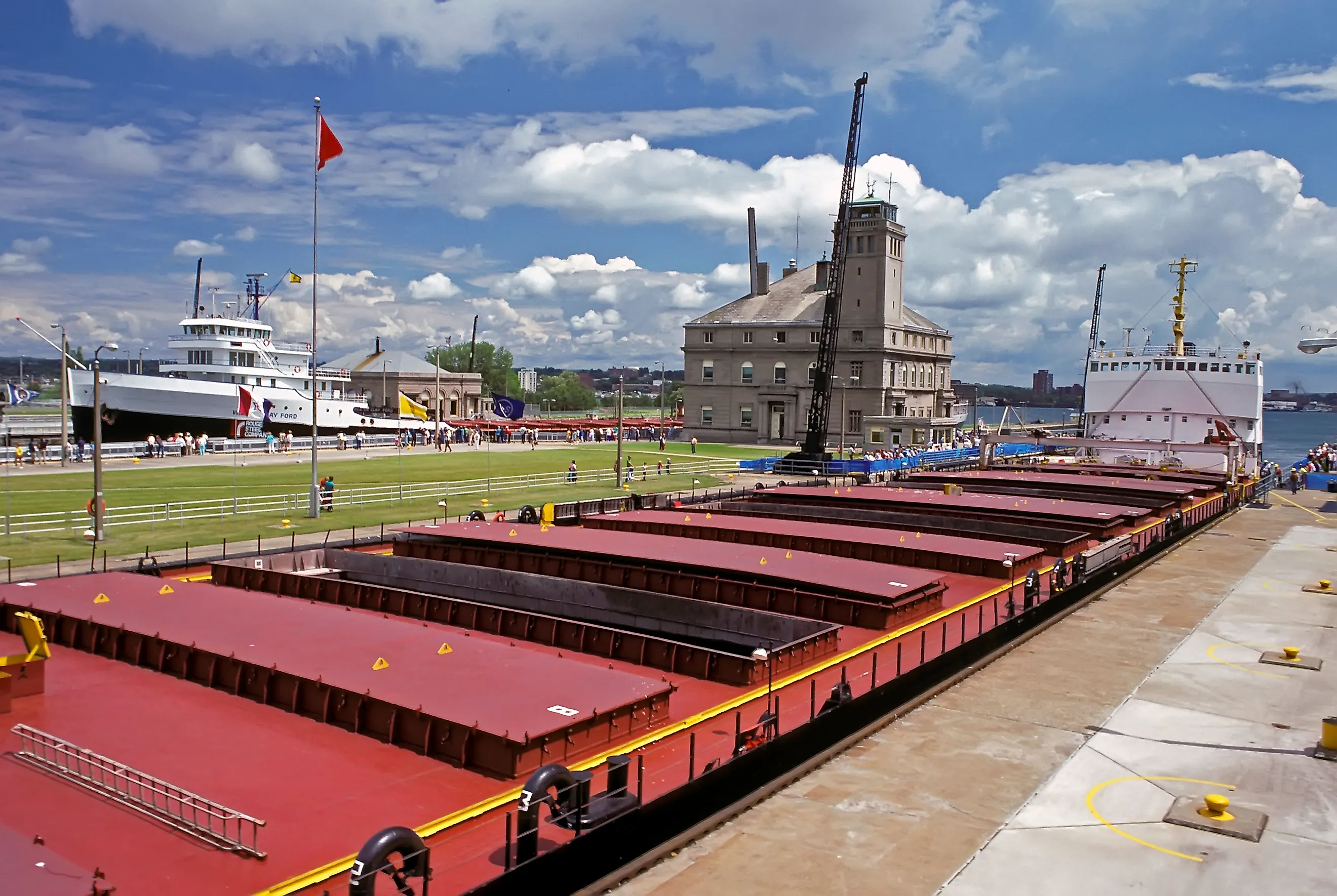
How A Freighter Squeezes Through The Soo Locks With Two Feet To Spare
The Poe Lock is 110 feet wide. A thousand-foot laker is 105 feet across the beam. That leaves two and a half feet on each side, and the ship has to be stopped dead inside the chamber, in a current, with the pilot standing in a wheelhouse at the stern unable to see either wall where it matters. The whole operation takes about sixty minutes from approach to departure, and it happens thousands of times a season.
Only One Chamber Will Take Them

Of the locks at Sault Ste Marie, exactly one can handle the largest ships on the lakes.
The Poe Lock measures 1,200 feet long, 110 feet wide and 32 feet deep. The MacArthur Lock alongside it is 800 by 80, which rules out every thousand-footer on the lakes immediately.
There are thirteen of those vessels. All thirteen depend on a single chamber rebuilt in 1968, which is why an unplanned Poe closure is treated as a national supply-chain problem rather than a local inconvenience.
Thirty Inches Of Water Each Side

The width figure is the one that makes people look twice.
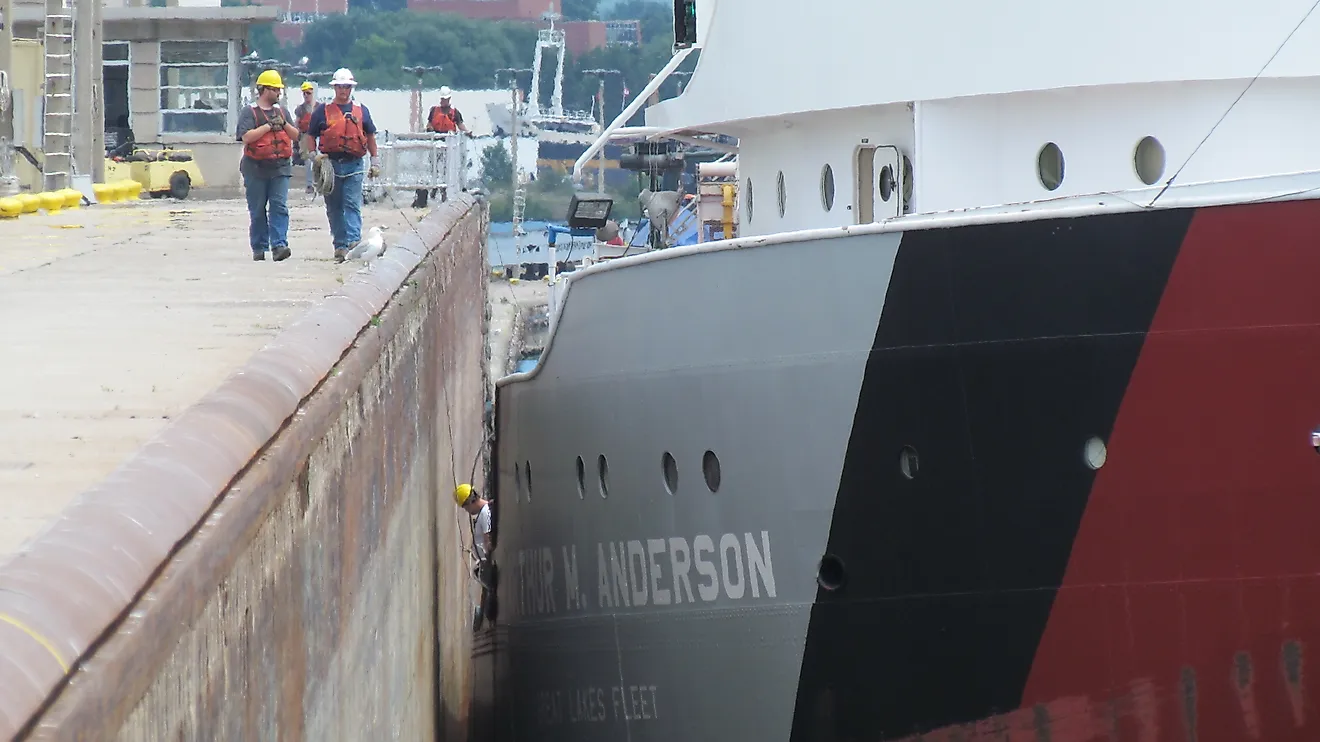
The Paul R. Tregurtha's 105-foot beam clears the lock walls by about two and a half feet on either side. That is less than the width of a doorway, on a vessel over a thousand feet long carrying 68,000 tons.
One mariner's description of the view from the pilot house is that at 110 feet of chamber against 105 feet of ship, there is nothing to see but wall.
They Arrive At Walking Pace

Speed on the approach is kept down to something a person could match on foot.
Freighters come into the Soo Locks at around 2.5 miles per hour. A thousand-footer has to come to rest inside a chamber with less than 200 feet of length to spare, which is one of the most exact stops these ships ever make.
At that speed there is no margin for correcting a bad line. The approach has to be right before the bow enters the chamber.
An Hour From Start To Finish

The published transit time covers far more than the water moving.
It takes about 60 minutes to transit a lock, measured from the moment a vessel approaches until it leaves. The lift itself is 21 feet, the difference between Lake Superior and the lower lakes.
Most of that hour is spent positioning, securing and waiting. The water transfer is the quick part.
The Lock Has Length Nobody Uses

The dimension nobody is squeezing against is the one the lock has most of.
The Poe allows 1,200 feet and the longest ship ever built for it reached 1,013.5. That leaves 186 feet of chamber that has never been filled, despite length being the only dimension available to a naval architect working within a fixed width.
Width and depth are set in concrete. Length was free, and still nobody used it.
It Was Half This Size Once

The current chamber is the second lock to carry the name.
The original Poe, completed in 1896, measured 800 feet by 100 and was the largest lock in the world at the time. It was enlarged to 1,200 by 110 in a project begun in 1963 and finished in 1968.
That rebuild is what made the thousand-footer possible. Every ship in that class was designed afterwards, to fit it.
Tight Clearances Are Normal Here

Thirty inches is generous compared with some of what these ships have managed.
The Cliffs Victory, a converted Victory ship lengthened twice until she became the longest vessel on the lakes, once passed under a bridge with five inches of clearance.
She was also too long for the final lock on the Chicago Sanitary and Ship Canal at 620 feet, which is a reminder that every lake vessel is built against somebody's concrete.
The Ships Have No Thrusters To Waste

Getting a hull that size into position without tug assistance depends on equipment built into it.
Lakers carry tunnel thrusters at bow and often stern, typically around 1,000 horsepower, which push the vessel sideways at zero forward speed in a way no rudder can.
That capability is what makes a 30-inch clearance survivable. A ship that could only steer while moving would have no way to correct itself inside the chamber.
A Closure Stops The Steel Industry

The dependence on one chamber has been studied formally and the findings are stark.
Iron ore moves from Minnesota mines to Lake Superior ports, onto thousand-footers, through the Poe and down to steel mills. Analysis of an unexpected Poe closure treats it as a single point of failure for the domestic steel supply chain.
Every alternative route involves rail, smaller vessels or both, and none of them replaces the volume.
The Big Ships Cannot Finish The Trip

Clearing the Poe does not mean a vessel can reach its customer.
A thousand-footer cannot unload at the Cleveland steel mill, because it cannot navigate the Cuyahoga River. It discharges at the Cleveland Bulk Terminal instead, and the ore is transferred to smaller lakers that can make the river trip.
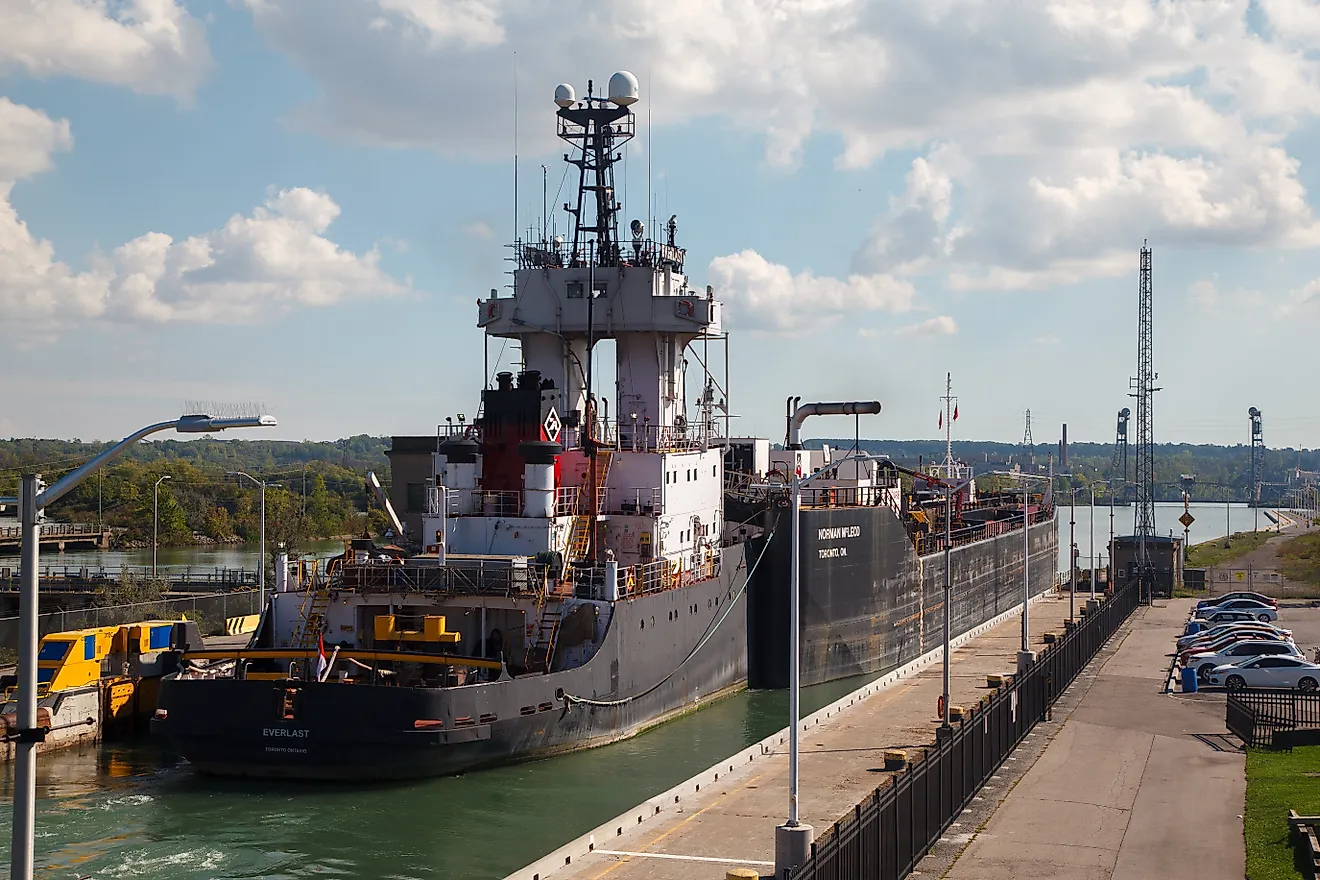
The same ships are also too wide for the Welland Canal, whose locks are 80 feet across, so they are confined above Niagara permanently.
The Short Answer

A thousand-footer squeezes through the Poe Lock with about two and a half feet of water on each side, entering at roughly 2.5 miles per hour, stopping inside a 1,200-foot chamber with under 200 feet to spare, and clearing the whole transit in about an hour for a lift of 21 feet.
It works because the ships were designed around the lock rather than the other way round. The Poe was enlarged in 1968, the thousand-footers came afterwards, and all thirteen of them were built to use 105 of the 110 feet available.