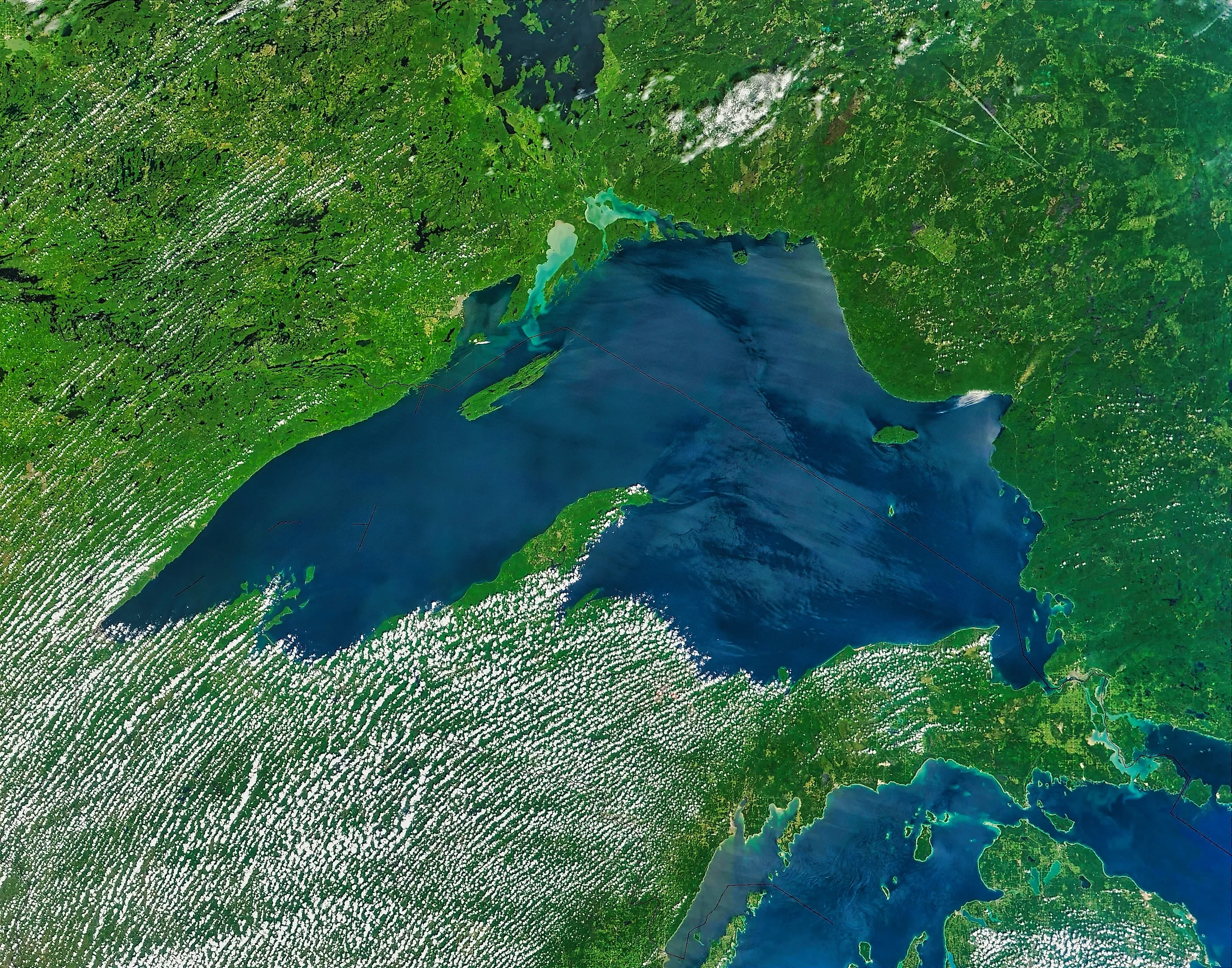
How Lake Superior Could Cover North And South America In A Foot Of Water
One often repeated fact is that Lake Superior has so much water that if you drained it all, it could flood all of North and South America with a foot of water.
Lake Superior has 3.1932 quadrillion gallons of water (written out, it would be a 3 with 15 zeros). By comparison, the Mississippi River, which is the largest river in the North America by water volume, discharges over 106 trillion gallons of water into the Gulf of Mexico every year, which is only 3.3% of the water contained in Lake Superior alone. However, is this colloquialism actually true?
How does the math work?

First off, we have to examine the math behind this claim by converting Lake Superior's gallons into acre-feet. An acre-foot is the amount of water that covers one acre to a depth of one foot.
When converting 3.1932 quadrillion gallons into acre-feet, this gives a total of 9.799 billion acre-feet. North America has a total surface area of 6.1 billion acres, while South America has 4.4 billion acres, for a total land area of 10.5 billion acres. In order to cover the entire surface in one foot of water, Lake Superior would come up about 7 percent short.
In addition, this calculation only takes into account land that is relatively flat, not mountain ranges, plateaus, hills, or other higher elevation land features.
So what would Lake Superior actually cover?

Despite this, Lake Superior could cover either North and South America completely, although the coverage will vary due to their different sizes.
Dividing Lake Superior by the surface area of North America gives a total of 1.606 feet. This would equate to 19.272 inches of water over the surface of the continent. While this much water would certainly be devastating, higher elevation areas would still have plenty of land left over.
When looking at South America, 9.799 billion acre-feet divided by 4.4 billion acres is 2.227 feet, or 26.724 inches.
Put another way, Lake Superior has enough water to cover all of North America in a foot of water and 3.699 billion acres of land in South America, which represents 84% of its total landmass.
How big is Lake Superior in reality?

While Lake Superior couldn't actually cover both continents, it is among the top contenders for lakes across multiple data points. For example, in terms of water volume, it ranks third at 2,900 cubic miles. It is only eclipsed by Lake Tanganyika in Central Africa with 4,500 cubic miles and Lake Baikal in Russia with 5,521 cubic miles.
However, when compared with the other Great Lakes, Lake Superior has more water than all of them put together, which amounts to 2,539 cubic miles.
Lake Superior also breaks records in terms of its surface area of 31,700 square miles, the largest freshwater lake on Earth. If salt lakes are considered, it ranks second just behind the Caspian Sea in Central Asia.
How does Lake Superior hold so much water?

Lake Superior holds so much water because of a major geological event dating back 1.1 to 1.2 billion years ago called the Midcontinent Rift. During this time, the North American continent was splitting apart, with a huge center of it being right where Lake Superior is today. It left behind vast amounts of lava that welled up through the Earth's crust.
A rift valley began to form in North America, pulling the earth downwards, especially in Lake Superior. Eruptions from volcanoes flowed upward, producing vast lava lakes and further pulling down the rift valley.
However, in the end, the continent did not tear in two, and the eruptions stopped. The basin left behind continued to shift downward, but compression caused an uplift in volcanic basalts up to the surface of the basin. These basalt rocks are still found beneath the water in Lake Superior today. For example, there is a volcanic structure known as Superior Shoal that rises 1,000 feet from the bottom of Lake Superior to just a few dozen feet below its surface. The rocks here date back to the original rift from 1.1 billion years ago.

Over time, this basin was filled with 5 miles of sediments, but these sediments were highly erodible and were gradually washed away by streams, creating the deep valley that would one day hold Lake Superior.
As for Lake Superior itself, it formed relatively recently in geological history. Originally, the basin and the other Great Lakes were covered beneath a vast glacier known as the Laurentide Ice Sheet. The thickness of the sheet varied, as it was less thick in the southern Lake Erie, but thicker in Lake Superior, which is the northernmost of the Great Lakes. Estimates put its overall thickness at 3,000 feet, though it did reach up to 2 miles. This glacier was the final step in the formation of Lake Superior's huge size and water volume, as its weight carved the basin even deeper than before.
Beginning with the end of the last ice age 20,000 years ago, the Laurentide ice sheet began to subside and melt, revealing first Lake Erie and Lake Michigan about 14,000 years ago.
Lake Superior's earliest form began to emerge from under the ice about 11,000 to 12,000 years ago. Today, geologists refer to this early body of water as Lake Duluth, which drained out into the St. Croix and Mississippi Rivers. Lake Superior reached its current form around 3,000 years ago.
The importance of analyzing popular sayings

This statement that Lake Superior could flood all of North and South America is so well known that it can even be found on the National Park Service's website. Like most popular sayings, there is an element of truth to it, as it could flood either North or South America, and it comes close to covering all of the surface area of both continents, but in the end the math doesn't add up. And even if it were correct, this would only apply if North and South America were completely flat surfaces such as a steppe, which isn't the case either.
The truth about Lake Superior is far more interesting than popular sayings, as its size and volume would not have been possible if not for a massive volcanic event that predated the dinosaurs by hundreds of millions of years and left behind stunning reminders of this volcanic history buried beneath the waves of this deep lake.