How Lake Ladoga Compares To The Great Lakes
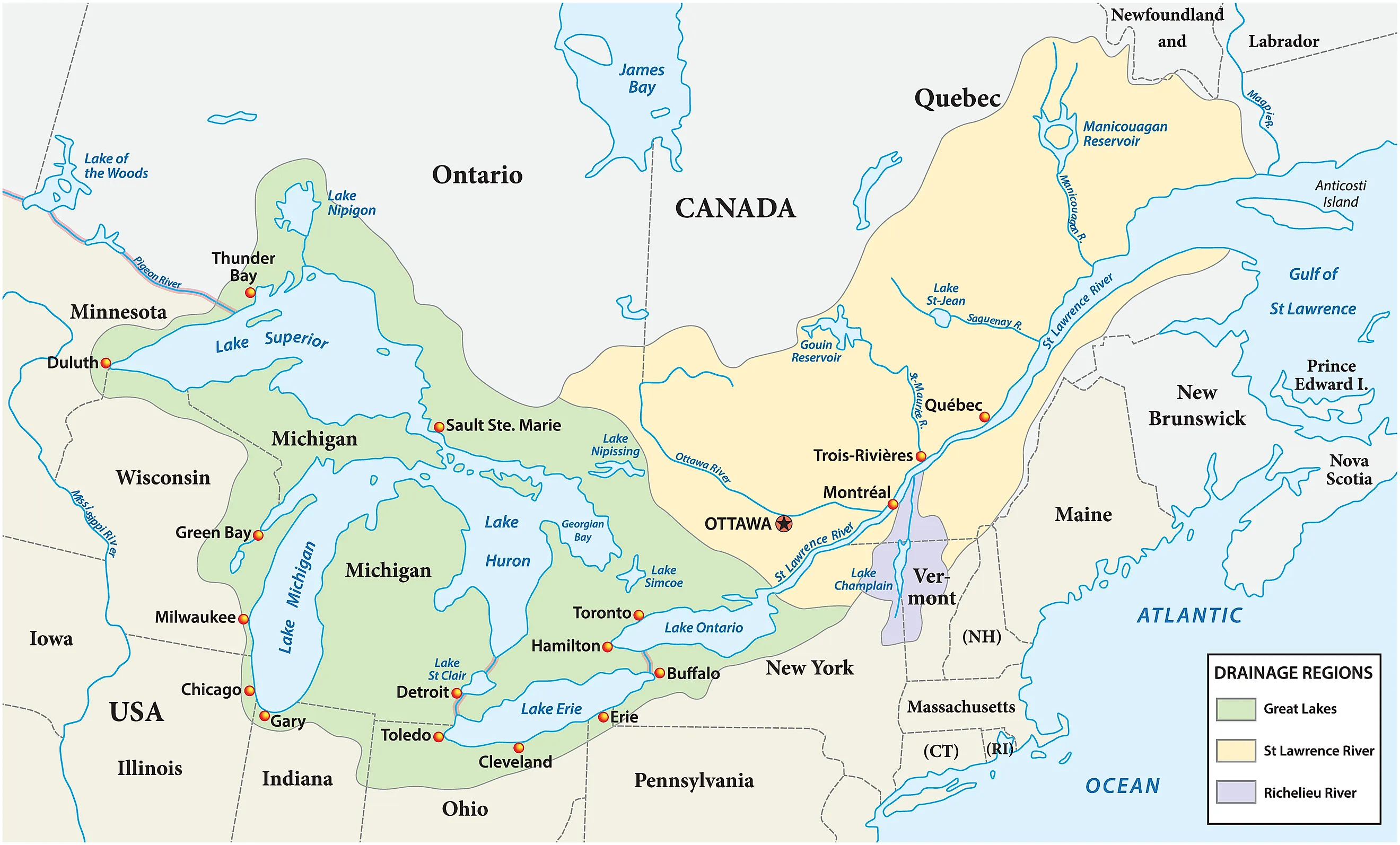
Lake Ladoga is the largest lake in Europe, which sounds impressive until you discover it would finish last in the Great Lakes. At roughly 17,700 square kilometers it is smaller than Lake Ontario and smaller by enough that the gap is not a rounding error. It would not be the biggest Great Lake, or the second, or the fifth. It would be sixth out of six. Europe's champion arrives in North America and immediately becomes the small one, which is a fairly good summary of the entire comparison.
It Loses The Area Round To Everything
Ladoga covers about 17,700 square kilometers without its islands, or roughly 18,135 with them. Lake Ontario covers 18,960.
So Europe's largest lake comes to roughly 93 percent of the smallest Great Lake, which is close but not close enough. Against the others it is not remotely competitive: Erie is 1.45 times larger, Michigan 3.3, Huron 3.4, and Superior 4.6. Stacked against all five together, Ladoga represents about 7 percent of the surface area.
It Wins Exactly One Depth Contest, By One Metre
Here is the best statistic in this article and possibly in the entire comparison series. Lake Ladoga reaches a maximum depth of 230 meters near Valaam Island. Lake Huron reaches 229. Ladoga is therefore deeper than one of the Great Lakes by a single meter, which is a photo finish between a Russian lake and an American one that neither country has ever thought to celebrate.
It beats Erie more comfortably, since Erie bottoms out at 64 meters. Against Ontario at 244, Michigan at 281 and Superior at 406, it loses in the ordinary way.
Volume Is Where It Really Suffers

Ladoga holds about 837 cubic kilometers of water. That is more than Lake Erie's 484, which is the only win available here.
It is roughly half of Ontario's 1,640, a quarter of Huron's 3,540, a sixth of Michigan's 4,920 and about a fourteenth of Superior's 12,100. Superior holds more than fourteen Ladogas, which is the kind of figure that explains why North Americans are relaxed about fresh water and Europeans historically are not.
One River Takes Everything Out
Around 40 rivers and streams flow into Ladoga and exactly one flows out, which makes its plumbing far simpler than the Great Lakes chain. That outlet is the Neva, which runs about 74 kilometers to the Gulf of Finland and the Baltic, and which happens to flow straight through the middle of St Petersburg. A city of five million people sits on the drain of Europe's largest lake.
The Great Lakes pass water through four connecting channels and the St Lawrence before reaching the Atlantic. Ladoga does the whole job with one short river.
It Has Six Hundred And Sixty Islands

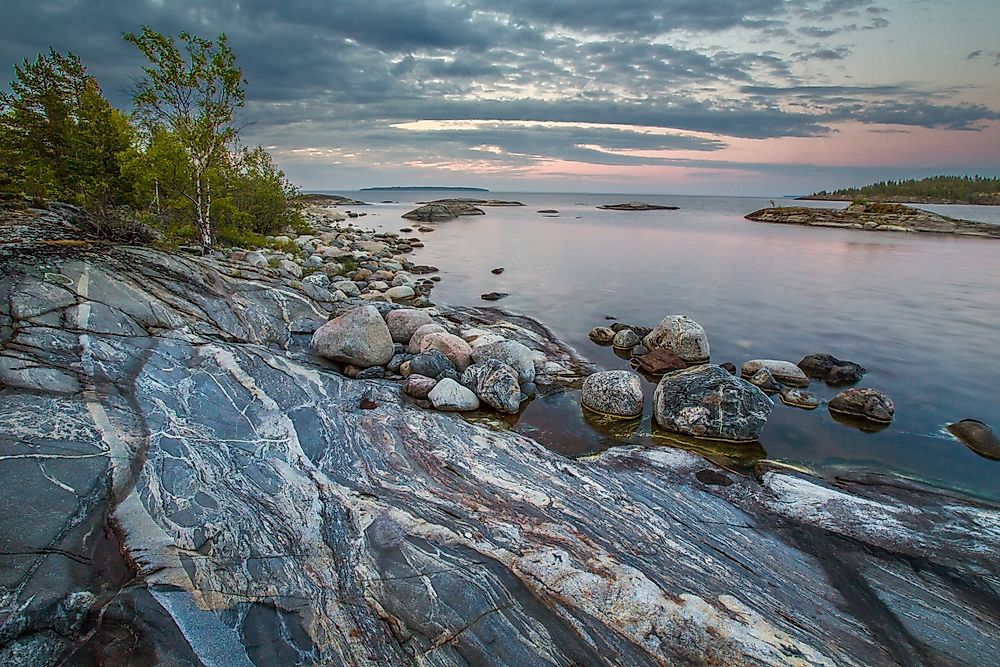
This is the one category where Ladoga comfortably outclasses its own size. The northwestern shore shatters into roughly 660 islands totaling about 435 square kilometers.
The Valaam archipelago alone holds around 50 of them and has been home to a monastery for centuries. The surrounding skerries are protected as a national park covering more than 1,200 square kilometers, 44 percent of which is water, and the islands are about 90 percent pine.
Lake Erie, by comparison, is mostly just lake.
It Has Seals
The Great Lakes have lake trout, whitefish, salmon and an unwelcome quantity of invasive mussels. Ladoga has a seal, which settles that.
The Ladoga ringed seal is endemic to the lake, a freshwater population cut off when the land rose after the last glaciation, and it is one of only a small number of freshwater seal populations anywhere in the world. The lake also holds 48 fish species and a large Arctic char population closely related to chars in Swedish lakes.
No Great Lake has a seal. This is Ladoga's clearest victory and it is not particularly close.
The Road Of Life

One part of this lake's history deserves to be stated plainly rather than compared to anything. When German forces besieged Leningrad from 1941, Lake Ladoga was the only route remaining between the city and the rest of the Soviet Union. Supplies crossed by boat in summer and by truck over the ice in winter, along a route that became known as the Road of Life, under bombardment and with vehicles regularly going through the ice.
The siege lasted close to 900 days and killed hundreds of thousands of civilians. Whatever else this lake is, it is the reason a great many people in that city survived.
The Border Moved, The Lake Did Not
Ladoga has also had an unusually eventful political life for a body of water. From the early nineteenth century until 1940 the lake was divided between Finland and Russia, with the border running through it. After the Winter War and the Moscow Peace Treaty it ended up entirely within Soviet and then Russian territory.
The Great Lakes have had the same international border, in the same place, since the nineteenth century, and the most dramatic thing to happen on it is the occasional disagreement about fishing quotas.
Both Were Made By The Same Ice
The one thing Ladoga and the Great Lakes genuinely share is their origin, which explains the family resemblance. Ladoga's basin is a glacial depression, and during the Last Glacial Maximum around 17,000 years ago it channeled ice from the Fennoscandian Ice Sheet eastward. It was initially part of the Baltic Ice Lake before the land rebounded and separated it.
Swap the Fennoscandian sheet for the Laurentide and that is the Great Lakes story as well. Two continents, the same process, wildly different results.
The Scoreboard

Lake Ladoga is smaller than all five Great Lakes, out-volumed by four of them, and deeper than only two, one of those by a single meter. As a Great Lake it would rank sixth of six and nobody would mention it much.
What it does have is 660 islands, a monastery older than most European states, its own species of freshwater seal, and a wartime history no North American lake can approach. Europe's largest lake loses the measurements comfortably and wins almost everything else.