South Sudan's Struggle for Stability
In July 2011, millions of South Sudanese celebrated the birth of the world's newest country. Nearly 99 percent had voted to break away from Sudan after decades of war. Within two years the young nation collapsed into civil war along ethnic lines. President Salva Kiir and his deputy Riek Machar turned a personal rivalry into a national catastrophe. Colonial borders had stacked the deck against the South generations earlier. Today floods and fresh fighting still keep millions of people from home.
The Road to Independence and the Birth of a Nation

South Sudan's path to independence was born through a history of political exclusion and conflict. In 1899, following the defeat of Mahdist forces, Sudan came under the Anglo-Egyptian Condominium, a system of joint British and Egyptian rule. Before 1947, the North and South were part of the same colonial territory, but each was administered separately. The British restricted interaction between these areas and administered the South using its own local systems instead of merging it with the North. The North was largely Arab and Muslim, while the South was mainly African, with its own cultures and religions.
So, it was managed in a manner that deepened the division between the North and South, applying different policies for governance for things like religion and education. This system changed after the 1947 Juba Conference, when colonial officials decided to integrate the separately administered South more closely with the North. In the years that followed, northern officials replaced British administrators across the South. Many in the South were upset with the lack of representation.
As Sudan pushed for independence in the 1950s, political divisions between the North and South became even more pronounced. Political authority was centered in the North. This left many people in the South feeling excluded and uncertain about their future, regardless of independence from Britain. Resistance to this concentration of northern power showed its face in 1955, when the Equatoria Corps, a military unit composed mainly of southern Sudanese soldiers, staged an uprising in Torit, leading to the First Sudanese Civil War.
On January 1, 1956, Sudan officially became independent under a government dominated by northern political leaders, leaving many southern grievances unresolved, and the civil war continued. Southern insurgent groups called Anyanya fought with government troops. Although the First Sudanese Civil War lasted more than a decade, the fighting was not continuous. Instead, the conflict shifted in intensity, with periods of violence and periods of more scattered insurgent activity. After many long years, the war ended with the Addis Ababa Agreement in 1972.
While the settlement provided some level of self-rule to the South, peace would not last. The settlement unraveled during the early 1980s as President Gaafar Nimeiri weakened southern autonomy, divided the autonomous region, and attempted to bring southern military units under tighter central control. Rebellion broke out in 1983, and Nimeiri's subsequent imposition of Islamic law deepened southern opposition, beginning the Second Sudanese Civil War. The Sudan People's Liberation Movement and Army (SPLM/A) emerged as the main southern resistance movement, organizing military campaigns against the Sudanese government while also advocating for greater political rights. The war caused destruction across the South, leading to millions of deaths and forcing more to flee their homes and villages. By the time peace talks began, the South had already gone through more than two decades of conflict, leaving communities devastated and deepening demands for self-determination.
The Comprehensive Peace Agreement (CPA) in 2005 finally ended more than 20 years of conflict. It established a power-sharing government, divided oil revenues between the North and South, and granted Southern Sudan autonomy for six years before a referendum on independence. As the authors of "Ceasefires in the Sudan North-South Negotiations, 2002-2005" argue, the CPA gave southern Sudan its greatest opportunity to achieve self-rule and self-determination. But the agreement didn't figure out every dispute. Although it allowed the South to govern itself, disagreements over border demarcation and oil revenue continued to threaten the peace.
Death of Garang and Its Consequences

The agreement began a six-year interim period meant to share power and divide oil revenue. But it did not settle the status of Abyei, a disputed border territory inhabited principally by the Ngok Dinka and seasonally used by Misseriya cattle herders. The region contained important oil fields, but the dispute also involved political representation, residency, grazing rights, and control of the territory. The Sudanese government and the autonomous southern administration remained divided over its future.
To make things worse, soon after, the South suddenly lost John Garang, the SPLM leader behind the Peace Agreement. Garang died in a helicopter crash just months after it was signed, leaving Salva Kiir to step in as president of the autonomous government. John Young, in "John Garang's Legacy to the Peace Process, the SPLM/A & the South," says Garang's death created uncertainty around the peace deal. He was a central figure in both the SPLM/A and the 2005 agreement, and his death raised doubts about the CPA's durability and weakened the already fragile goal of a united nation.
The shift in leadership introduced uncertainty, but the desire for self-determination and independence continued to grow stronger. Problems with Sudan's government in Khartoum were still there, and fighting started in border areas. The death of Garang also led to civil unrest. Riots broke out in both Khartoum and Juba as people caught wind of the crash, showing how unsettled things remained in both Sudan and South Sudan. While Kiir stepped up to lead after Garang's death, major issues left unresolved by the peace agreement continued to threaten stability.
By 2008, the joint North-South border commission had reached broad agreement over much of the proposed boundary, but several strategically important areas, including oil-producing zones, remained disputed. In Abyei, fighting broke out in May 2008 between Sudanese soldiers and the SPLA (the military wing of the SPLM). The fighting destroyed most of Abyei and forced thousands of people to flee. In "Why Abyei Matters," Douglas H. Johnson argues that although the Abyei Boundaries Commission issued a "final and binding" decision in 2005, the Sudanese government blocked its implementation, leaving the border in turmoil, and allowing tensions and violence to flare.
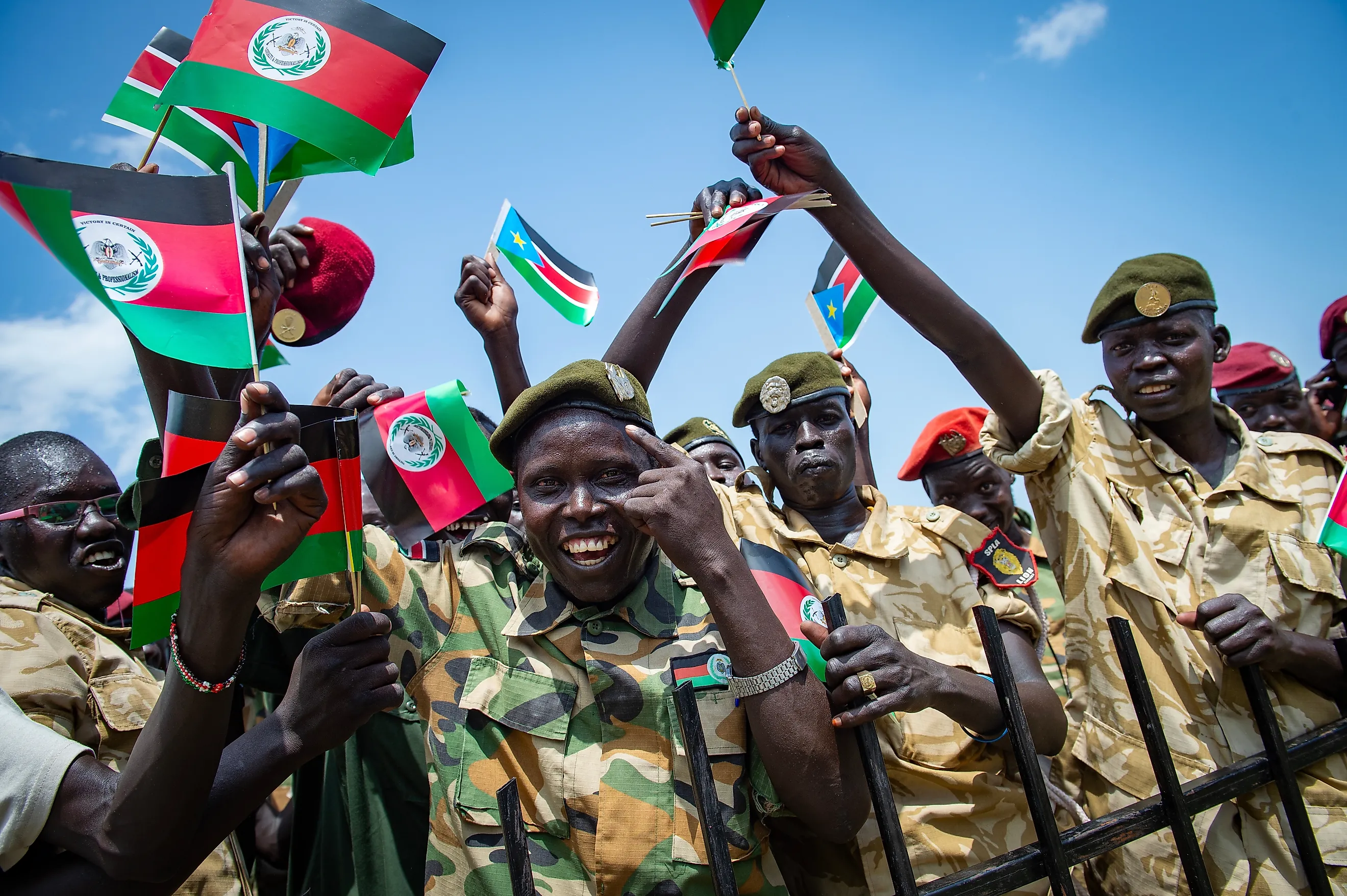
Still, the six-year waiting period set by the CPA continued. In January 2011, people in the South voted in a much-awaited referendum about independence. The outcome was clear: almost 99 percent voted to separate from Sudan. On July 9, 2011, South Sudan became the world's newest nation. For many, freedom meant the struggle was over, but independence did not solve all the issues for the new nation.
Rivalry at the Top: Kiir vs. Machar and the Outbreak of Civil War

South Sudan finally gained independence, but what was formed was fragile. Salva Kiir was president, with his trademark black hat. There was also Riek Machar as vice president. Kiir came from the Dinka, the largest ethnic group in the country. Machar was Nuer, the second largest. On the surface, it appeared to be a strong partnership between the two groups, but beneath, there was a rivalry simmering. The rivalry dated back to divisions within the SPLA, including its 1991 split between supporters of Machar and Garang.
At the beginning, their collaboration was uneasy but intact. In reality, mistrust and uncertainty lingered. In July 2013, Kiir dismissed his cabinet and removed Machar as vice president, bringing their rivalry into the open. Kiir was worried Machar was trying to replace him. Machar retorted that Kiir was trying to keep him away from power. The split between these leaders filtered down to their communities, fueling divisions between the Dinka and Nuer. In December 2013, skirmishes broke out in Juba between rival factions of the presidential guard. Kiir accused Machar of attempting a coup, an allegation Machar denied and that has remained disputed.
What had begun as a political disagreement turned into ethnic bloodshed. Soldiers attacked residents in the surrounding areas, and ordinary citizens became caught between the fight. What began as a political and military struggle within the governing movement quickly became ethnicized, as armed forces targeted civilians believed to support the opposing side and mobilized communities along Dinka and Nuer lines. The war made it clear that independence alone could not unite South Sudan. Machar fled and became the face of the opposition. His supporters formed the SPLA-In Opposition, also called the SPLA-IO. Government troops loyal to Kiir struggled to maintain power while both groups committed atrocities as hundreds of thousands of people fled to places like Uganda and Sudan.
From this, regional parties came together to cobble up a peace deal in 2015. While it had international support, it wasn't enough. Luka Kuol, in "Navigating the Competing Interests of Regional Actors in South Sudan," says the peace agreement was weakened from the start by divided regional interests and poor enforcement. The promise of independence had turned into a nightmare. South Sudan's leaders had taken the unity born out of decades of war against the North and broken it apart. The rivalry between Kiir and Machar was more than a fight for power. It was the spark that set the young country on fire.
Representatives from the Intergovernmental Authority on Development continued trying to get Salva Kiir and Riek Machar to return to negotiations. The prime minister of Ethiopia, Hailemariam Desalegn, along with Kenya's president, Uhuru Kenyatta, contributed to forming the agreement. Leaders gathered in Addis Ababa, Khartoum, and Nairobi. There, they produced a ceasefire in 2014; however, it was violated just days later as violence spread into Jonglei and Upper Nile. The 2015 Agreement on the Resolution of the Conflict in the Republic of South Sudan called for a ceasefire and a transitional unity government. That government was finally formed in April 2016, when Machar returned to Juba as first vice president, but renewed fighting in the capital that July caused the arrangement to collapse.
Regional mediation produced another settlement in September 2018, known as the Revitalized Agreement on the Resolution of the Conflict in South Sudan. It called for Kiir and Machar to share power again, combine their rival forces into a unified national army, draft a permanent constitution, and prepare the country for elections. After repeated delays, a revitalized unity government was formed in February 2020, with Machar once again serving as first vice president. The agreement reduced nationwide warfare, but many of its most important provisions were never fully implemented.
By April 2018, researchers estimated that the conflict had caused approximately 383,000 excess deaths, including deaths from violence, disease, hunger, and disrupted medical care. The destruction left mistrust between the two sides, making cooperation difficult even after the agreement was signed. Key parts of the agreement, including plans to merge rival armed groups into a single national army, were delayed. The agreement did not end the war. Fighting resumed in Juba in July 2016 and spread to other parts of the country, while attempts to merge rival forces and establish functioning transitional institutions remained stalled.
A Nation in Crisis: Flooding and the Struggle for Peace

Everyday life was getting harder for regular people. With ongoing raids, a staggering number had no choice but to flee. Many crammed into refugee camps or tried their chances in nearby countries. For a lot of families, "peace" was not about the politics. It meant returning home and being able to live their lives in safety.
Things got worse as flooding devastated the country's agricultural industry. Aid organizations were ringing the alarm bells that some regions were close to famine. In 2024, floods slammed the country. Farmlands were destroyed, and massive numbers of farm animals died off. Every new flood seemed to trigger more hunger and sickness. The numbers from 2024 show how widespread the flooding became. By September, more than 700,000 people had been affected. By the end of the year, that number had climbed to over a million, with more than 379,000 people forced to leave their homes.
Flooding was only part of the humanitarian crisis. During the 2023 lean season, approximately 7.7 million people were projected to face crisis-level or worse acute food insecurity. The war in neighboring Sudan created additional pressure as refugees and South Sudanese returnees crossed the border, increasing demand for food, shelter, health care, and other already limited resources. By November 2024, flooding had affected approximately 1.4 million people across South Sudan and the Abyei Administrative Area and displaced more than 379,000.
Political tensions also worsened. Elections originally planned for December 2024 were postponed because major provisions of the 2018 peace agreement, including security reforms, constitutional preparations, and electoral arrangements, remained incomplete. The transition was extended until February 2027, with elections rescheduled for December 2026.
In March 2025, fighting erupted in Nasir between government forces and armed Nuer youth associated with the White Army. The government alleged that Machar and other opposition officials had supported the attack, accusations they disputed. Machar was later charged with treason, murder, and crimes against humanity in connection with the violence. Conflict continued into 2026, particularly in Jonglei, where renewed fighting and airstrikes had displaced nearly 280,000 people by February. The new displacement added to an existing crisis involving more than two million internally displaced people, South Sudanese refugees living abroad, and refugees and returnees entering from Sudan.
Peace agreements have repeatedly promised a new beginning, but many of the problems that fueled the country's violence remain. For millions of South Sudanese, peace is still measured less by political agreements than by whether they can return home and live without fear.
In Conclusion
Since its independence, South Sudan has shown the difference between political promises and reality. Independence brought real optimism, but ethnic and political divisions continue to stand in the way of lasting peace. The rivalry between Salva Kiir and Riek Machar deepened those divisions, while violence continued across much of the country.
Peace agreements and unity governments have slowed the fighting at times, but they have not resolved the underlying problems. Much of South Sudan remains unstable, and many still face displacement and insecurity. More than a decade after independence, the country is still struggling to achieve the peace its people hoped for.