6 Must-See Historic Forts In Indiana
Indiana sat on the frontier between American settlements and the contested Old Northwest through most of the late 18th and early 19th centuries. That made it one of the most strategically important early territories in North American history. No single site illustrates this better than Fort Wayne, where four successive forts (one French-era Miami post, one British post, two American posts) anchored the strategic confluence of the St. Mary's, St. Joseph, and Maumee Rivers. Fort Ouiatenon was the first European fort built in Indiana and changed hands several times across nearly a century. The six sites below preserve the core of Indiana's military and frontier history, and all are open to visitors today.
The Old Fort at Fort Wayne

The original American fort at the site was built in October 1794 under the direction of General Anthony Wayne, immediately after his decisive victory over the Northwest Indian Confederacy at the Battle of Fallen Timbers that August. Wayne's fort secured the strategic three-rivers confluence (the St. Mary's and St. Joseph join to form the Maumee here), which Native American forces had previously used as the staging ground for Little Turtle's defeats of Generals Harmar (1790) and St. Clair (1791). The original log structure deteriorated quickly, and Colonel Thomas Hunt rebuilt the fort about 300 feet from the original site in 1800. Hunt's fort held during a 1812 siege that prevented its capture by British and Native American forces during the War of 1812, with the relief of Fort Wayne being one of the war's notable American defensive victories in the Northwest.
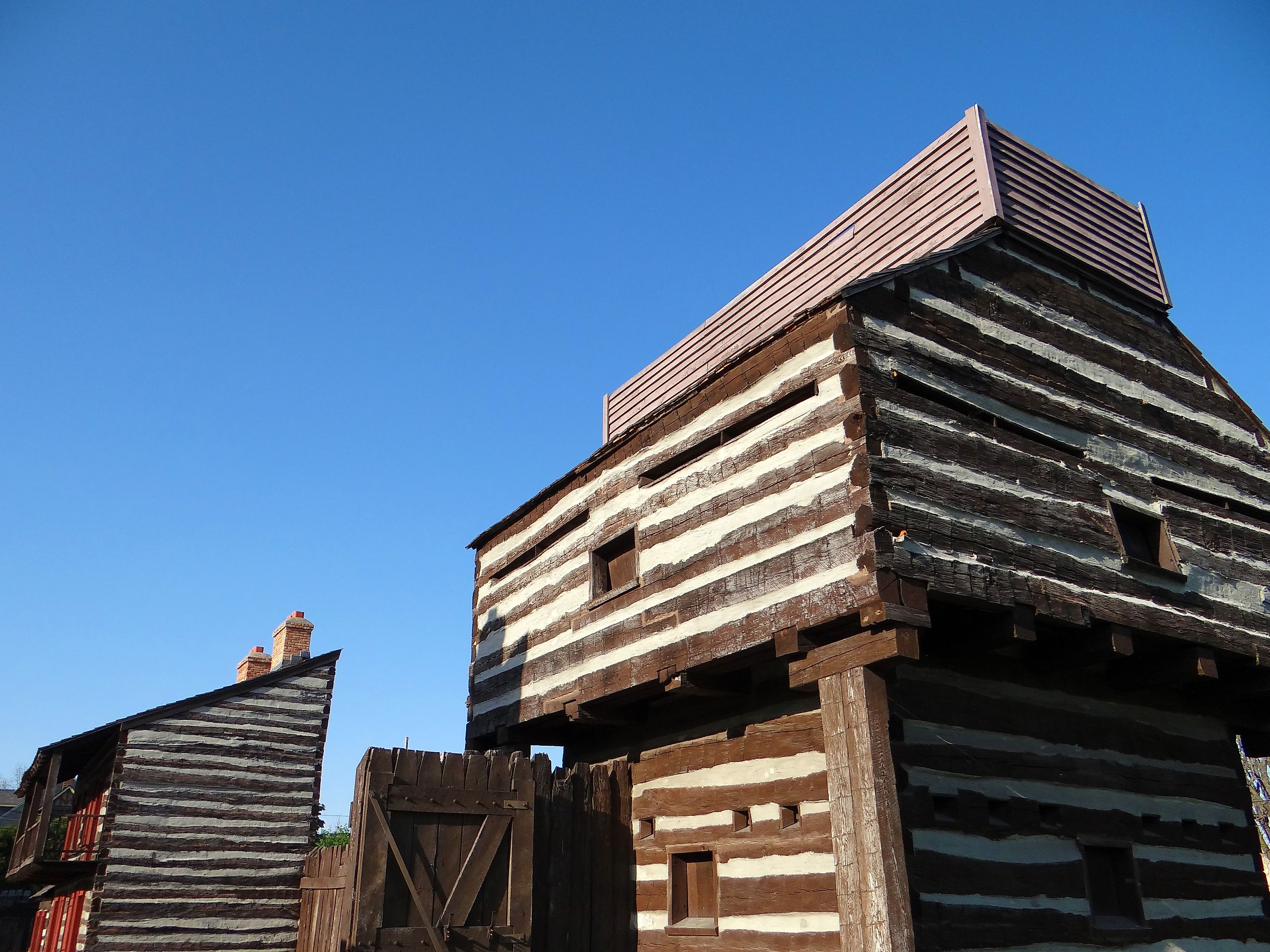
Major John Whistler (grandfather of the painter James McNeill Whistler) built the third American fort at the location in 1815, replacing Hunt's structures. The fort was decommissioned in 1819 as settlement spread west and the frontier moved beyond it. Today, the Old Fort in downtown Fort Wayne is a full-scale reconstruction of Whistler's 1815 fort, built between 1973 and 1976 as a Bicentennial project. The reconstruction hosts regular reenactments and living-history programs through the warm-weather season.
Fort Ouiatenon Historical Park

Fort Ouiatenon on the Wabash River near present-day West Lafayette was the first European fort built in Indiana, established in 1717 by the French as a fur-trading post serving the surrounding Wea villages. By the 1750s the trading complex around the fort housed several thousand people, making it the largest European-Indigenous settlement on the Wabash. The fort passed to the British in 1761 during the French and Indian War (the North American theatre of the Seven Years' War). It was briefly captured by Wea, Kickapoo, and Mascouten forces during Pontiac's War in 1763 before returning to British hands.
Native American forces occupied the fort after the British abandoned it during the American Revolution, using it as a staging point to disrupt American settlement in the Northwest Territory. To eliminate the threat, President George Washington ordered the post destroyed; the burning was carried out by Brigadier General Charles Scott and roughly 750 Kentucky mounted militia in June 1791. The exact fort site was lost for nearly two centuries before archaeologists at Purdue University rediscovered it in 1968. Today, Fort Ouiatenon Historical Park contains a 1928 replica blockhouse (open on select weekends, including the annual Feast of the Hunters' Moon every October), while the confirmed original fort site sits west of the park within the protected Ouiatenon Preserve.
Fort Knox II

Vincennes on the Wabash River was the most strategically important point on the lower Wabash through the colonial and early-American periods, and French, British, and American forces all built fortifications nearby. Fort Knox II, built by American troops in 1803, saw little military action until 1811, when Governor (and future President) William Henry Harrison used it as the assembly point for the militia force that would fight at the pivotal Battle of Tippecanoe later that year. With the War of 1812 imminent, officials concluded that Fort Knox II sat too far from Vincennes town to provide adequate defence, and in 1813 the fort was dismantled and rebuilt closer to the settlement.
Today, the original Fort Knox II site is part of Vincennes' interpretive historic landscape, with outlines of the fort's buildings on the ground and signage explaining the site's role in the Tippecanoe campaign. Self-guided admission is free.
Fort Harrison State Park

Fort Harrison State Park, on the northeast side of Indianapolis, occupies the former grounds of Fort Benjamin Harrison, an army post established in 1903 and named for the 23rd US President (an Indiana native). During World War I the post handled officer and specialist training; during World War II it ran as a major induction and training centre and also held a prisoner-of-war camp for captured Italian and German soldiers. After scaled-down use through the Cold War, the fort closed in 1991 under the Base Realignment and Closure process.
Within the state park visitors can still see many of the original installation's features, including the former POW camp site, the Citizens' Military Training Camp grounds, and the Civilian Conservation Corps work-camp area from the 1930s.
George Rogers Clark National Historical Park

George Rogers Clark National Historical Park preserves the believed site of Fort Sackville, the British post at Vincennes captured by Colonel George Rogers Clark and his small Virginia-Kentucky frontier militia force in February 1779. Clark's winter march across flooded Illinois country and the surprise capture of Fort Sackville broke British control of the Northwest Territory south of the Great Lakes and was one of the most consequential American military actions west of the Appalachians during the American Revolution. The fort itself was renamed Fort Patrick Henry under American control.
Nothing of the original fort structure remains. President Calvin Coolidge authorised the George Rogers Clark Memorial under federal commission legislation in 1928, and the granite-rotunda monument was dedicated by President Franklin Roosevelt in 1936. The site became a National Historical Park in 1966. Visitors can enter the memorial rotunda from 9:00 AM to 4:45 PM by request at the visitor centre.
Fort Miamis Marker

Fort Miamis grew from a French trading post near the modern Fort Wayne three-rivers confluence around 1706 into a fortified palisade in 1722 after French officials recognised the area's strategic importance for the Wabash-Maumee portage. A second palisade went up in 1750 as British pressure on the region grew. Fort Miamis featured in several conflicts including the French and Indian War, Pontiac's War, and the Northwest Indian War. After Anthony Wayne's 1794 campaign concluded with Fallen Timbers, the American forces built Fort Wayne nearby on the same strategic confluence, superseding the earlier French, British, and Miami-era posts in the area.
Today, the site is marked only by an interpretive historical marker explaining the fort's role across the eighteenth century.
How These Six Sites Fit Together
The six forts above mark different layers of the same strategic geography. The Fort Wayne three-rivers confluence (Old Fort, Fort Miamis) controlled the portage that linked the Maumee-Wabash river systems and gave passage between the Great Lakes and the Ohio River basin. The Vincennes-Wabash position (Fort Knox II, Fort Sackville/George Rogers Clark) controlled the lower Wabash and the approach to the Ohio. Fort Ouiatenon controlled the middle Wabash and the largest trading complex on the river. Fort Benjamin Harrison, a century-later post on Indianapolis's edge, marks a different era entirely (active duty rather than frontier defence) but ties to the same Indiana ground. Together they cover French trade, British control, Native American resistance, the Revolutionary contest for the Northwest, the War of 1812, and the modern military century.