These 8 Towns In Alaska Were Ranked Among US Favorites
Ketchikan holds one of the largest standing-totem-pole collections in the world across the Totem Bight and Totem Heritage Centers. Kodiak protects more than 3,000 Kodiak brown bears across two-thirds of its namesake island. Talkeetna serves as the staging base for climbers attempting Denali, North America's highest peak at 20,310 feet. Sitka was the capital of Russian America until the 1867 sale of Alaska to the United States. These eight stops cover Russian colonial heritage, Klondike Gold Rush history, and wildlife refuges that exist nowhere else in the country.
Ketchikan

Ketchikan sits at the southern entrance to the Inside Passage along the Tongass Narrows, with about 8,200 residents and roughly 13 feet of annual rainfall (one of the rainiest cities in the United States). The rain keeps the surrounding rainforest a deep green year-round. Creek Street, the historic district built on wooden pilings over Ketchikan Creek, holds shops like The Rain Barrel and Sockeye Sams, with black bears regularly fishing for salmon at the boardwalk during the late-summer run.
The town holds one of the largest collections of standing totem poles in the world, displayed at Totem Bight State Park, Saxman Totem Park, and the Totem Heritage Center. The Tongass National Forest, the largest national forest in the country at 16.7 million acres, wraps the town with waterfalls, dense rainforest, and a trail network that spans easy boardwalks through all-day climbs.
Kodiak

Kodiak runs about 5,600 residents on the northeast shore of Kodiak Island, and the bears are the headline event. The Kodiak National Wildlife Refuge covers about two-thirds of the 3,588-square-mile island and protects more than 3,000 Kodiak brown bears, a subspecies (Ursus arctos middendorffi) that lives nowhere else on Earth and includes some of the largest bears alive. Floatplane tours out of Kodiak fly visitors to remote streams to watch bears fishing for salmon. Fort Abercrombie State Historical Park, 4 miles north of town, holds tide pools, abandoned World War II coastal defense bunkers, and shoreline trails.
Kodiak served as the first capital of Russian America under Alexander Baranov before the 1867 sale of Alaska to the United States. The Baranov Museum, housed in the 1808 Russian-American Magazin, is the oldest standing wooden building on the US West Coast and preserves Russian colonial-era artifacts.
Homer

Homer is a coastal arts town with the nickname "End of the Road," since the Sterling Highway terminates here at the Homer Spit, a 4.5-mile sand-and-gravel arm reaching into Kachemak Bay. The town runs about 5,500 residents. The downtown art scene runs through the Bunnell Street Arts Center and Homer's Goldmine Gifts and Fine Jewelry, and the Salty Girls gift shop sits near the very end of the highway. Halibut fishing draws the largest sport-fishing fleet in the state during the summer.
The Kenai Mountains and the Grewingk Glacier sit directly across the bay, and a quick water taxi ride from the Homer Spit drops hikers at the trailhead in Kachemak Bay State Park. The Grewingk Glacier Trail runs a relatively easy 6.5-mile round-trip approach to a glacial lake studded with icebergs.
Sitka

Sitka served as the last capital of Russian America before the 1867 sale of Alaska to the United States, and the Russian heritage runs through the town. The Russian Bishop's House and St. Michael's Orthodox Cathedral (rebuilt after a 1966 fire to the original 1848 specifications) both run self-guided summer tours. Sitka National Historical Park preserves the 1804 Battle of Sitka site, where Russian forces under Alexander Baranov defeated the Kiks.ádi clan of the Tlingit; a 2-mile interpretive trail through old-growth forest displays carved totem poles donated to the park.
Mount Edgecumbe, the dormant stratovolcano about 15 miles west of town, anchors the horizon and rewards hikers willing to take on a 14-mile round-trip route over lava beds and dense forest. The Indian River Trail and Harbor Mountain Trail deliver good views without the same effort. Whale-watching tours leave Sitka Sound through summer and frequently spot humpbacks, sea otters, and bald eagles.
Talkeetna

Talkeetna sits at the confluence of the Susitna, Chulitna, and Talkeetna rivers and serves as the climbing base for Denali, North America's highest peak at 20,310 feet. Most expedition climbers fly in by ski-equipped plane from the local airstrip, and the small town empties and fills with the May-July climbing season. The Talkeetna Ranger Station handles climbing permits and registration. Talkeetna Riverfront Park offers gentle trails and clear views of Denali on a good day.
The downtown runs three or four blocks of false-front buildings, and Nagley's General Store and the Talkeetna Roadhouse have both been operating for over a century. Stubbs the cat served as the town's honorary mayor from 1997 until his death in 2017, and locals will happily tell you stories.
Skagway

Skagway grew up almost overnight during the Klondike Gold Rush of 1897-1898, when an estimated 100,000 stampeders converged on Lynn Canal in the rush north to the Yukon goldfields. About 30,000 made the trip over the Chilkoot or White Pass to Dawson City; the rest turned back. The wooden boardwalks and false-front buildings along Broadway are preserved as part of the Klondike Gold Rush National Historical Park. The Red Onion Saloon (originally a 1898 brothel, now a working bar with a museum upstairs) and the Golden North Hotel (one of the oldest hotels in the state) anchor the historic district.
The White Pass and Yukon Route Railroad, the 1898 narrow-gauge line, climbs nearly 3,000 feet into the Sawtooth Range and crosses the Canadian border for a working scenic round trip. The Chilkoot Trail National Historic Site preserves a 33-mile stretch of the original goldfields route, with day-hike access available from the Dyea trailhead. Lynn Canal, the deepest fjord in North America at about 2,000 feet, frames the landscape.
Seward

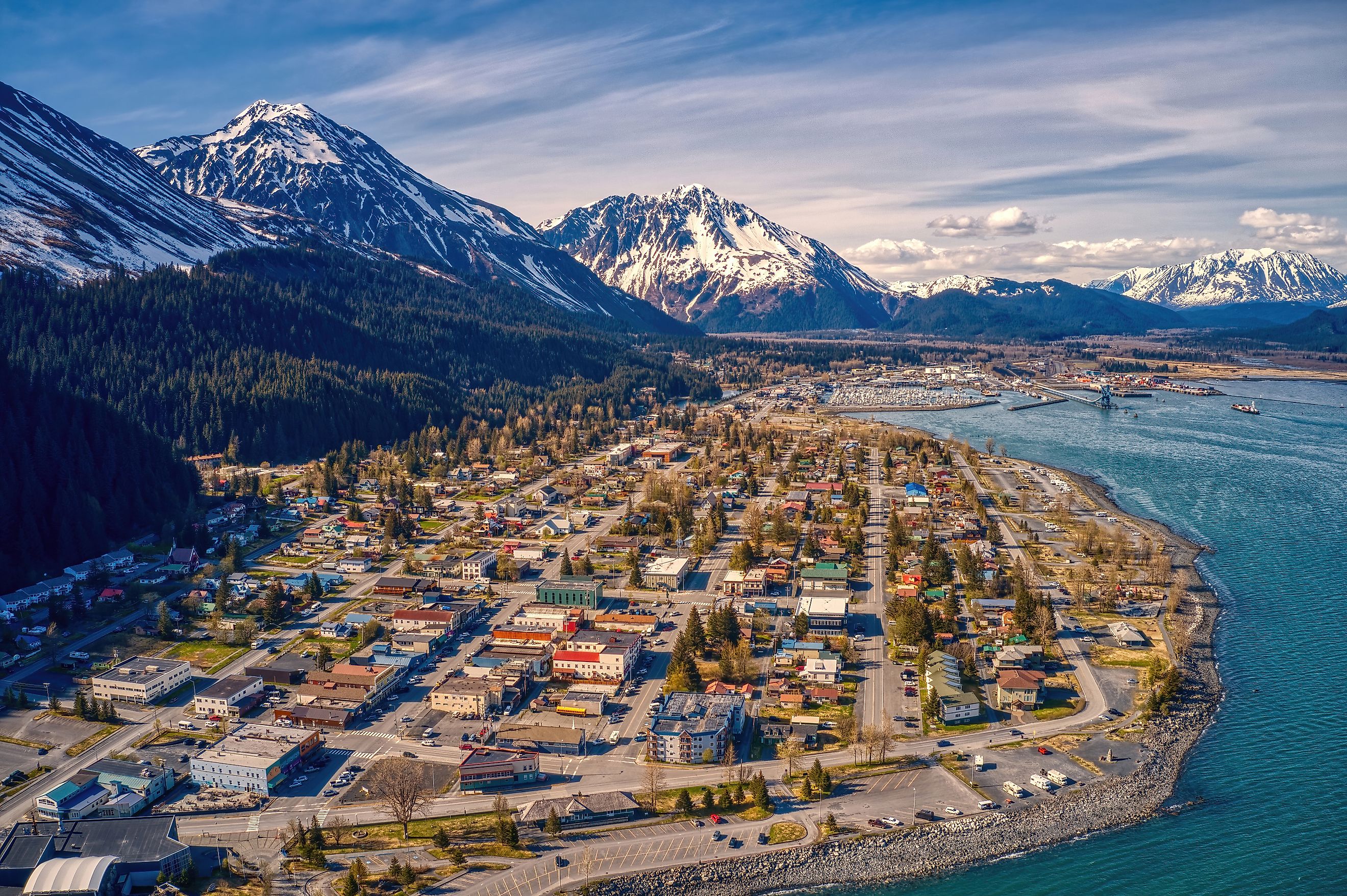
Seward is the Gateway to Kenai Fjords National Park, with the town of about 2,800 residents sitting on Resurrection Bay and the Chugach Mountains rising directly behind it. Half-day boat tours run out to calving tidewater glaciers with reliable orca and humpback sightings in summer. Exit Glacier sits 10 minutes outside town for direct walk-up access to a wall of blue ice. The harder Harding Icefield Trail climbs about 3,500 feet over an 8-mile round trip to an overlook above the 700-square-mile icefield that feeds dozens of glaciers across the park.
The downtown grid dates to the early 1900s and sits in the shadow of the surrounding peaks. The Alaska SeaLife Center is the state's only public aquarium and operates as a marine wildlife rehabilitation hub. The Seward Silver Salmon Derby each August draws anglers from across the state for a shot at the largest catch.
Valdez

Valdez is the gateway to Prince William Sound and one of the easier places in the state to get close to calving glaciers without a remote expedition. Day boats run out to Columbia Glacier (which calves 1.5 cubic miles of ice annually, the most active tidewater glacier in Alaska) and Meares Glacier through summer. The Chugach Mountains drop straight into the sound from heights above 5,000 feet. The Shoup Bay Trail follows the coast for about 10 miles to a tidewater glacier. Horsetail Falls in Keystone Canyon delivers a quick payoff right off the Richardson Highway.
Modern Valdez sits 4 miles west of where the original town stood. The 1964 Good Friday earthquake, a magnitude 9.2 event that ranks as the second-strongest ever recorded worldwide and the strongest in US history, destroyed the original townsite, which now sits as a memorial to the victims. The Valdez Ice Climbing Festival each February brings climbers from across the country, with the frozen waterfalls in Keystone Canyon serving as the main venue. Valdez Gold Rush Days runs in late summer.
The Alaska Read
Alaska is bigger than people picture, and these eight towns are a good way into it. Ketchikan and Sitka hold the Tlingit and Russian colonial layers most travelers do not know. Kodiak protects the Kodiak brown bear subspecies in its only natural habitat on Earth. Talkeetna serves climbers staging for Denali. Skagway preserves the Klondike Gold Rush on wooden boardwalks. Homer, Seward, and Valdez each handle a different version of Alaska tidewater-glacier access. Each town earns its place on US favorites lists by being specifically itself.