12 Of The Most Captivating Small Towns In Victoria
Victoria is Australia's smallest mainland state, but the towns scattered through it carry an outsized share of the country's gold-rush heritage, alpine terrain, and coastal history. The towns on this list anchor those different identities. Beechworth and Maldon date to the 1852-53 Victorian gold rush. Portland marks the first permanent European settlement in Victoria, established by the Henty brothers in 1834. Daylesford sits at Australia's largest concentration of natural mineral springs. Mount Buller runs over 80 kilometres of ski trails through the Australian Alps. Sorrento and Mallacoota anchor the western and eastern ends of Victoria's coastline, with Point Hicks near Mallacoota being where James Cook first sighted the Australian east coast in April 1770. The twelve towns below are sized for a weekend rather than a city break.
Olinda

Olinda sits high in the Dandenong Ranges about 41 kilometres east of the Melbourne CBD, surrounded by cool-climate gardens that anchor the village. The R.J. Hamer Arboretum, Cloudehill Gardens, and the Dandenong Ranges Botanic Garden are all walking distance from the town centre, and the trail to Olinda Falls runs into the adjoining national park. The Silvan Mountain Bike Trails run alongside the Silvan Reservoir reserve for riders.
The village has a working arts scene, with Touchstone Craft Gallery and Emma Jennings Gallery showing local artists. Olinda Tea House and Miss Marple's Tea Room both build their menus around full afternoon-tea service. Arcadia Cottages is the local self-contained option for stays of more than a night, each cottage with its own spa.
Jamieson

Jamieson sits at the head of Lake Eildon in Victoria's High Country, where the Goulburn and Jamieson Rivers meet the lake. The Jamieson Stroll, a 3.7-kilometre loop, runs through the surrounding forest and is locally regarded for birdwatching. The Jamieson Boat Ramp provides direct access to Lake Eildon for sailing and fishing. Granny's Flat Camping Reserve east of town opens onto hiking, angling, and four-wheel-drive country in the surrounding alpine wilderness.
The Jamieson Brewery & Grill is the town's main pub and brewer, with pay TV and Wi-Fi for football and cricket and food paired to its house craft beers. Jamieson Valley Retreat handles overnight stays, with self-contained cottages set to panoramic mountain views.
Mount Macedon

The town of Mount Macedon sits below its namesake 1,001-metre summit at the northern edge of the Melbourne metro region. Macedon Regional Park covers the upper slopes, with the rock-climbing area at Camel's Hump, the easy walking circuit at Sanatorium Lake, and the horse trails out of Old Scout Camp. Tony Clarke Reserve in town has bowling greens, cricket nets, basketball courts, and an indoor stadium.
Mount Macedon's cool four-season climate suits cool-climate vineyards, and Mount Macedon Winery and Mount Towrong Vineyard are among the closest producing wineries to Melbourne. Mistwood is the town's best-known guesthouse for overnight stays among the forest.
Mount Buller

Mount Buller is Victoria's primary alpine resort and the country's second-largest ski area by lifted terrain. The Mount Buller Alpine Resort runs around 80 kilometres of marked ski and snowboard trails reaching 1,780 metres above sea level, with about 405 metres of vertical drop. Summer turns the same terrain into a mountain-biking and hiking network; the Mount Buller-to-Mt Stirling Trail crosses into the adjacent peak and its alpine reserve.
Upper Howqua Camping Area east of the village provides basic riverside camping for visitors wanting the rustic version. The Mount Buller Chalet in the village core has on-site dining and a spa, walking distance to the lifts.
Portland

Portland is Victoria's oldest European settlement: the Henty brothers established a whaling-and-pastoral base here in 1834, four years before Melbourne. The Portland Visitors Centre houses the Maritime Museum, with one of the oldest surviving shore-based lifeboats in Australia (built 1858) on display. The Powerhouse Vintage Car and Motor Museum, the 1863 Old Town Hall, and the vintage cable-tram service that still runs along the foreshore all fill out the heritage circuit.
South of town, Cape Nelson State Park's trail network passes through coastal scrubland holding rare endemic plant species including the soap mallee, which grows only in southeastern Australia. The Cape Nelson Lighthouse, completed in 1884, has guided shipping into Portland Bay for more than 140 years; cottage accommodation on the lighthouse reserve is available for booking through the lightkeeper's quarters.
Colac

Colac sits on the southern shore of Lake Colac in Victoria's Western District and functions as the access town to the Otway Ranges. The Otways carry one of southern Australia's most significant temperate rainforests, with Stevensons Falls and the surrounding gully sitting an easy drive south of town. Great Otway National Park extends from the rainforest down to the surf coast at Apollo Bay and Lorne.
In town, Colac Botanic Gardens carries mature oak groves and curated planting along the lakefront. Colac Golf Club is the local 18-hole course. Otway Gate Motel sits across the street from the botanic gardens for a central place to stay.
Bright

Bright sits in the Ovens Valley in Victoria's alpine northeast and is best known nationally for the deciduous autumn colour the town's European planting produces every April and May. West of Bright, Mount Buffalo National Park covers the granite plateau of Mount Buffalo, with the over-200-metre cliffs at the Gorge, the high point at The Horn (1,723 metres), and the waterfalls at Ladies Bath and Eurobin Falls. Bright Pioneer Park covers the town's football oval, netball courts, and playgrounds.
Bakers Gully has a series of short nature trails close to town. Mystic Park is the area's mountain-bike park, with over 45 kilometres of marked trails and a downhill-rated descent. Mystic Mountain Lodge a few blocks from the park covers larger groups and family bookings looking for whole-house rentals.
Maldon

Maldon was a major Victorian gold-rush town from 1853 onwards, when gold was discovered in the hills above the present townsite by Captain John Mechosk. The Maldon Historic Area Park still carries the surface remains of the mining period (shafts, tunnels, stone walls, vintage machinery) surrounded by remnant Box-Ironbark forest, one of the most threatened forest types in Victoria. The Maldon Vintage Machinery and Museum runs a fuller indoor collection covering the mining-and-agricultural transition.
Maldon was the first town classified as a Notable Town by the National Trust of Australia, in 1966, in recognition of the intact 1860s-1880s streetscape. Cascade Art Gallery on the main street stocks works by local artists. Panacea Estate south of town runs weekend cellar-door tastings and vineyard tours.
Daylesford

Daylesford and neighbouring Hepburn Springs sit on top of around 80% of Australia's natural mineral springs, the largest such concentration on the continent. The Hepburn Mineral Springs Reserve was gazetted in 1865 after Italian and Swiss-Italian residents petitioned the state to protect the springs from gold-mining damage; the public bathhouse on the reserve opened thirty years later in 1895 and is recognised as Australia's first formal bathhouse. The current Hepburn Bathhouse and Spa sits on the same site, with the original 1895 building still standing as the Pavilion Café. The Jubilee Lake walk and the trails around Lake Daylesford reach several other named springs including Wombat Flat and Central Spring.
The Convent Daylesford, a former 19th-century convent and boarding school, has been converted into a gallery and accommodation complex on the hill above town. Lake House Daylesford on the edge of Lake Daylesford operates one of regional Victoria's best-known restaurants alongside a full-service spa and waterside accommodation.
Beechworth

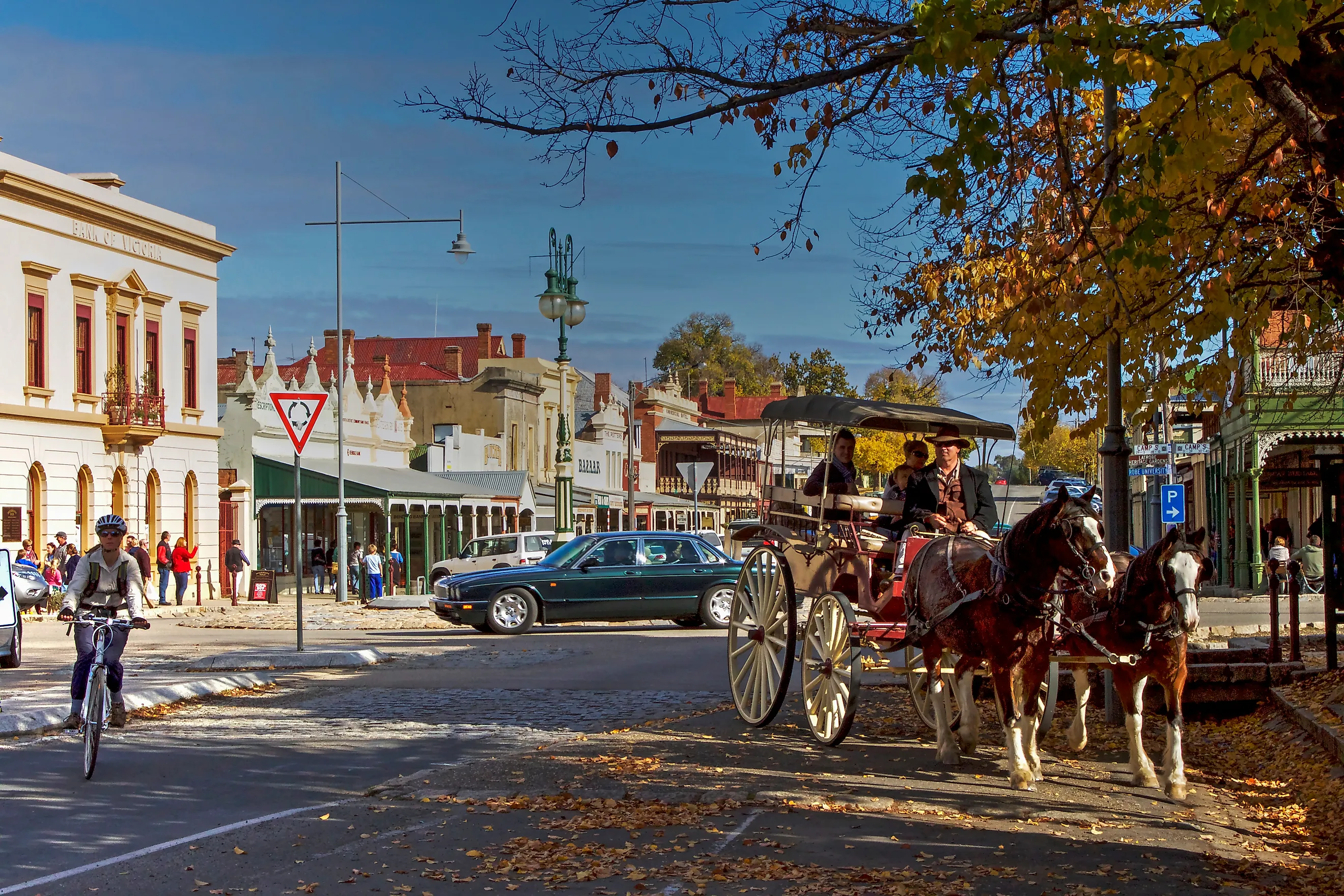
Beechworth was the centre of the Ovens goldfield from 1852 onwards, and the gold rush that followed produced the substantial granite-and-honey-coloured-brick streetscape that still defines the town today. Beechworth Historic Park covers the surface workings and tailings of the gold-era mines; the Burke Museum, in the original 1857 athenaeum building, houses over 30,000 artefacts and remains one of the oldest provincial museums in Australia. Ned Kelly was tried in Beechworth's courthouse in 1880, and the courthouse is open to the public.
Beechworth now anchors the regional food-and-drink circuit for northeast Victoria. Provenance, in a converted bank building, runs as a destination restaurant. Bridge Road Brewers is one of the older Victorian craft breweries. The Beechworth Honey shop sells single-varietal and raw honeys produced regionally. Freeman on Ford operates as bed-and-breakfast accommodation in the former Oriental Bank building.
Sorrento

Sorrento sits near the western tip of the Mornington Peninsula and dates to the same 1830s pastoral expansion that put settlers in Portland. Point Nepean National Park at the peninsula's tip contains the Quarantine Station established in 1852 (Victoria's first migrant quarantine processing facility) and Fort Nepean, which fired the first Allied shots of both World War I and World War II from its coastal-defence batteries. The fort remained in military use until 1945. The park's coastline fronts both Port Phillip and the Bass Strait.
Sorrento Ocean Beach on the Bass Strait side has surf breaks and tide-pool rock platforms. The Port Phillip beaches on the calmer bay side suit swimming. The Hotel Sorrento, in continuous operation since 1871, was built by theatrical impresario George Coppin and remains the landmark on the bay-side waterfront.
Mallacoota

Mallacoota sits in Victoria's far east near the New South Wales border, and the town is the main staging point for Croajingolong National Park, the largest coastal wilderness in Victoria. The park covers about 87,500 hectares of white-sand beaches, eucalypt forest, and ridge country, with the Point Hicks Lighthouse on its southern coast. Point Hicks itself was the first part of the Australian east coast sighted by Lieutenant James Cook on the morning of April 19, 1770; Cook named it after the lieutenant who spotted it but did not land there. The Genoa Peak walk in the park's interior reaches a summit with cross-Strait views.
Betka Beach has surf and swimming conditions along with saltwater fishing. The Mallacoota Bunker Museum preserves the World War II Royal Australian Air Force operations bunker that coordinated air patrols of the Bass Strait sea lanes during the war. The Wave Oasis is a small bed-and-breakfast on the inlet side of town.
What the List Has in Common
The towns on this list cluster around four anchors. The gold-rush belt (Beechworth, Maldon, and the older parts of Daylesford) gave Victoria its colonial-era wealth and most of its remaining 1860s-1880s architecture. The alpine corridor (Mount Buller, Bright, Jamieson, Mount Macedon) covers the state's snowfields and four-season high country. The mineral-springs belt around Daylesford is unique on the continent. And the coastline runs from Portland's 1834 Henty settlement in the southwest to Sorrento's 1852 quarantine station and Mallacoota's wilderness coast at the eastern border. The list works as a sequence: most of Victoria's history sits in the towns rather than in Melbourne, and each of these twelve makes the case for a piece of it.