8 Arizona Towns With Unforgettable Main Streets
Arizona's small downtowns still reveal what their towns were built to do. Tombstone went up around an 1879 silver strike, and Allen Street between 3rd and 6th still closes to motor traffic so the 1880s boardwalk feel survives. Bisbee climbed the slopes of the Mule Mountains around a copper deposit that ran continuously from 1877 to 1975, and the staircase passages between hillside storefronts still set the path through town. Williams was the last community on Route 66 to be bypassed by Interstate 40, in October 1984, and its main drag has kept the neon. The eight downtowns below each anchor on something specific: a courthouse plaza, a presidio site, a Mogollon Rim setting, a ranching headquarters.
Prescott

The Yavapai County Courthouse, completed in 1916, sits at the center of Prescott's downtown grid on a square that fills with summer concerts and Fourth of July events. Across Montezuma Street, Whiskey Row holds about 20 historic bar and restaurant buildings, anchored by the Palace Restaurant and Saloon, which has operated under that name since 1877. Bashford Courts, a former 1880s commercial block on Cortez Street, now houses retail tenants in the original brickwork. The Sharlot Hall Museum two blocks west covers the original 1864 territorial governor's mansion and seven other historic structures on a four-acre campus, including the 1875 William Bashford House. Prescott served as the first capital of the Arizona Territory from 1864 until the capital moved to Tucson in 1867 and returned briefly to Prescott in the 1870s.
Sedona

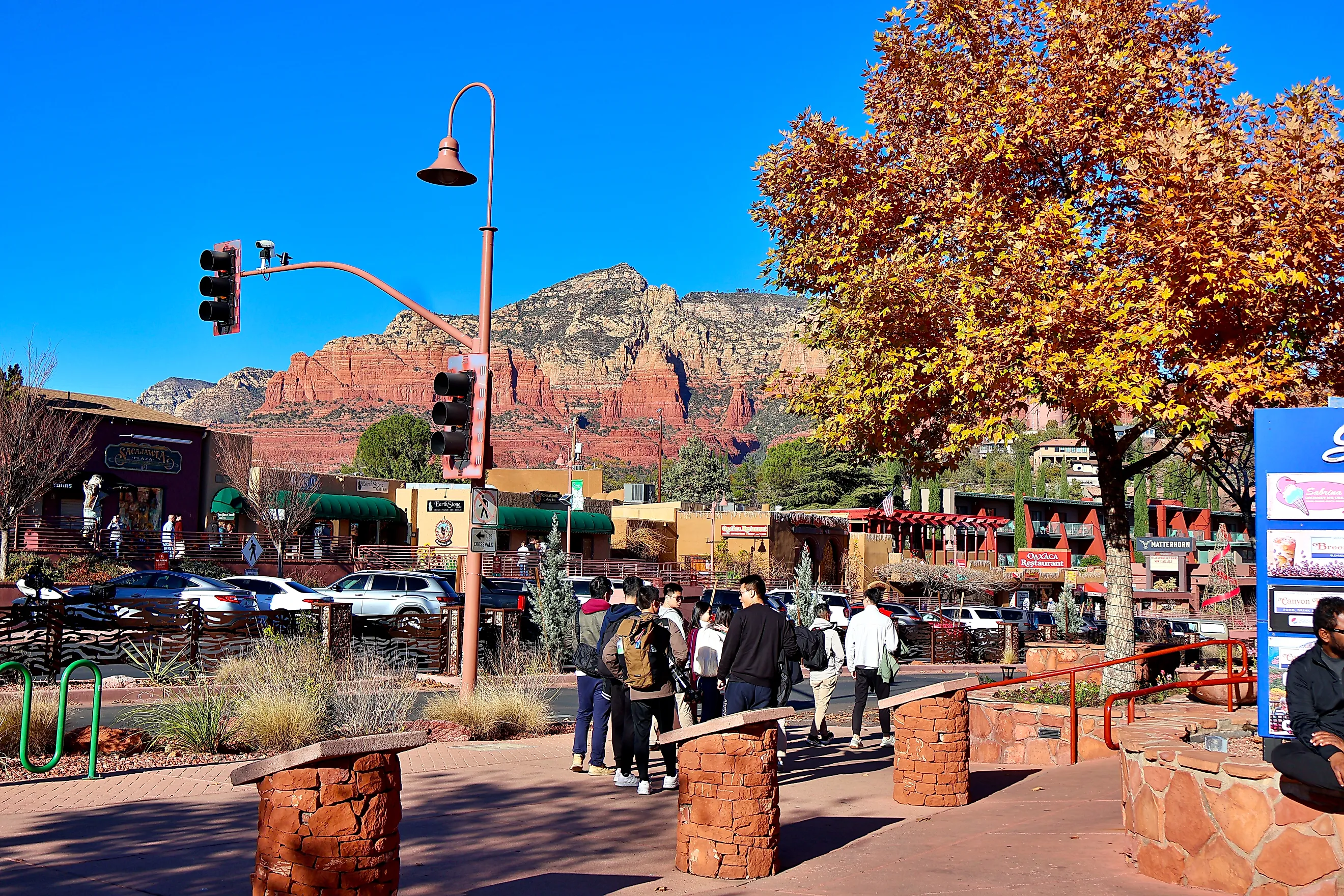
Sedona never developed a single compact downtown grid. State Route 89A through Uptown functions as the main commercial corridor, running below the Mogollon Rim and the red Permian-age sandstone formations that gave the area its tourism economy. Tlaquepaque Arts and Shopping Village, built in 1971 by businessman Abe Miller to resemble a traditional Mexican village, is the most recognized retail anchor with about 50 galleries and shops arranged around courtyards and fountains. The Sedona Arts Center two blocks north has operated as a member-run artist cooperative since 1958. The Sedona Heritage Museum at Jordan Historical Park covers the area's apple-ranching past in the 1930 Jordan Family farmhouse, where commercial orchards operated through the mid-20th century.
Bisbee

Old Bisbee climbs the slopes of Tombstone Canyon in the Mule Mountains, with Main Street, Brewery Avenue, and Subway Street linked by public staircases that locals turn into the annual Bisbee 1000 Stair Climb each October. The Bisbee Mining and Historical Museum, housed in the 1897 Phelps Dodge General Office building on Copper Queen Plaza, became the Smithsonian Institution's first rural affiliate in 1999 and covers the Warren Mining District's 95-year copper run. The Bisbee Restoration Museum at 37 Main Street fills the 1909 Fair Store building with three floors of donated family and business artifacts. The Copper Queen Hotel a block away opened in 1902 and has run continuously since, making it one of the longest-operating hotels in Arizona. Bisbee shifted away from copper mining and toward an arts economy after the mines closed in 1975, when artists bought up the cheap Victorian-era housing on the canyon walls.
Williams

Williams was the last Route 66 town in the country to be bypassed by Interstate 40, on October 13, 1984, and the eastbound and westbound segments of the original Mother Road still run through downtown as one-way couplets. The Grand Canyon Railway departs the 1908 Williams Depot daily, running the 64-mile line north to the South Rim that the Atchison, Topeka and Santa Fe completed in 1901 and the current operator restored in 1989. Cruiser's Route 66 Cafe operates out of a former Mobil station on the historic alignment. Pete's Route 66 Gas Station Museum across the street fills a 1949 Texaco station with period signage, pumps, and pre-war auto memorabilia. Bearizona Wildlife Park three miles west of downtown opened in 2010 and runs as a 160-acre drive-through wildlife habitat with black bears, bison, and wolves.
Tombstone

Allen Street between 3rd and 6th closes to motor traffic so the historic core can host the daily reenactments that drive the town's tourism economy. The Gunfight at the O.K. Corral took place on October 26, 1881, in a 30-second exchange that left Tom McLaury, Frank McLaury, and Billy Clanton dead and Virgil and Morgan Earp wounded. The O.K. Corral Historic Complex runs reenactments three times daily on the actual ground where the gunfight occurred. The Bird Cage Theatre at 535 East Allen Street opened December 26, 1881, ran 24 hours a day as a saloon, gambling hall, and brothel until silver prices collapsed and the mines flooded, and closed in 1889. The New York Times described it that year as "the wildest, wickedest night spot between Basin Street and the Barbary Coast." The walls still carry about 140 bullet holes from gunfights inside.
Tubac

The Spanish established the Presidio San Ignacio de Tubac in 1752, making the site the oldest European settlement in what is now Arizona. Juan Bautista de Anza, the second commander of the presidio, led the 1775 expedition from Tubac that established the colony at San Francisco. Tubac Presidio State Historic Park preserves the foundations of the original 1752 fort, an 1885 territorial schoolhouse, and an 1898 Otis press in the working printing museum. The Tubac Center of the Arts operates out of a converted 1971 building on Plaza Road and runs rotating exhibits drawn from the village's 100-plus working artist studios and galleries. The annual Tubac Festival of the Arts, held the first full week of February since 1959, is one of the longest-running outdoor arts festivals in the state.
Wickenburg

Henry Wickenburg discovered the Vulture gold deposit in 1863, and the town that grew up at the Hassayampa River crossing 12 miles east of the mine became Arizona's third-largest community by the mid-1870s. The Vulture Mine produced an estimated $30 million in gold between 1863 and 1942, the largest figure of any gold operation in the state. The Sigler Western Museum on Frontier Street (formerly the Desert Caballeros Western Museum until an October 2025 rename following a $20 million donation from longtime residents Carey and Jack Sigler) anchors the downtown cultural district with a Smithsonian affiliate collection of 600-plus Western artworks. The museum is breaking ground on a 27,100-square-foot expansion across the street, scheduled for completion in 2027. Vulture City, the ghost town that grew around the mine, is preserved as a private historic site with original adobe and stone buildings still standing.
Payson

Payson sits at 4,887 feet at the foot of the Mogollon Rim, the 200-mile escarpment that defines the southern edge of the Colorado Plateau and divides the Sonoran lowlands from the Arizona high country. The Rim Country Museum at Green Valley Park covers the region's cattle-ranching history and includes the Zane Grey Cabin replica, a reconstruction of the author's 1922 hunting lodge that burned in the 1990 Dude Fire. Grey wrote much of his Western fiction at the original cabin, which sat on a hill seven miles north of town. The Pieper Mansion at 505 West Main Street, built in 1890 by ranching family the Piepers, is the oldest surviving residential structure on the original Main Street alignment. Payson hosts what is recognized as the world's oldest continuous rodeo, the August Doin's Rodeo, which started in 1884 and has run annually since.
The Common Thread
Each Arizona main street above stops short of being a single shared template. Tombstone built itself for the 1880s silver boom, and the original Allen Street commercial blocks survive because the mines closed before the town could prosper enough to replace them. Bisbee's hillside layout exists because copper mining ran the bottom of the canyon and houses had to climb the canyon walls. Williams owes its surviving neon and one-way couplets to a 1984 Interstate decision. What links the eight is the chain of events that left the original downtown infrastructure standing: the local industry boomed, then collapsed or moved on, before construction patterns standardized in the late 20th century could erase the original streetscape. Each town's main street is what was there when the money ran out.