10 Best Small Towns in Italy for a Weekend Retreat
Italy keeps surprising travellers who venture past the major-city circuit. Porto Venere sits on the Ligurian coast with a Genoese castle and panoramic views over the Gulf of La Spezia. Alberobello's trulli houses, built without mortar from local limestone, hold UNESCO World Heritage status. Matera's cave dwellings rank among the oldest continuously inhabited places on Earth, with evidence of human occupation reaching back to the Paleolithic. Sicily delivers two stops: San Vito Lo Capo for Blue Flag beaches and Cefalù for a Norman cathedral with Byzantine mosaics. The ten towns ahead make for a weekend retreat with no waiting lines.
Porto Venere, Liguria

Porto Venere is the calmer alternative to the busier Cinque Terre just up the Ligurian coast. As the smallest seaside village in the province of La Spezia, it offers the same kind of pastel-stacked harbour views without the heavy summer crowds. Porto Venere and the surrounding islands of Palmaria, Tino, and Tinetto were inscribed as a UNESCO World Heritage Site in 1997, with the Gulf of La Spezia (locally known as the Gulf of Poets) at the centre. The Castello Doria, originally a 12th-century Genoese fortification later rebuilt and expanded into the 16th and 17th centuries, sits at the top of the village. The 12th-century Church of San Pietro on the headland and Lord Byron's Grotto below it round out the main short-walk circuit. The Grand Hotel Portovenere, a 17th-century former monastery on the seafront, sits a short walk from the historic centre.
Treia, Marche

Treia sits less than 20 kilometres from Macerata in the eastern part of the Marche region, with the long-range view running east from the town walls toward the Adriatic and west toward the Sibillini Mountains. The main historic sights include the 12th-century San Marco Tower, the neoclassical Teatro Comunale, and the ancient Roverella Oak (a centuries-old downy oak that has long been a local landmark). The annual Disfida del Bracciale on the first Sunday of August keeps alive the historic ball game Gioco della Palla col Bracciale, played with a heavy spiked-wood arm guard, which was the most popular spectator sport in central Italy during the 18th and 19th centuries. Hotel Grimaldi sits in the historic centre in a landmark building suited to a weekend stay.
Anghiari, Tuscany

Perched on a hilltop in the Upper Tiber Valley in eastern Tuscany, Anghiari is one of Italy's most intact medieval hill towns. The town walls still ring the historic centre, and the surrounding artisan workshops keep alive traditions in woodwork, textiles, and ceramics. The Museo della Battaglia di Anghiari commemorates the 1440 Battle of Anghiari, in which Florentine forces under Pier Giampaolo Orsini defeated the Milanese army of the Visconti, and which Leonardo da Vinci was commissioned to depict on a wall of the Palazzo Vecchio in Florence (the fresco was lost). Other downtown stops include the churches of Santo Stefano and Sant'Agostino. Anghiari sits in the corner of Tuscany closest to Umbria and the Marche, with the Romagna border further north over the Apennines. Less than a mile from downtown, Il Cardo Resort occupies a 15th-century farmhouse converted into a small resort suited to extended Tuscan-countryside stays.
Brisighella, Emilia-Romagna

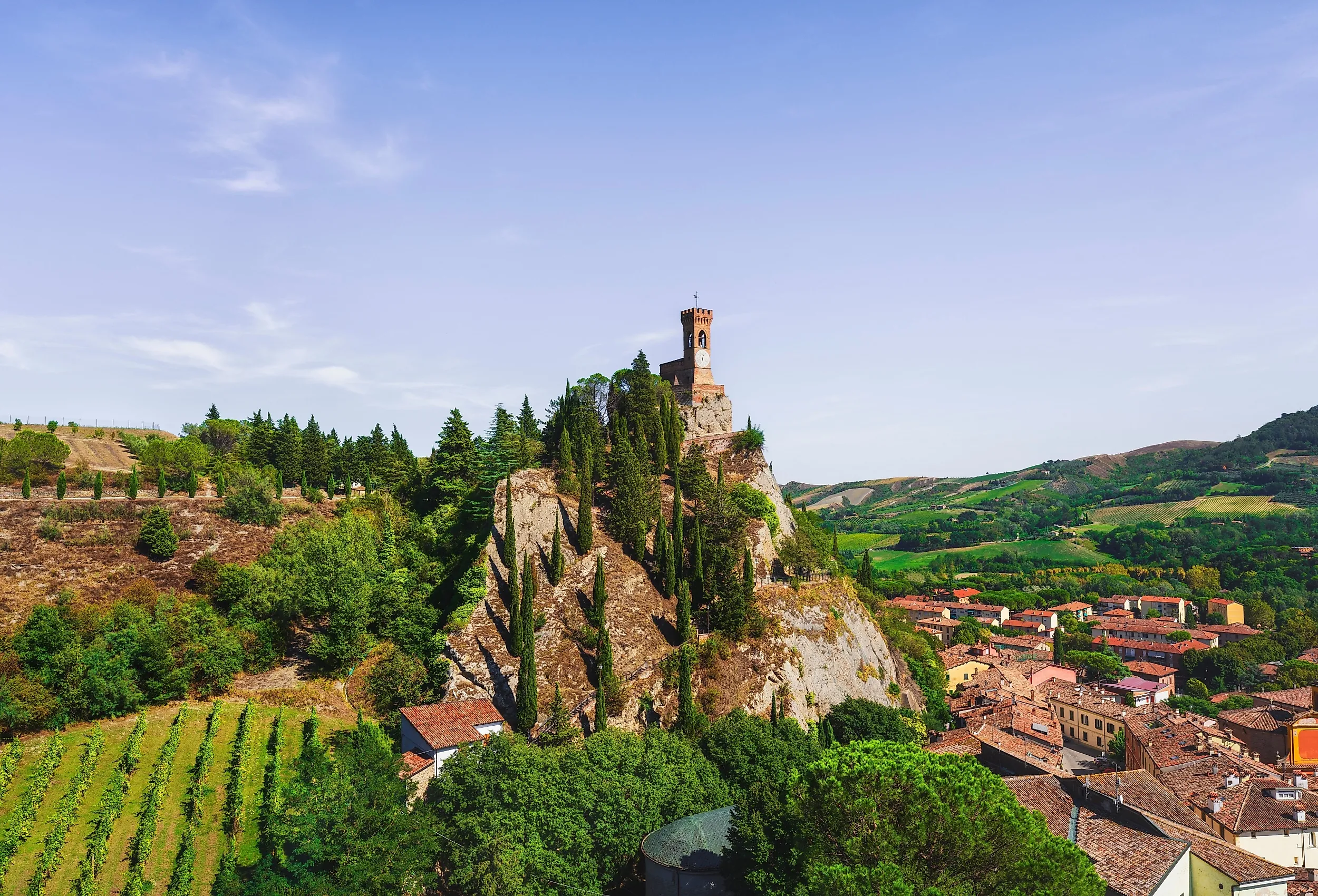
Brisighella is one of the I Borghi più Belli d'Italia certified villages and sits at the foot of three gypsum spurs in the Lamone Valley of the Romagna Apennines, with a separate fortress, clock tower, and shrine each crowning one of the three. La Rocca Manfrediana, a 14th-century fortress built by the Manfredi family of Faenza, sits on the western spur. The Clock Tower (built 1850 on a 13th-century base) sits on the central spur. The Monticino Sanctuary occupies the third. Down in the village, the Via Degli Asini (the Donkey Street) is the elevated covered passage that once connected the donkeys hauling gypsum down from the quarries to the warehouses below. The Vena del Gesso Regional Park, with more than 200 documented caves carved through Italy's largest exposed gypsum formation, runs immediately around the town. Florence sits about a two-hour drive away through the Apennines. Villa Liverzano, just outside town, runs as a weekend country-hotel option with garden, pool, and spa.
San Vito Lo Capo, Sicily

San Vito Lo Capo sits at the northwestern tip of Sicily, with the sandy white beach running directly into the limestone face of Monte Monaco. The beach has held Blue Flag certification (the European environmental and water-quality standard) consistently over the past two decades and is one of the most-photographed stretches of sand in Sicily. The Zingaro Nature Reserve, established in 1981 as Sicily's first protected nature reserve, runs seven kilometres of undeveloped coastline immediately east of town with seven coves accessible only on foot. The Couscous Fest each September pulls cooks from around the Mediterranean for the international couscous championship, with the dish reflecting San Vito's longstanding North African culinary connection. Il Faro E La Luna Beach Apartments, a one-minute walk from the main beach, run with a private hot tub.
Orvieto, Umbria

Orvieto sits on top of a flat-topped tufa butte rising about 1,000 feet above the surrounding valley floor, and the cliff itself shapes the town. The Gothic Duomo di Orvieto, completed over three centuries beginning in 1290, holds a multi-tiered façade considered one of the most elaborate in Italy and frescoes by Luca Signorelli in the San Brizio Chapel that influenced Michelangelo's later Sistine Chapel work. The Orvieto Underground tour leads through the network of more than 1,200 caves, wells, and storage cellars excavated into the tufa over the past 2,500 years. The Torre del Moro, a 12th-century clock tower at the centre of the historic district, climbs to a 360-degree view over the surrounding Umbrian countryside. Orvieto sits roughly halfway between Florence and Rome on the main A1 motorway, which makes it the standard weekend stop between the two. La Magnolia is a historic-building hotel less than 500 feet from the cathedral, with free bike rentals.
Matera, Basilicata

Matera, in the southern region of Basilicata, is one of the longest continuously inhabited settlements in the world, with archaeological evidence of human occupation stretching back roughly 9,000 years. The Sassi di Matera (the two cave-dwelling districts of Sasso Caveoso and Sasso Barisano, carved into the gorge of the Gravina river) were designated a UNESCO World Heritage Site in 1993. The Sassi were inhabited continuously from Paleolithic times into the 1950s, when the Italian government forcibly relocated their residents on public-health grounds and the districts sat empty for decades before the late-20th-century restoration that converted many of the caves into hotels, restaurants, and homes. The Casa Grotta di Vico Solitario preserves one cave home in the condition it was in at the time of the 1950s evacuation. Parco della Murgia Materana, across the gorge, holds more than 150 rupestrian (rock-cut) churches, many with surviving Byzantine frescoes. Palazzo degli Abati, inside the Sassi, runs accommodation with rooms carved into the original rock.
Cefalù, Sicily

The Cefalù Cathedral, begun in 1131 under the Norman king Roger II and inscribed as a UNESCO World Heritage Site in 2015 as part of the Arab-Norman Palermo route, is the architectural anchor of this coastal Sicilian town. The cathedral holds a Byzantine Christ Pantocrator mosaic in the apse (1148) considered one of the finest surviving examples of Byzantine mosaic art outside Constantinople. The town wraps around the Norman cathedral with medieval lanes leading down to the long sand of Spiaggia di Cefalù. The Rocca di Cefalù, the 270-metre limestone headland looming over the town, runs an hour-and-a-half climb to the ruins of a megalithic temple and a Norman castle at the summit. Cefalù has served as a filming location for several Italian productions and appeared in select scenes of Giuseppe Tornatore's Cinema Paradiso (the film's primary village location was Palazzo Adriano, further south in the Sicilian interior). Taliammari operates as a beachfront hotel in the old-town district.
Alberobello, Puglia

Alberobello is a town of around 11,000 in the Itria Valley of Puglia, with around 1,500 trulli (dry-stone limestone houses with conical roofs) concentrated in the historic Rione Monti and Rione Aia Piccola districts. The trulli were designated a UNESCO World Heritage Site in 1996 as one of the most concentrated and best-preserved examples of vernacular architecture in Europe. The dry-stone construction (no mortar) reflects a 17th-century quirk of Puglian tax law: the Count of Conversano allowed peasants to settle the area on the condition that any houses they built could be dismantled quickly to avoid royal property tax. Most of the original trulli survived into the 19th century, when the tax was lifted. The Trullo Sovrano in the centre of town is the only two-storey trulli, built around 1730 and now open as a small museum. Trulli Holiday Albergo Diffuso runs accommodation in a network of restored trulli around the town centre.
Cortona, Tuscany

Cortona is one of the major Etruscan cities of antiquity, with the original 4th-century-BCE city walls still partly standing on the lower slopes of Monte Sant'Egidio. The town sits 600 metres above the Val di Chiana with a panorama running south to Lago di Trasimeno, the fourth-largest lake in Italy (after Lakes Garda, Maggiore, and Como) and the largest lake in central Italy. The Museo dell'Accademia Etrusca and the Museo Diocesano hold the principal antiquities, including the bronze Etruscan chandelier and Fra Angelico's Annunciation altarpiece. The Basilica of Saint Margaret (rebuilt 1856-1897) sits at the highest point of the town. Cortona also pulled a tourism wave through the 2000s after Frances Mayes' memoir Under the Tuscan Sun and the 2003 film adaptation. Dolce Maria, a small hotel in a medieval building a short walk from Piazza della Repubblica, suits a weekend stay.
Italy Beyond The Big Names
These ten towns combine history, landscape, and cultural depth without the queues that come with Rome or Florence. A weekend in any of them buys real time to wander rather than line up. The southern picks (Matera's caves, Alberobello's trulli, the two Sicilian towns) deliver the most distinctive built environments on the list. The Tuscan and Umbrian hill towns (Anghiari, Cortona, Orvieto) cluster within a few hours of each other and pair well into a multi-stop weekend. The Ligurian coast (Porto Venere) and the Adriatic-side towns (Treia, Brisighella) offer the alternative to the Cinque Terre and Florence respectively. Each of the ten supports at least two nights of focused exploration without exhausting the local options.