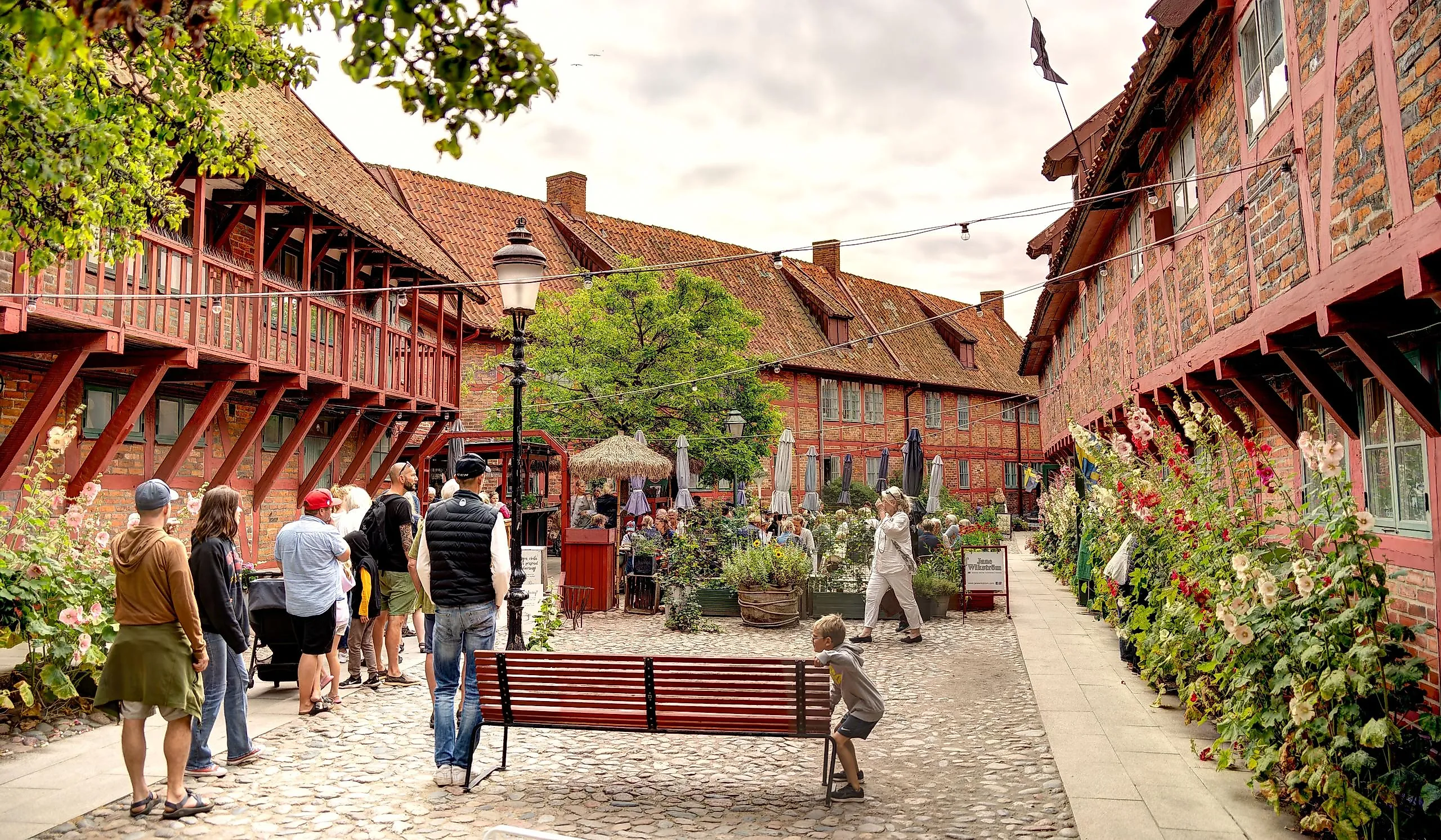
9 Most Charming Small Towns in Sweden
Sweden's small towns hold more medieval architecture than most travellers expect. Visby keeps a 2.1-mile defensive wall and a dozen church ruins inside its 13th-century perimeter. Sigtuna minted the country's first coin and still runs the oldest main street in the nation. Kiruna sits above the Arctic Circle and pulls Northern Lights chasers through every long winter. Kalmar holds a Renaissance castle that anchored the medieval Kalmar Union between Denmark, Norway, and Sweden. These nine towns make a strong case for stepping past the major-city circuit.
Visby

Visby sits on the Swedish island of Gotland and runs as a year-round summer-resort town built around an extraordinarily intact medieval core. It is one of Sweden's UNESCO World Heritage Sites, designated in 1995, and is widely considered the best-preserved medieval town in Scandinavia. The roofless ruins of about a dozen medieval parish churches stand within the walls, including St. Clemens, St. Nicolai, Drotten, and St. Karin, alongside the Cathedral of St. Mary (Sankta Maria), the only medieval church still in use, with construction running from 1190 to its 1225 consecration.
The Visby City Wall (Ringmuren) runs 3.4 kilometres (about 2.1 miles) of largely-intact 13th- and 14th-century limestone fortification, with 27 of the original 29 saddle towers and 9 of the 22 smaller towers still standing. The Gotland Museum's Fornsalen (Hall of Antiquities) holds the Spillings Hoard, the largest Viking silver hoard ever found, unearthed in 1999 on a Gotland farm: 67 kilograms of silver, 14,295 coins, and around 20 kilograms of bronze, buried beneath the floor of a Viking-era outhouse in the 9th century. The Pippi Longstocking films of the 1969-1973 series were shot at Kneippbyn just south of Visby, where the original Villa Villekulla set still stands. Local lodging includes Scandic Visby, Kalk Hotel, and Visby Fängelse (the converted prison).
Ystad

Anyone who has watched Henning Mankell's Wallander series will recognise Ystad on sight. The coastal town at the southern tip of Skåne is where the title detective walks the pastel-coloured houses and cobblestone streets between cases, and the screen-friendly cohesion of the historic centre is the reason the town now hosts Ystad Studios, Scandinavia's largest film and television production complex, on the eastern edge of town.
The half-timbered Latinskolan from 1500 is the oldest surviving school building in Scandinavia. The 13th-century St. Mary's Church on Stortorget still rings the night-watchman's call every fifteen minutes from 9:15 pm to 1:00 am (the watchman's task is to call out that there is no fire in the town). Past the town centre, around 25 miles of sandy beach and the open Skåne countryside take over. Villa Strandvägen and Ystad Saltsjöbad both work as town-base options.
Sigtuna

Sigtuna sits between Uppsala and Stockholm and was founded around 980 CE during the reign of Erik the Victorious, which makes it the oldest town in Sweden by founding date. Stora Gatan is the oldest main street in the country and follows the original 10th-century town plan. The first Swedish coin was minted in Sigtuna under King Olof Skötkonung around the year 995. Princess Ingegerd of Sweden, daughter of Olof Skötkonung and later venerated as Saint Anna of Novgorod, was born in Sigtuna around 1001 and is sometimes counted among Sweden's earliest saints.
The local runestones (the town has the largest concentration of runestones of any town centre in Sweden) tell the rest of the story over more than a thousand years. Period buildings range from the Baroque Skokloster Castle and the 1630s Rosersberg Palace to the 12th- and 13th-century stone-church ruins of St. Olaf, St. Peter, and St. Lawrence. Walk along the shore of Lake Mälaren and book rooms at the STF Sigtuna Vandrarhem or Sigtunahöjden.
Mariefred

Mariefred, about 70 kilometres west of Stockholm, takes its name from the Mariefred Charterhouse (Pax Mariae, "Peace of Mary"), the Carthusian monastery founded in 1493 that gave the town its identity. The monastery was suppressed during the Swedish Reformation in the 1520s, but the town survived alongside the much larger Gripsholm Castle, built in 1537 by King Gustav Vasa and now the home of the Swedish National Portrait Collection (one of the oldest portrait collections in the world).
The historic Östra Södermanlands Järnväg narrow-gauge steam railway runs between Mariefred and Läggesta in summer, on rails laid in 1895 and operated as a heritage railway since the 1960s. Like Sigtuna, the town has Lake Mälaren boat trips, and Taxinge Castle just outside town puts out at least 60 varieties of cake at its long-running fika operation. The Callanderska gården, an 18th-century manor in the town centre, runs as a museum with a coffee corner. Deer regularly graze in the Gripsholms hjorthage, the local deer park. Local lodging options include the Gripsholm Inn, the Röda Magasinet, and Vandrarhem Djurgårdsporten.
Kiruna

Kiruna is Sweden's northernmost town, sitting in Lapland about 145 kilometres north of the Arctic Circle, and runs around the largest underground iron ore mine in the world, operated by the state-owned Luossavaara-Kiirunavaara Aktiebolag (LKAB). The mine's expansion has been steadily undermining the original town centre; in a project running since the early 2010s, the entire town centre is being relocated about three kilometres east, with the new city hall Kristallen opening in 2018 and the historic 1912 Kiruna Church scheduled to be moved (intact) to the new centre as part of the relocation.
Hjalmar Lundbohmsgården, the home of LKAB's first managing director, runs as a museum on the mining-era founding of the town. Kiruna Church, designed by Gustaf Wickman in the National Romantic style with a roof resembling a Sámi lavvu tent, was voted Sweden's most beautiful pre-1950 building in a 2001 national poll. Local lodging includes Camp Ripan, the Husky Lodge, and the Ice Hotel of Jukkasjärvi, about 17 kilometres east of Kiruna. Visit in summer for the Midnight Sun, when daylight lasts for weeks at a time, or in winter for the Aurora Borealis.
Jokkmokk

Jokkmokk, about three hours south of Kiruna, is the second hub of Swedish Lapland and the cultural centre of the Sámi people on the Swedish side of Sápmi. The Jokkmokk Winter Market, held on the first Thursday-Friday-Saturday of February since 1605, is the longest continuously running market in Sweden and the principal annual gathering of the Sámi reindeer-herding community, drawing around 30,000 visitors to a town of fewer than 3,000 residents. The Ájtte Museum (the Swedish Mountain and Sámi Museum) holds the principal collection of Sámi material culture, with strong holdings in silverwork and traditional dress. The associated Jokkmokk Mountain Garden grows the alpine and sub-alpine flora of the surrounding mountains. The Arctic Camp Jokkmokk handles summer water activities. Local lodging includes Hotell Akerlund, Hotel Jokkmokk, and the STF Åsgård.
Rättvik

Rättvik is widely regarded as the birthplace of Swedish tourism. On the shore of Lake Siljan, Sweden's first purpose-built tourist hotel, the Rättviks Turisthotell, opened in 1894 (the original building has since been demolished). The town still holds Rättvik Church, the long wooden "kyrkstall" stalls along the lakeshore where churchgoers once stabled their horses, and the Vasa Monument on Vasastenen.
Rättvik is now also a vehicle-enthusiast town, with Classic Car Week running in late July and early August. Midsummer at Rättviks Gammelgård on June 21 is the traditional folk-celebration event in town. The biggest summer draw is Dalhalla, the natural-acoustic outdoor amphitheatre in a flooded former limestone quarry six kilometres north of town, which hosts a summer concert series of national and international acts between June and September. Local lodging includes Stiftsgården, the Jöns Andersgården Bed and Breakfast, and Hotell Rättvik.
Kalmar

Kalmar sits on the Baltic Sea on Sweden's southeast coast and held strategic importance for centuries as the southernmost large town in Sweden before the country expanded south into Skåne in 1658. Kalmar Castle, on a small island connected to the mainland by a causeway, was where the Kalmar Union was signed in 1397 under Queen Margaret I of Denmark, uniting Denmark, Norway, and Sweden under a single monarch (a union that lasted until 1523). The castle's current Renaissance form is the work of King Gustav Vasa and his sons through the 16th century. The Kvarnholmen district north of the castle is a planned 17th-century town inside its own surviving fortification walls, with the Baroque Kalmar Cathedral designed by Nicodemus Tessin the Elder as the architectural centrepiece.
The Kalmar County Museum holds the recovered artefacts from the Regalskeppet Kronan, the 17th-century Swedish flagship that exploded and sank off Öland in 1676 and has produced one of the most significant European underwater archaeological finds of the 20th century. The Öland Bridge, the longest bridge in Sweden at 6,072 metres, crosses to Öland, the country's second-largest island. Spend the night at Slottshotellet Kalmar or Hotell Hilda.
Marstrand

Marstrand sits on a small island on the Kattegat-facing coast of Bohuslän in western Sweden, about 45 minutes north of Gothenburg, and is one of the country's clearest concentrations of maritime history. The Carlsten Fortress, built starting in 1658 on the orders of King Carl X Gustav after the Treaty of Roskilde gave the Bohuslän province to Sweden, sits on a granite hilltop 39 metres above the sea and functions as a living museum where visitors can walk through the dungeons, ramparts, and courtyards. July is the fortress's main month, with annual reenactments of the 17th- and 18th-century military engagements that shaped its history.
The town itself is car-free and is consistently rated Sweden's sailing capital, with the annual GKSS Match Cup Sweden every July drawing one of the world's top match-racing fields to the harbour. The Strandverket Konsthall (Strandverket Art Museum), housed in an old coastal-defence fort, runs modern and contemporary sculpture and visual-art exhibitions. The original founding of Marstrand is generally dated to the 13th century under Norwegian King Håkon Håkonsson, when the area was part of Norway; it became Swedish in 1658. Local lodging includes the Marstrands Havshotell, Villa Maritime Marstrand, and Hotell Nautic.
Why Sweden's Small Towns Hold Up
The nine towns above cluster into three practical regional groupings. The Gotland and Mälardalen entries (Visby, Sigtuna, Mariefred) deliver the strongest medieval-architecture cases, with Visby's UNESCO-listed Hanseatic core leading the lineup. The two Lapland towns (Kiruna, Jokkmokk) handle the Arctic and Sámi cultural draws, including the Midnight Sun in summer and the Aurora Borealis in winter. The southern and western towns (Ystad, Rättvik, Kalmar, Marstrand) split between the Wallander country of southern Skåne, the Lake Siljan tourism heritage of Dalarna, the strategic Baltic-coast position of Kalmar and its Kalmar Union history, and the Kattegat-side sailing culture of Marstrand. Across all nine, the small-town pace and the depth of preserved historical material reward visitors who pick one and stay rather than try to circle the whole country in a single trip.