2026's 11 Most Scenic England Towns
Englands's small towns hold many surprises in their streets, landmarks, and surrounding landscapes. In Ambleside, a tiny house sits over a stream, cruises cross Windermere, and woodland trails start a short climb from the centre. Robin Hood’s Bay drops down a steep hillside of narrow alleys to a beach where the falling tide exposes fossils. Rye’s cobbled lanes lead to a walled garden at Lamb House and a local history museum inside the Ypres Tower. The towns are spread across six of England’s nine regions. Some lead with lakes and valleys, others with medieval streets or fossil beaches. Each entry names the places worth planning around, so you can build a trip from one town or link several into a longer route.
Bourton-on-the-Water

Bourton-on-the-Water earns its "Venice of the Cotswolds" nickname the moment you arrive, with the River Windrush running shallow and clear straight through the village center, crossed by a string of low stone footbridges that you can practically touch from a bench. Wading right into the water is part of the fun here, especially on a warm afternoon when local children do exactly that. Birdland Park and Gardens brings an unexpected splash of the exotic to the Cotswolds, with king penguins, flamingos, and free flying birds wandering riverside gardens that make for a genuinely relaxed wander. The Model Village recreates Bourton itself in miniature at a ninth of its real size, and it's the kind of detail obsessed attraction that rewards a slow, close look rather than a quick glance. Beyond the village, a network of gentle riverside walks connects Bourton to the quieter neighbouring villages, following the Windrush through open meadows and past working water mills. Cafés and pubs line the main street, many with tables angled toward the river, so a coffee or a pint comes with its own view.
Castle Combe

Often called the prettiest village in England, Castle Combe rewards visitors who simply stop and look, honey colored stone cottages lean gently over a narrow brook, and the whole scene has changed so little over the centuries that film crews return to it again and again. At the heart of the village, a 14th century market cross still stands on its original spot, its stone pedestal and pyramidal roof marking the place where the wool trade once brought Castle Combe real wealth. Just behind it, St. Andrew's Church holds a soaring 15th century tower and an unusual faceless clock, one of the oldest working examples in the country. The Bybrook Valley surrounding the village offers quiet countryside walks along the same stream that flows beneath the village bridge, with wooded slopes and open fields replacing any trace of crowds within minutes. For those craving a different kind of thrill, Castle Combe Circuit sits just outside the village, hosting motor racing and driving experiences that feel worlds away from the hush of the main street.
Bakewell

Bakewell sits unhurried on the banks of the River Wye, and its riverside paths make for one of the most pleasant short strolls in the Peak District, with stone bridges, grazing sheep, and views that shift with every bend in the water. The Monsal Trail follows a former railway line out of town, a flat, traffic free route that leads walkers and cyclists through old tunnels and across a dramatic viaduct with sweeping views over Monsal Dale. Just 12 minutes away, Chatsworth House opens its gardens to visitors year round, with over a hundred acres of fountains, sculpture, and woodland paths to explore at whatever pace suits you, whether that's a brisk walk or a full afternoon of wandering. A farmers' market fills the town square on the last Saturday of every month, drawing shoppers in for local produce sold straight from the growers, and no visit is complete without trying the town's namesake dessert, still made to a closely guarded recipe in bakeries along the main street. Beyond the town, Lathkill Dale offers quieter, wilder walking through limestone valley scenery, a favorite for those who want their Peak District without the crowds.
Ambleside

Ambleside sits where the fells meet the northern tip of Windermere, and that position makes it one of the best placed towns in the Lake District for combining water, woodland, and mountain in a single day. Bridge House, a tiny 17th century building perched directly over Stock Beck, is one of the most photographed spots in Cumbria and is impossible to miss on a walk through the town centre. From the lakeshore at Waterhead, regular cruises head out across Windermere, England's largest lake, offering views of its wooded islands and surrounding fells without requiring a single step of walking. Skelghyll Woods, a short climb from town, holds some of the tallest trees in the Lake District and a network of shaded paths that open onto framed views of the lake below. For something quieter, Stagshaw Garden offers a peaceful collection of rhododendrons and unusual shrubs just outside the bustle, with benches positioned to make the most of the view. Ambleside's compact center is full of outdoor shops, cafés, and pubs that happily fill up with walkers coming off the fells, giving the whole town an energized, well earned pint kind of atmosphere by late afternoon.
Grasmere

Grasmere has drawn visitors for over two centuries, ever since William Wordsworth called this small lakeside village home and declared it "the loveliest spot that man has ever found." A gentle circular walk around Grasmere Lake takes in the still water, wooded shoreline, and views of the surrounding fells, and its level path makes it accessible to almost anyone. Dove Cottage, the modest home where Wordsworth lived and wrote some of his best known poetry, sits at the edge of the village and offers a genuinely evocative glimpse into his daily life and the landscape that shaped it. Just beside St. Oswald's Church, the world famous Grasmere Gingerbread Shop has been baking its secret recipe gingerbread from the same tiny building for well over a century, and the queue outside is very much part of the experience. Allan Bank, another of Wordsworth's former homes, offers a more relaxed, come as you are visit, with board games, a second hand bookshop, and sweeping views over the village from its garden.
Whitby

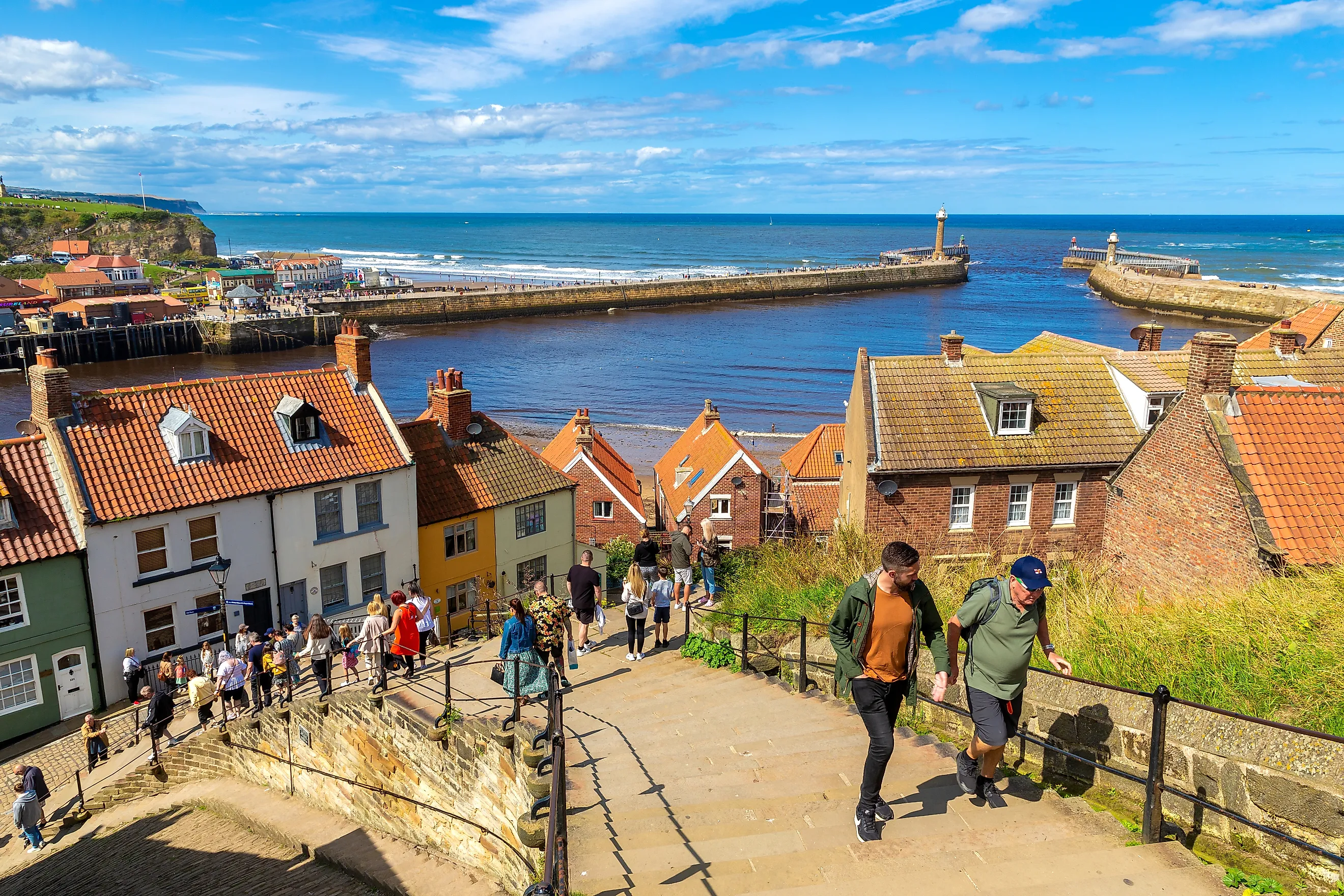
Whitby announces itself with a skyline unlike anywhere else on the Yorkshire coast: the gothic ruins of Whitby Abbey crowning the clifftop above the harbour, visible for miles before you ever reach the town. Climbing the 199 steps up to the abbey rewards you with some of the best views in North Yorkshire, and the ruins themselves feel genuinely haunting, especially in low afternoon light. The abbey's clifftop setting also inspired Bram Stoker to write Dracula here, and the town leans into that legacy with real enthusiasm, drawing visitors from around the world for its Goth weekends andatmospheric evening walks. Down below, Whitby's working harbour is lined with fish and chip shops, ice cream stalls, and fishing boats coming and going, giving the town a lively, salty energy that contrasts nicely with the quiet above. Across the swing bridge, the old town's narrow cobbled streets and yards are worth losing an hour or two in, filled with independent shops selling Whitby jet jewellery and local crafts.
Robin Hood's Bay

Robin Hood's Bay tumbles dramatically down a steep hillside to the sea, its maze of cobbled alleyways barely wide enough for two people to pass, let alone a car. Wandering down from the top of the village to the slipway feels like stepping into another century, and the village's smuggling past is still very much part of its character, locals will happily point out which cottages once hid secret passageways for moving contraband between houses. Down at the beach, fossil hunting and rockpooling are genuine highlights here, with the receding tide regularly revealing ammonites and other traces of the area's rich Jurassic geology among the rocks. The Old Coastguard Station, right at the water's edge, makes an ideal first stop, with exhibits on the coastline's geology and history alongside a café serving tea and cake with sea views. In the evenings, the village's pubs come alive with live folk music, a tradition that has held on here for decades.
Rye

Visitors who are eager to wander without much of a plan will find that Rye rewards them; the town's cobbled mediaeval streets are designed for exactly that kind of aimless exploring. Mermaid Street is the obvious starting point, lined with crooked, half timbered houses that lean into one another at odd angles, giving the whole street a fairytale quality that draws photographers from all over. Rising above the rooftops, the 13th century Ypres Tower has guarded the town since it was built to defend against French raids, and today it houses a small museum covering Rye's long history as one of England's most important Cinque Ports. Tucked down another cobbled lane, Lamb House offers a quieter, more literary stop, having once been home to novelist Henry James, whose walled garden remains a peaceful place to sit even in the height of summer. From the higher points of town, views stretch out across the surrounding marshland toward the sea, a reminder that Rye was once a working harbor town before the coastline shifted away from it.
Lavenham

Lavenham looks almost too perfectly medieval to be real, its streets lined with over 300 timber framed buildings that lean, tilt, and jetty out over the pavement in ways that seem to defy gravity. At the center of it all stands the Guildhall of Corpus Christi, one of the finest surviving timber framed buildings in the country, its carved beams and creaking floors telling the story of a village that grew rich on the medieval wool trade. A short walk down the high street brings you to the Crooked House, a dramatically tilted 14th century building and now one of the most photographed buildings in Suffolk. Look closely at the timber frames throughout the village, and you'll spot carved faces, mythical creatures, and hidden details worked into the wood by medieval carpenters showing off their skill, a self guided hunt that keeps both children and adults entertained for a wonderful hour. Fans of the big screen might also recognize a few doorways from the Harry Potter films, shot here for their genuinely untouched medieval atmosphere.
Lyme Regis

Lyme Regis has fossils built into its very identity, and nowhere is that clearer than along the beach beneath its dramatic, crumbling cliffs, where 185 million years of geological history lie exposed at your feet. Guided fossil walks led from the town's museum take visitors out onto the shore to search for ammonites and other remains, following in the footsteps of Mary Anning, the pioneering 19th century fossil hunter who made some of her greatest discoveries on these very beaches. The Cobb, Lyme's curving stone harbor wall, has stood for centuries and offers one of the most scenic short walks in Dorset, with views back over the town's pastel colored houses stacked up the hillside behind it. Beyond fossil hunting, the surrounding Jurassic Coast offers dramatic clifftop walking paths with sweeping views of the Channel in both directions. Come in summer for the town's Fossil Festival, when the whole waterfront fills with hands on activities and expert talks.
St. Ives

St Ives has drawn artists for well over a century, pulled in by a quality of light that still feels genuinely different once you're standing on one of its beaches looking out over turquoise water. Tate St Ives sits right above Porthmeor Beach, its striking modern building showing work by the artists who made the town famous, from Barbara Hepworth to Patrick Heron, with a rooftop café that adds its sweeping sea view to the visit. A short walk away, the Barbara Hepworth Museum and Sculpture Garden lets visitors wander among her sculptures in the walled garden where she actually worked, a genuinely peaceful spot tucked just behind the town's busier streets. St Ives itself has several beaches within easy walking distance of one another, each with a slightly different character, from the surf friendly swell at Porthmeor to the calmer, family friendly sands at Porthminster. Between the beaches, a maze of narrow cobbled lanes holds independent galleries, seafood restaurants, and fishermen's cottages that provide the town its distinctive, lived in charm.
What connects the 11 towns is that the view always comes with somewhere to go. In Lavenham, the medieval Guildhall and the leaning Crooked House anchor streets of carved timber frames. Hunting for the faces and creatures hidden in the beams can fill an hour on its own. Lyme Regis sends visitors to a beach below crumbling cliffs to search for fossils, with the Cobb curving out into the harbor nearby. St Ives puts a Tate gallery, Barbara Hepworth's sculpture garden, and several beaches within a few walkable streets. The gallery overlooks Porthmeor Beach, so the sea is never more than a window away. None of these towns need a long itinerary. They ask for comfortable shoes, an early start, and a willingness to follow a lane you had not planned to take. Whenever possible, visit outside the summer peak, as small towns are most enjoyable when the streets are quiet. Pick the landscape you want, then plan around the specific places each town offers.