The Oldest Subway Systems In The World
London opened the world's first underground passenger railway in 1863. Istanbul's Tünel followed in 1875 as an underground funicular, while Budapest opened its electrically operated underground railway in 1896, pioneering the innovation. Chicago's early rapid-transit network initially developed on elevated tracks, and Boston opened the first subway tunnel built for public transportation in the United States in 1897. These early systems developed in different ways, yet each contributed to the growth of urban rail transportation and has become a symbol of some of the world's most important cities today.
London Underground (1863)

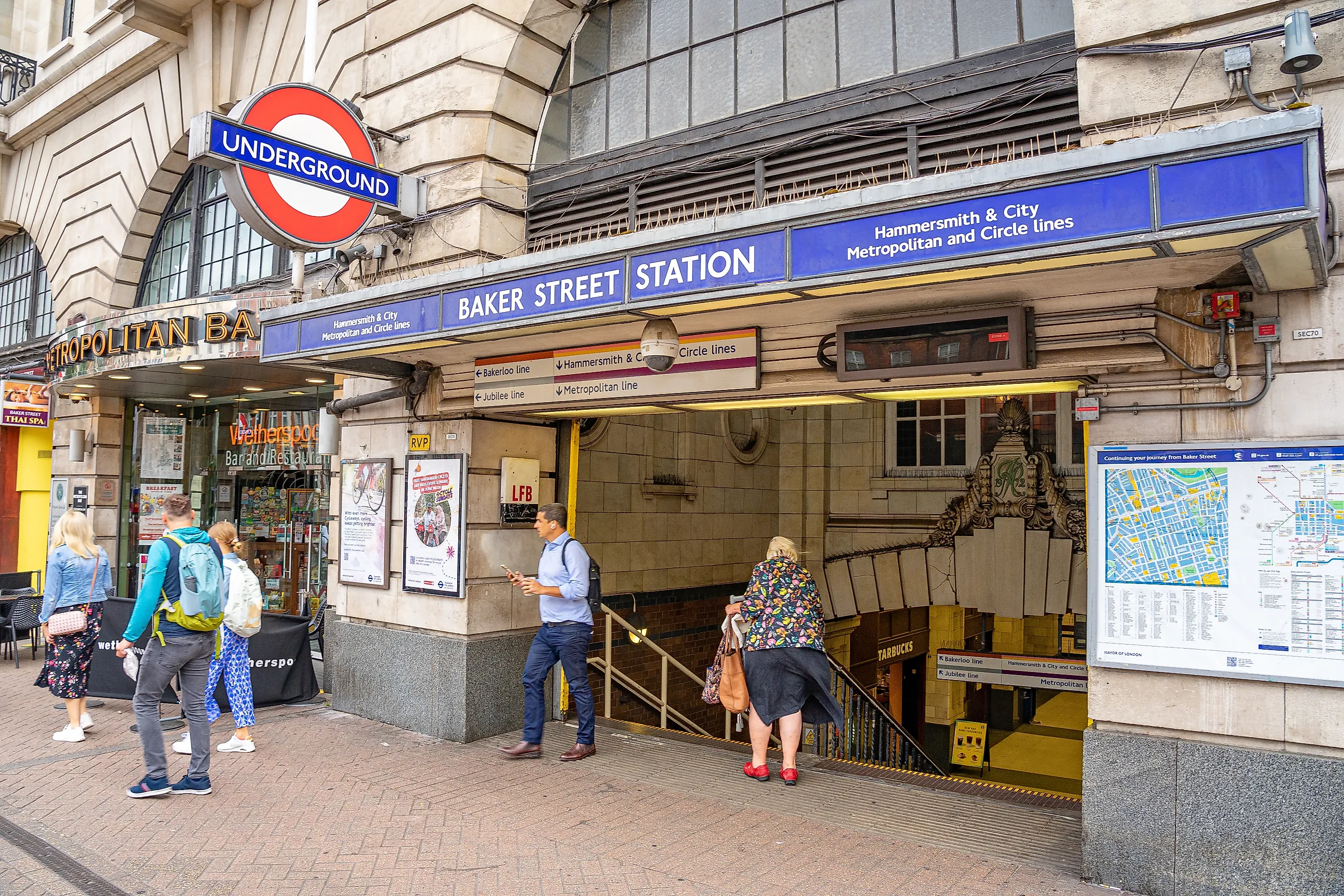
Charles Pearson, Solicitor to the City of London, promoted plans for an underground railway beginning in the 1840s as congestion in central London worsened. The Metropolitan Railway finally opened on January 10, 1863, between Paddington and Farringdon. About 40,000 passengers rode it on the first day. Chief engineer John Fowler oversaw construction using the cut-and-cover method, in which streets were excavated, the railway was built below them, and the surface was restored. Steam locomotives, initially supplied by the Great Western Railway, hauled trains between the original seven stations.
London's underground network expanded rapidly in the decades that followed. The City and South London Railway opened in 1890 as the world's first deep-level electric underground railway, while the Central London Railway opened in 1900 via circular-bored tunnels and became known as the "Twopenny Tube" because of its original flat two-pence fare. Over time, independently built railways were integrated into today's London Underground, which extends for about 402 kilometers (250 miles) and serves 272 stations. Its history is documented at the London Transport Museum in Covent Garden.
Istanbul Tünel (1875)

Istanbul's Tünel is one of the world's oldest surviving underground urban railways. French engineer Eugène-Henri Gavand proposed the route to connect the busy waterfront area of Galata, now associated with Karaköy, with the higher district of Beyoğlu. The Tünel opened on January 17, 1875, during the Ottoman period. Unlike a conventional metro line, it is an underground funicular. Its short route spared passengers the steep climb between the commercial district near the Golden Horn and the neighborhoods above it.
The line runs through a tunnel about 573 meters (1,880 feet) long beneath the steep hillside. Its original system used stationary steam power to operate a cable that moved wooden passenger cars along the route. After extensive reconstruction, Tünel reopened in 1971 with electric operation and modern vehicles. It continues to connect Karaköy and Beyoğlu within Istanbul's much larger public transportation system, which today includes metro lines, trams, buses, and ferries.
Chicago 'L' (1892)

Chicago's first rapid-transit service opened on June 6, 1892, on the South Side Elevated Railroad. The original steam-powered elevated route ran north from 39th Street toward downtown Chicago and later became part of the network now represented by sections of the Green Line. Building above streets and alleys allowed rapid-transit tracks to cross a crowded city without relying on street-level rights-of-way. Other elevated companies soon added routes, helping create the network eventually known as the Chicago "L."
Underground sections came decades later. The State Street Subway opened in 1943 and is now used by the Red Line, while the Dearborn Street Subway opened in 1951 and is used by the Blue Line. The Chicago Transit Authority lists about 18.3 kilometers (11.4 route miles) of subway in a system better known for its elevated tracks. The Red and Blue lines provide 24-hour service, making Chicago one of the relatively few major cities where parts of the rapid-transit network operate around the clock.
Budapest Metro (1896)

Budapest's Millennium Underground Railway opened on May 2, 1896, during celebrations marking 1,000 years since the Hungarian conquest of the Carpathian Basin. Built in under two years, the railway used cut-and-cover construction beneath Andrássy Avenue. It was designed for electric operation from the outset, avoiding the steam locomotives used by earlier underground railways. The historic route survives today as Metro Line M1 and remains one of the most important early examples of electric underground urban transport.
Budapest's network expanded considerably during the 20th century. The first section of Line M2 opened in 1970, with its full route completed in 1972. The city now has four metro lines. In 2002, UNESCO extended Budapest's existing World Heritage property to include Andrássy Avenue and the Millennium Underground Railway beneath it. Historic stations along M1 retain architectural details that recall the system's 19th-century origins while remaining part of the city's active transit network.
Glasgow Subway (1896)

The Glasgow Subway opened on December 14, 1896, with 15 stations arranged around a circular route. The original trains did not carry their own engines. Instead, stationary steam engines powered continuously moving cables that hauled the carriages through twin tunnels beneath the city. The railway provided an important connection between districts around the River Clyde, including the heavily industrialized area around Govan.
The system was electrified in 1935. After decades of service, it closed in 1977 for an extensive modernization program and reopened in 1980 with new trains and upgraded infrastructure. The circular route remains about 10.5 kilometers (6.5 miles) long, with trains traveling in opposite directions on inner and outer circles. A complete circuit takes roughly 24 minutes. The system's orange trains also helped inspire the enduring nickname "Clockwork Orange."
Boston MBTA Subway (1897)

By the late 19th century, congestion from horse-drawn vehicles and electric streetcars had become a serious problem in central Boston. On September 1, 1897, the Tremont Street Subway opened as the first subway built for public transportation in the United States. Its original tunnels carried streetcars beneath heavily traveled downtown streets near Boston Common, which dates to 1634 and is one of the country's oldest public parks.
Parts of the original Tremont Street Subway remain in service as part of today's Green Line. The surviving historic tunnel is recognized as a National Historic Landmark. Construction also produced an unusual archaeological discovery near the Central Burying Ground. Excavators encountered 910 sets of human remains from graves disturbed by the project. The bodies were subsequently reinterred. More than a century after the subway opened, portions of the pioneering tunnel continue to carry passengers beneath central Boston.
Paris Métro (1900)
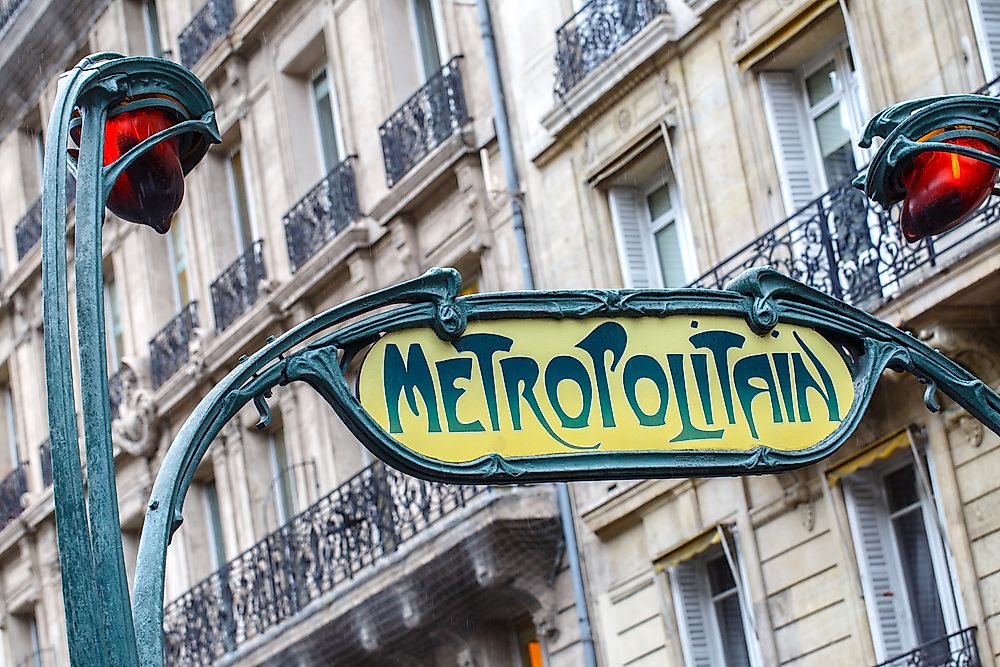
The Paris Métro opened on July 19, 1900, while the city was hosting the Exposition Universelle. The first section of Line 1 ran between Porte de Vincennes and Porte Maillot with eight stations in service on opening day. Additional stations along the route opened during the following weeks. The new railway quickly became a major part of Paris's transportation system, and the network later expanded throughout the city and into surrounding communities.
One of the system's most recognizable features came from architect Hector Guimard, whose Art Nouveau entrances introduced flowing metalwork and distinctive "Métropolitain" lettering above station stairways. Eighty-eight Guimard entrances survive, of which 86 are protected as historic monuments. The Métro now comprises 14 main numbered lines along with Lines 3bis and 7bis and extends for roughly 226 kilometers (140 miles). Paris also hosted the Games of the II Olympiad in 1900, the second modern Olympic Games.
Berlin U-Bahn (1902)
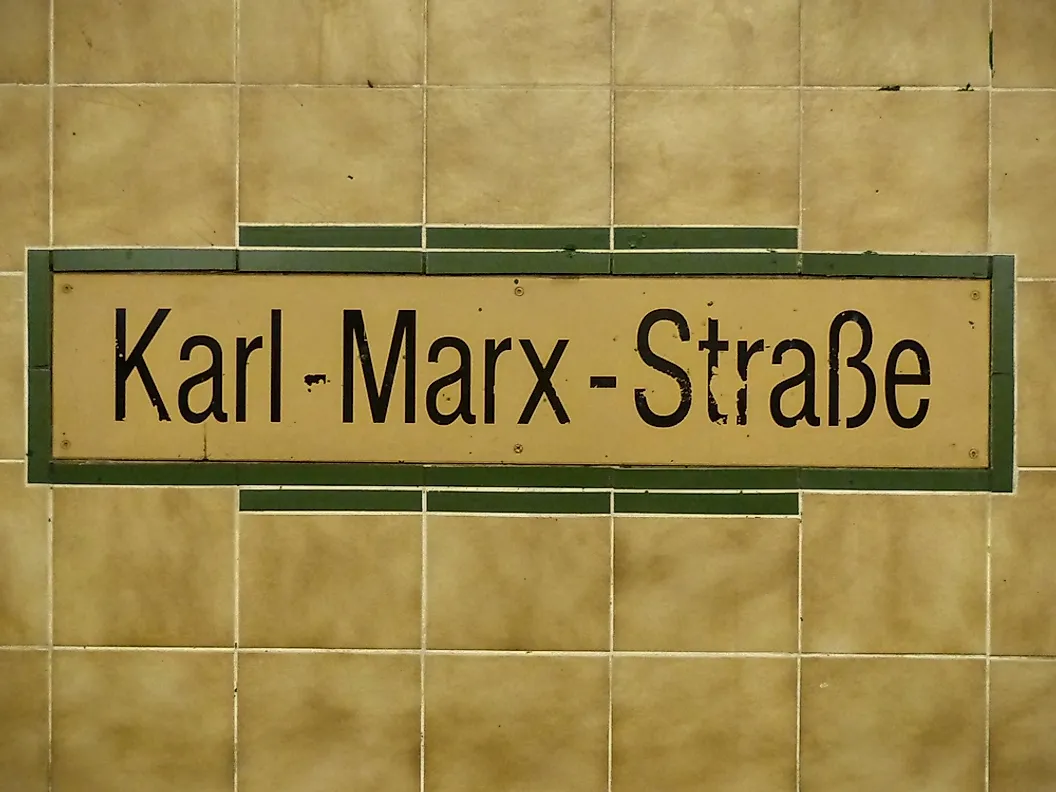
Berlin's first rapid-transit route opened on February 18, 1902, between Stralauer Tor and Potsdamer Platz. The early system combined elevated viaducts with underground sections, an arrangement reflected in the original German name Hoch- und Untergrundbahn. Today's U-Bahn has nine lines, 175 stations, and roughly 155 kilometers (96 miles) of route. Much of its early infrastructure still forms part of the modern network.
Berlin's division after World War II created one of the system's most unusual chapters. After the Berlin Wall was built in 1961, West Berlin trains on the U6 and U8 continued to pass through several stations in East Berlin without stopping. These sealed stations became known as Geisterbahnhöfe, or ghost stations. Elsewhere, the Wall interrupted service across the Oberbaum Bridge and left Warschauer Brücke station isolated from the western network. Passenger service there eventually returned in 1995 under the name Warschauer Straße. Some underground facilities in Berlin were also adapted for civil defense purposes during the 20th century.
Athens Metro (1869/1904)

The oldest part of the Athens Metro began as a conventional railway between Piraeus and Athens in 1869. Steam locomotives initially operated the route. An extension reached Omonia in 1895 and included an underground section in the city center. The railway was electrified on September 16, 1904, and eventually developed into today's Line 1. Construction of the modern Lines 2 and 3 began in 1992, and their first sections opened to passengers in January 2000.
Metro construction in Athens has required close cooperation with archaeologists because tunneling regularly encounters remains from earlier periods of the city's history. Excavations have revealed ancient roads, cemeteries, Roman baths, wells, aqueducts, and other structures. Some discoveries are displayed inside metro stations. Line 1 also underwent extensive modernization ahead of the 2004 Olympic Games. Work on the city's new Line 4 remains underway, adding another major project to a rail history that began in the 19th century.
New York City Subway (1904)

New York's rapid-transit history began before its subway tunnels. An experimental elevated railway began carrying passengers along Greenwich Street in Manhattan in 1868 and later developed into part of the Ninth Avenue elevated system. The city's first subway line opened on October 27, 1904. Its 14.6-kilometer (9.1-mile) route included 28 stations and ran from City Hall through Grand Central and Times Square before continuing north to 145th Street. The original fare was five cents.
The network grew through lines built by competing operators, principally the Interborough Rapid Transit Company and the Brooklyn Rapid Transit Company, later the Brooklyn-Manhattan Transit Corporation. The city also developed its own Independent Subway System. These networks were unified under municipal ownership in 1940. Today's subway serves 472 stations and operates around the clock, although maintenance and service changes can alter individual routes overnight. The numbered A Division routes descend from the former IRT system and use a smaller loading gauge than the lettered B Division routes.
Railways That Shaped the Modern City
The earliest underground and rapid-transit railways emerged as growing cities searched for ways to move large numbers of passengers through increasingly congested streets. London used shallow cut-and-cover tunnels, Chicago initially turned to elevated structures, and Istanbul built a short underground funicular through a steep hillside. Budapest, Glasgow, Boston, Paris, Berlin, Athens, and New York each adopted systems suited to their own geography and transportation needs.
More than a century later, these historic railways remain active parts of major public transportation networks. Some retain original tunnels and stations, while others have been repeatedly expanded and rebuilt. Their development also shows how rapidly urban transportation technology changed between the 1860s and the early 1900s, shifting from steam and cable haulage to large-scale electric rapid transit.