9 Most Quaint Small Towns in Michigan
Mackinac Island banned cars in 1898 and never got around to unbanning them. Copper Harbor has about 100 residents and sits at the very end of US-41, which otherwise runs to Miami. Charlevoix has thirty stone houses with wavy roofs that look like they grew there. Michigan has more coastline than any state but Alaska, and the small towns strung along it are stranger and more specific than the postcards suggest. Here are nine, and what each one actually has.
Mackinac Island

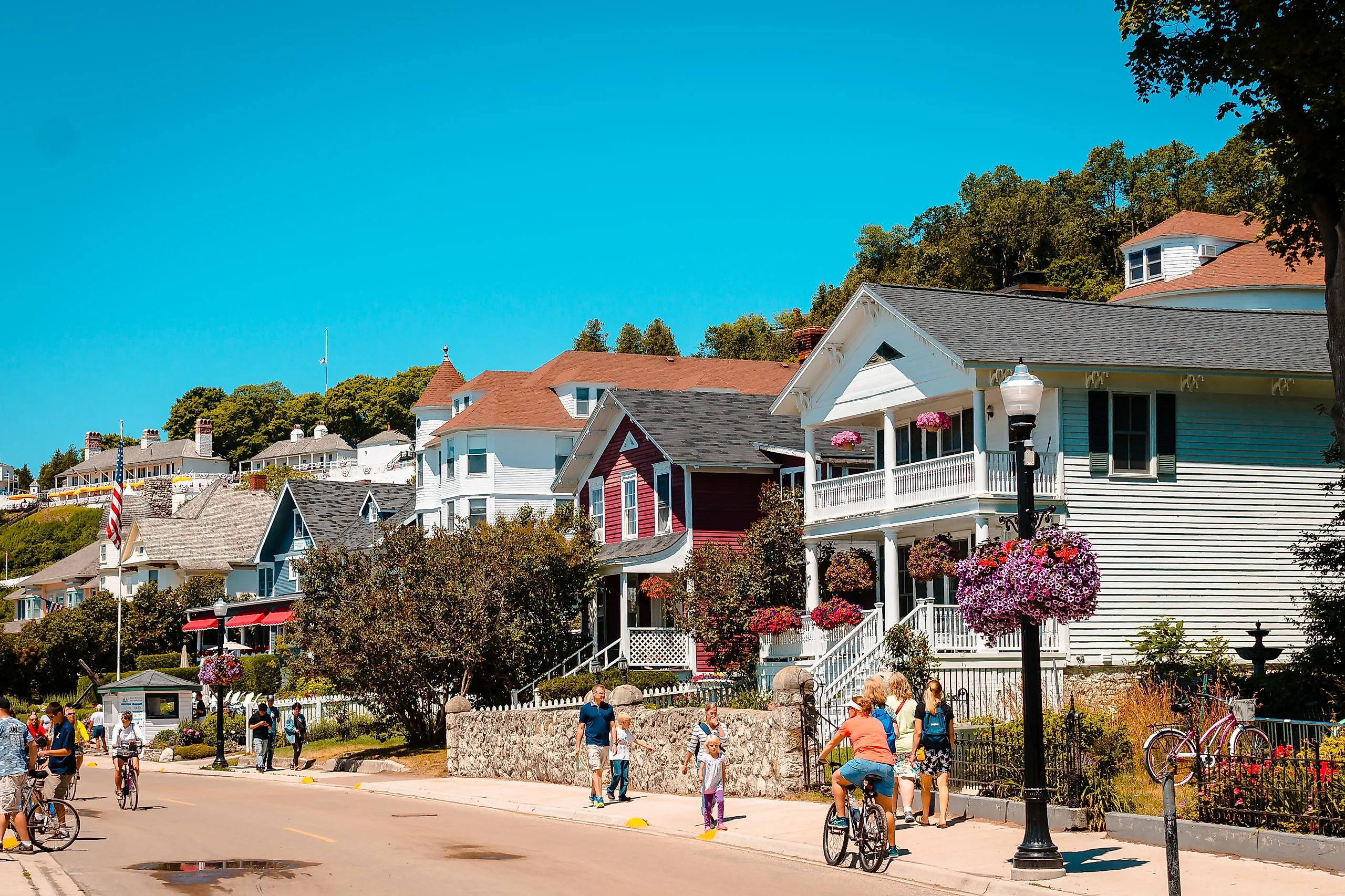
No cars. That ban has held since 1898, when the village council decided the new horseless carriages were frightening the horses, and it still holds today. Everything on Mackinac Island moves by horse, bicycle, or foot, including the freight, the ambulance, and the garbage. There are around 600 year-round residents and roughly 600 horses in season.
About 80 percent of the island is state park, the second national park in the country before it was handed to Michigan in 1895. Fort Mackinac sits above the harbor with buildings dating to the 1780s, and Arch Rock is a limestone span standing nearly 150 feet above Lake Huron. The eight-mile road around the perimeter is the only state highway in America with no motor vehicles on it.
Leland

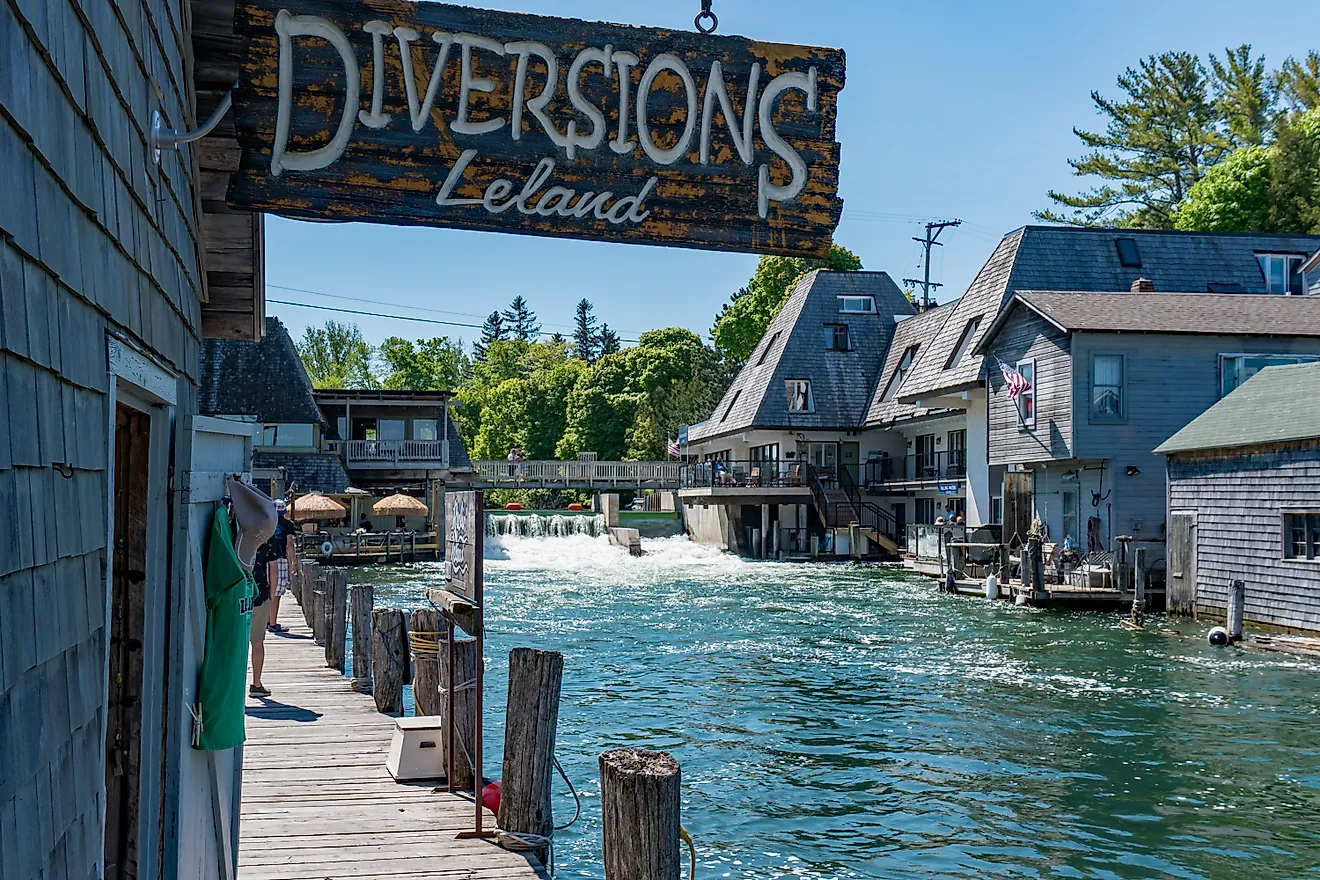
Fishtown is the reason to come. A row of weathered fishing shanties, net sheds, and docks sits on the Leland River exactly where commercial fishermen put them in the 1800s, and unlike most waterfronts of this type it was never prettified into a replica of itself. A nonprofit bought the whole thing in 2007 to keep it from being redeveloped, and working tugs still tie up there.

Fewer than 400 people live in Leland, which sits on the narrow strip between Lake Leelanau and Lake Michigan. Carlson's Fishery has been run by the same family for five generations and smokes its own whitefish. Van's Beach handles the swimming, and the Manitou Islands sit on the horizon offshore, reachable by ferry from the dock.
Charlevoix

Between 1918 and the 1970s, a self-taught builder named Earl Young put up around thirty stone houses in Charlevoix using boulders he collected himself, with undulating cedar-shake roofs that sag and curl like something out of a folk tale. Locals call them mushroom houses. Young had no architecture degree, designed around the stones rather than the other way round, and sometimes buried a boulder for years until he found the right building for it.

The houses are private, but most sit within a few walkable blocks and a self-guided map circulates in town. Beyond them, Charlevoix is wedged between three bodies of water, with the bascule bridge on Bridge Street lifting on the half hour in summer to let boats pass between Round Lake and Lake Michigan. Traffic simply waits, and everyone watches.
Frankenmuth

Franconian Lutheran missionaries founded Frankenmuth in 1845, and the town has spent the years since leaning into that harder than anywhere else in the state. Every storefront wears Bavarian half-timbering, there is a glockenspiel, and the two big restaurants have been serving family-style chicken dinners since the 1880s, to the tune of roughly a million birds a year between them.

The genuinely absurd part is Bronner's CHRISTmas Wonderland, the largest Christmas store on earth, covering more than seven acres of retail floor and open 361 days a year. It carries tens of thousands of ornaments and keeps half a million lights burning outside. There is also a covered bridge over the Cass River. Frankenmuth is among the most visited places in Michigan, which for a town of about 5,000 is a strange thing to be.
Petoskey

Petoskey gave its name to a fossil. The Petoskey stone is colonial coral that lived here around 350 million years ago when Michigan sat under a tropical sea, and the rounded pebbles wash up along this shoreline patterned with hexagons that only appear once the stone is wet. It is the state stone, and hunting for them on the beach is a genuine local pastime.
The Gaslight District downtown holds several blocks of 19th-century brick storefronts on the bluff above Little Traverse Bay. Ernest Hemingway spent his boyhood summers at the family cottage on nearby Walloon Lake and set several of the Nick Adams stories in this country. The Little Traverse History Museum occupies the old railway depot at the bottom of the hill.
Saugatuck

Saugatuck was a lumber port until the timber ran out, and then it became an art colony, largely because the School of the Art Institute of Chicago opened a summer campus called Ox-Bow here in 1910. It still runs. That century of working artists is why a town of under 1,000 supports this many galleries.

Butler Street handles the browsing. The chain ferry across the Kalamazoo River has been hand-cranked since 1838 and is the last of its kind in the country. On the far bank, Mount Baldhead is a 240-foot dune with a stairway to the top, and Oval Beach is on the Lake Michigan side below it. Saugatuck Dunes State Park covers a thousand more acres just north.
South Haven

The bright red South Pier Lighthouse at the end of its catwalk is one of the most photographed structures on Lake Michigan, and the walk out to it at sunset is the whole evening in South Haven. The town has about 4,300 residents and sits where the Black River meets the lake.
This is also blueberry country. Van Buren County grows a serious share of the nation's crop, the National Blueberry Festival takes over the town each August, and u-pick farms ring the outskirts. The Michigan Maritime Museum runs sailing trips on a replica 1800s sloop, and the Kal-Haven Trail heads 34 miles inland on an old rail bed.
Munising

Munising is the front door to Pictured Rocks, the first National Lakeshore in the country, where sandstone cliffs run 15 miles along Lake Superior and rise up to 200 feet straight out of the water. Mineral seeps stain them in bands of copper green, iron red, and manganese black, which is where the name comes from. Boat tours are the way to see them properly.
Munising Falls is a five-minute walk from a parking lot, and there are several dozen more waterfalls in the county. In winter the seeps freeze into enormous ice columns and climbers come for them. The town itself holds around 2,000 people and exists mainly to feed and house everyone heading for the cliffs, which it does without pretension.
Copper Harbor

Copper Harbor is the northernmost town in Michigan, has roughly 100 year-round residents, and sits at the end of US-41, a road that runs 2,000 miles south and ends in Miami. The Keweenaw Peninsula around it produced enormous quantities of copper in the 1800s, and Fort Wilkins was built in 1844 to keep order among the miners; it is now a state park with the original buildings standing.

Brockway Mountain Drive climbs to an overlook above the town and the lake, and the road is often described as the highest paved route between the Rockies and the Appalachians. The surrounding Keweenaw is a designated dark sky area, far enough from everything that the northern lights are a realistic prospect. Expect deep snow; this corner of the state measures its winters in feet.
Picking One
These nine share a shoreline and not much else. Mackinac Island has no cars and has not since 1898. Charlevoix has thirty houses built out of boulders by a man with no training. Frankenmuth has the largest Christmas store on the planet in a town of 5,000. Leland kept its working fish shanties instead of replacing them with a replica, and Saugatuck still hand-cranks a ferry built in 1838. Petoskey has a fossil named after it, South Haven has the blueberries, Munising has the cliffs, and Copper Harbor has a hundred people and the end of a road that starts in Florida. Pick by the oddity rather than the view, because the view is a given up here.