The Largest Temperate Rainforest On Earth
The largest temperate rainforest on Earth is the Pacific Temperate Rainforest. This rainforest stretches 2,500 miles along the Pacific coast between Alaska and northern California. It is known for its heavy rainfall, cool temperatures, and diverse plant life. These features make it a natural force unlike anywhere else on Earth. Few ecosystems can match its size or its influence on the wider world.
History

The Pacific Temperate Rainforest has a history that spans millions of years. Through the ups and downs of evolution, human interaction, and industrialization, it became the world's largest and one of its most influential ecosystems. Its distinctive climate, ecosystems, and wildlife have set it apart throughout history, allowing it to preserve ecological conditions found in few other regions. Millions of years ago, the region's cool climate provided a haven for ancient conifer trees. During the Pleistocene Glaciation, conifers, like Western Red Cedars, retreated into small, ice-free coastal pockets called "glacial refugia." When the glaciers retreated 13,000 years ago, the conifers remained and expanded into the 2,500-mile rainforest that exists today.
Geography

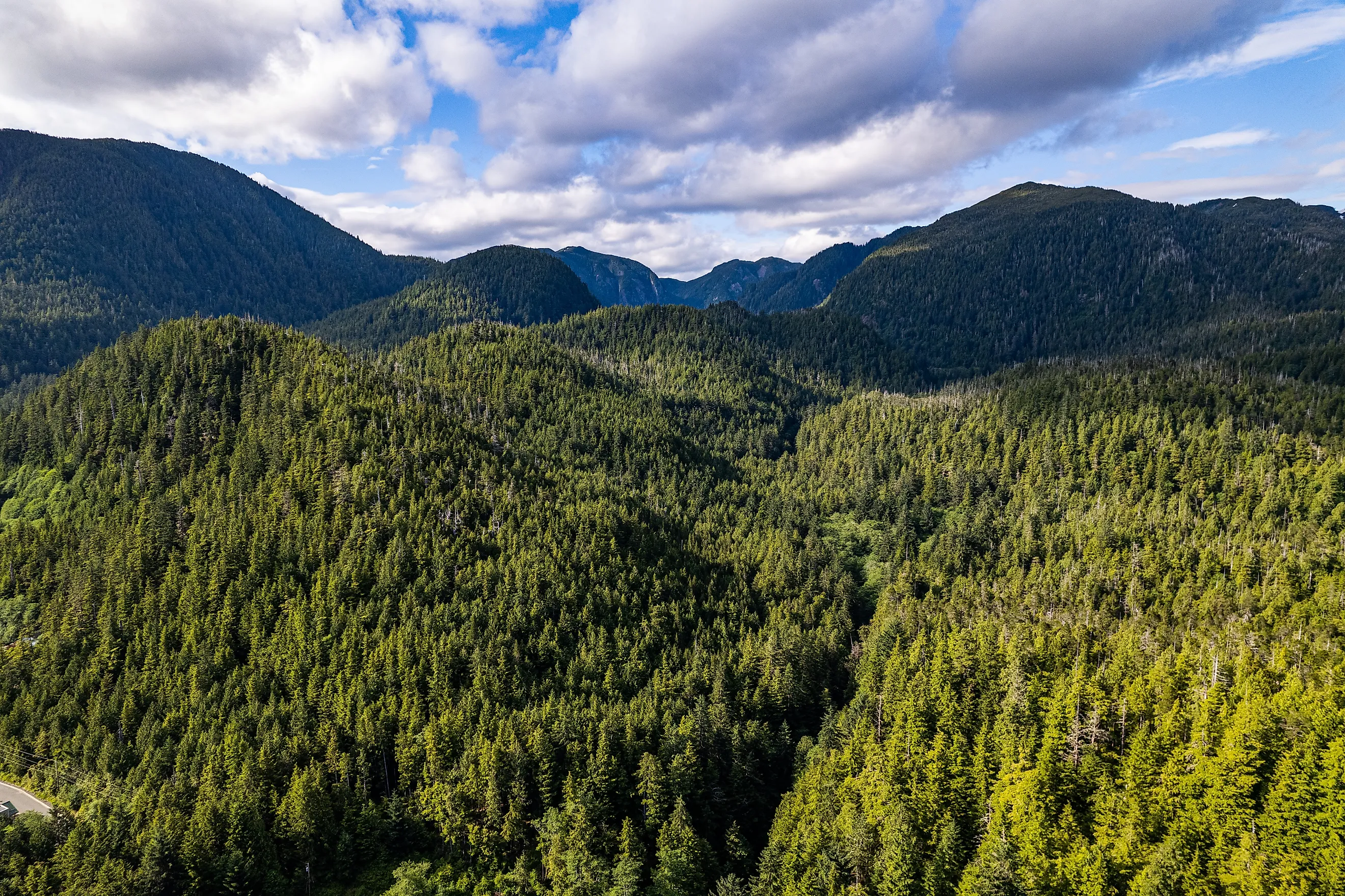
The rainforest spans thousands of miles, extending between Prince William Sound in Alaska and Cape Mendocino in California. Its proximity to the Pacific Ocean strongly influences the ecosystem. However, the region is also shaped by nearby natural landmarks, including the coastal mountains, icy glacial fjords, thousands of islands, and even volcanic peaks in the distance. This distinctive environment is further shaped by its cool climate, heavy rainfall, and foggy mist. This remarkable landscape highlights the importance of geography and the climate that sustains it.
Climate

One of the reasons this massive rainforest has endured is because of its climate. Unlike most rainforests, the Pacific Temperate Rainforest is not hot. Instead, it has a maritime climate influenced by the bordering Pacific Ocean and coastal mountains. This distinctive environment creates a stable ecosystem with mild temperatures, high precipitation, and heavy fog. Temperatures remain moderate year-round. Winters hover around 32 to 40°F, while summers average between 55° and 68°F. Rainfall is extreme, with the region receiving up to 200 inches annually. Fog is an important defense against the region's mini-droughts in the summer. The cold ocean water and warm air work to blanket the rainforest in marine fog. This helps reduce drought stress by supplying some rainforests with up to 30% of their water supply through fog drip. These characteristics work to support a complex ecosystem and diverse plant and wildlife communities.
Plants

The cold, wet climate of the rainforest supports a remarkable variety of plant life. Because of its cold environment, decomposition is slower. This slow decomposition allows it to accumulate some of the highest levels of biomass on Earth. Its vertical structure allows plants to grow at different levels throughout the rainforest. Hanging gardens, full of ferns and club mosses, grow on branches of trees, getting nutrients from the foggy air. The rainforest floor is full of mosses, shrubs, and nurse logs that provide nutrients to new trees and their seedlings. Trees, such as coast redwoods, western red cedars, and western hemlocks, dominate the rainforest with their stature, longevity, and ability to endure. Native to the region for thousands of years, these trees, particularly coast redwoods, can reach more than 350 feet. The western red cedar, called the 'tree of life,' can live more than 1,000 years and acts as a testament to the power of this vast ecosystem.
Wildlife

Wildlife inhabits the rainforest's land, sky, and sea. On land, grizzly bears, black bears, and spirit bears roam the rainforests, depending on the region's rivers and streams for food and resources. Sea wolves rely heavily on marine ecosystems. They swim between islands and hunt clams, fish, and even seals. Black-tailed deer browse through the rainforest, feeding on plants and shrubs. In the waterways and forest floor, amphibians such as the Olympic torrent salamander thrive in cold streams, while Pacific banana slugs move across the rainforest floor feeding on decaying plants and leaves. From the sky, bald eagles and waterbirds feed, hunt, and nest throughout the rainforest's rivers, trees, and coasts.
Conservation Efforts

Understanding the significance of plants and wildlife highlights the need for their conservation. Climate change and modernization have greatly affected the condition of the Pacific Temperate Rainforest. Natural conditions alone were not responsible for sustaining the enduring rainforest. As the climate became milder, Indigenous people played a large role in protecting the newly temperate region. Indigenous groups, such as the Tlingit and Haida, practiced cultural burning to clear out dead trees. They also built forest gardens and harvested bark from living trees. These proactive decisions worked to encourage healthy forest growth, cultivate wildlife, and ensure survival despite weather changes.
In the late 18th and 19th centuries, human settlement threatened the well-being of the rainforest. During the 19th century logging boom, important trees, like Western Red Cedar, became targets of mass destruction. Later inventions, such as chainsaws, accelerated logging and clear-cutting practices. Through this process, logging companies removed most of the rainforest's original trees, displacing animals and removing essential habitats. Today, only a small portion of the original rainforest remains.
From a contemporary lens, there have been many efforts to fix and prevent this kind of tree destruction. In the 1990s, there were intense efforts and protests to protect wildlife and prevent clear-cutting. Conservation debates ensued over endangered animals, like the Northern Spotted Owl, throughout Washington. International headlines also followed the War in the Woods over clear-cutting throughout the massive rainforest. The outrage led to the 1994 Northwest Forest Plan to prevent clear-cutting and logging in the protected areas. In 2016, an even more prominent protection took place. The Canadian government, British Columbia, and First Nations expanded protections for nearly 85% of the Great Bear Rainforest. The 1994 Northwest Forest Plan remains in effect, and the U.S. Forest Service is currently revising it to address wildfire resilience, old-growth forests, and species protection. A final decision on that amendment is expected in early 2028. There are also mass movements to include tribal groups in laws and practices concerning the home they've always known.
Wrapping Up
The Pacific Temperate Rainforest is a biological marvel. Spanning 2,500 miles, it truly is the largest temperate rainforest on Earth. Full of history, biodiversity, and sheer resilience, it showcases the complexity of nature and why it is worthy of protection. Trees, wildlife, and the people who live there contribute to the ecological health of the greater world. A true force of nature, its importance extends beyond its remarkable size.