The Most Beautiful Rainforests In The United States
Say "rainforest" and most people picture the Amazon, not the United States. But the country has several, and they are stranger and more scattered than you would guess. Two sit up in Alaska, of all places, one clings to the coast of Washington, and one steams away in the tropics of Puerto Rico. Here is the thing that surprises people: a forest only has to be wet to qualify, not warm. That single fact is why frozen Alaska has rainforests and sweaty Florida does not. Here are four of the most beautiful, and what makes each one worth the trip.
Tongass National Forest, Alaska

The Tongass is the big one, in every sense. Sprawling across 16.7 million acres of southeast Alaska, it is the largest national forest in the country and the largest intact temperate rainforest on Earth. Theodore Roosevelt set it aside in 1907, stitching it together from the older Alexander Archipelago Forest Reserve, and the scale is hard to wrap your head around: this single forest covers most of the Alaska panhandle.
Its history is not all scenery, though. The Tlingit and Haida peoples have lived here for thousands of years, and when the U.S. created the forest it effectively took the land out from under them. A court agreed, and in 1968 the government paid the tribes $7.5 million, a settlement that valued the whole Tongass at roughly 43 cents an acre. The forest was also hammered by industrial logging in the 1950s, when two pulp companies cornered the timber market until lawsuits in the 1970s started reining them in.

Today the Tongass soaks up around 110 inches of rain a year and holds 19 designated wilderness areas, more than any other national forest. About 70,000 people live in and around it, and a lot of them depend on the visitors who arrive by cruise ship to hike, camp, soak in hot springs, and watch bears swat salmon out of the waterfalls. There are even limestone caves threaded through the bedrock, some so remote that the spelunkers exploring them are likely the first humans to ever set foot inside.
Hoh Rainforest, Washington

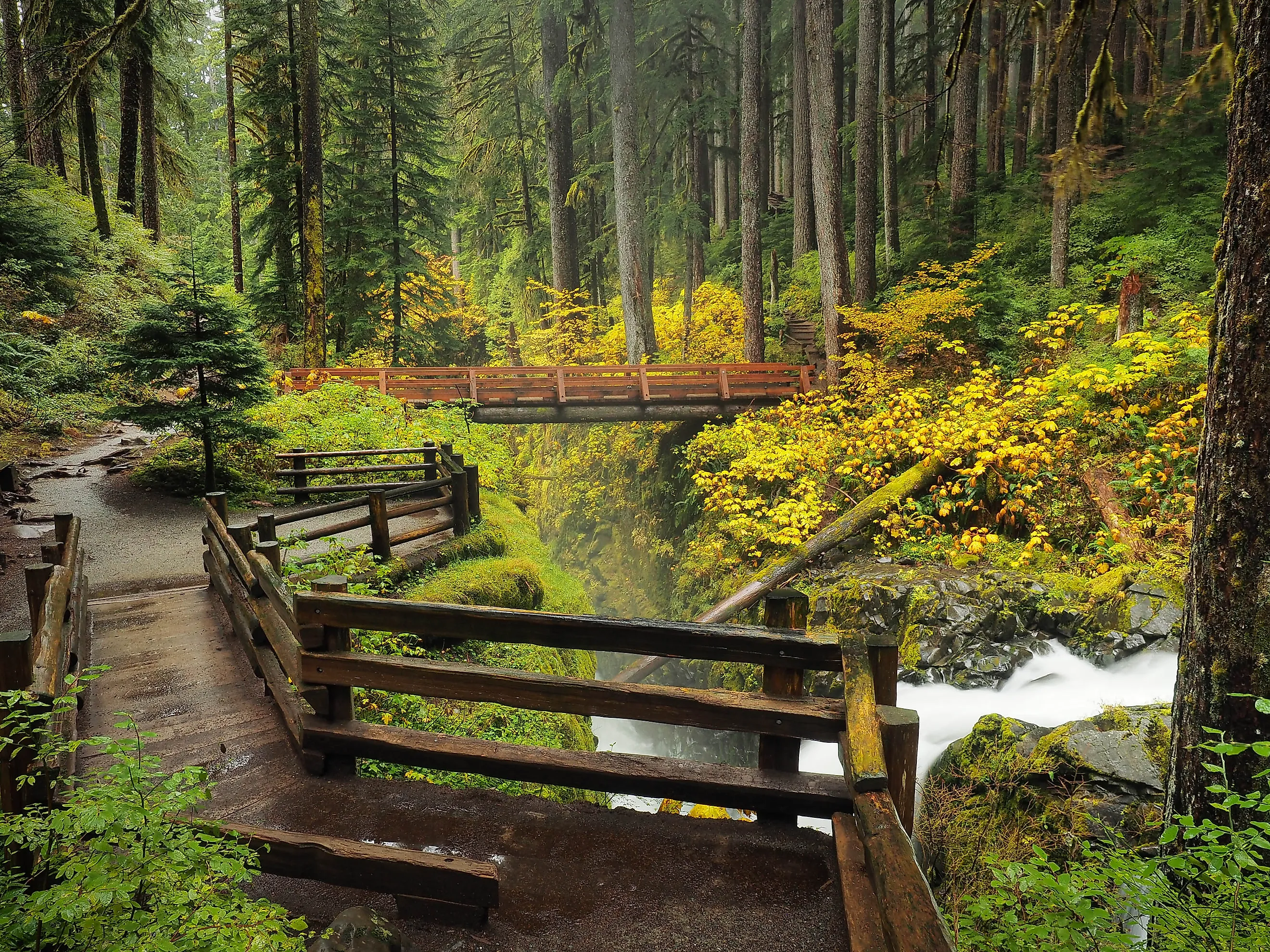
Drop down to Washington's Olympic Peninsula and you hit the Hoh, the rainforest most Americans actually picture when they finally believe the country has one. Carved by glaciers and strung along the Hoh River, it is a green so total it feels staged: moss drips from every branch, and the Sitka spruce and western hemlock grow to sizes that make you feel very small and very temporary. Look for western red cedar, black cottonwood, and bigleaf maple in the mix too.
The climate is mild and famously soggy, with roughly 100 inches of rain a year, summer highs around 65°F, and winters that rarely freeze. Pack rain gear and assume you will use it. The nearby coast adds sea-stack islands sheared off the mainland by erosion, and the trails serve up ridges and waterfalls worth the wet socks. Two oddities reward the curious: the Monarch, once one of the largest Sitka spruces on the planet until a storm finally toppled it, and a moss-swallowed phone booth deep in the green that has become an unofficial photo stop. Keep an eye out for cougars and black bears, and read the visitor-center signs on what to do if you meet one.
Chugach National Forest, Alaska

Back to Alaska for the country's second-largest national forest. The Chugach is a tangle of mountains, lakes, and coastline carved by glaciers, some of which were still advancing during the Little Ice Age between 1303 and 1850. People have wanted this land for a long time: the Alutiiq made homes here thousands of years ago, Russian fur traders moved in during the 1700s, and a gold rush followed not long after the U.S. bought Alaska in 1867. It has been federally protected since 1892, which today shields about 6.9 million acres of shoreline, forest, and wildlife.

This is a temperate rainforest too, drinking in about 167 inches of precipitation a year, including 80 inches of snow that melts into the streams and feeds the warmer-season landscape. The temperatures are gentler than Alaska's reputation suggests, swinging between 17°F and a downright pleasant 63°F. With so little of the land touched by people (only about 2% sees any logging), wildlife thrives: Dall sheep, moose, bears, timber wolves, and humpback whales offshore. The supervisor's office sits in Anchorage, with rangers reachable in Girdwood, Seward, and Cordova, and mining and tourism keep the local economy running.
El Yunque National Forest, Puerto Rico

Finally, the one that looks the part. El Yunque, in Puerto Rico, is the only tropical rainforest in the U.S. National Forest System, and it wears the title proudly. Spread across roughly 44 square miles of the Sierra de Luquillo mountains, it was sacred ground to the Taíno, who left petroglyphs across the forest and believed their gods lived in these peaks. It is a riot of Caribbean life: the tiny coquí frog whose two-note call is basically Puerto Rico's national soundtrack, the endangered Puerto Rican parrot, and boa constrictors that mostly want to be left alone, so do them the favor.

The trails range from gentle to genuinely demanding and thread through four distinct ecological zones, so the scenery shifts as you climb. Many of them end at the kind of payoff that sells the whole trip: a waterfall pool you can swim in, like La Mina Falls or the spot near Juan Diego. Just respect the closures, because El Yunque earns its name. More than 200 inches of rain fall here every year, over 100 billion gallons, and that water occasionally shuts trails down when flooding rolls through. That deluge is exactly what makes the place so impossibly green.
Wet, Not Warm
The four could hardly feel more different: the cathedral hush of the Hoh, the glacial sweep of the Chugach, the sheer scale of the Tongass, the tropical buzz of El Yunque. What unites them is nothing more exotic than rainfall, which is the quiet lesson here. A rainforest is defined by how much water falls on it, not how hot it gets, which is why two of the country's best sit in Alaska and none sit in steamy Florida. The map still hides surprises like these, hidden in corners nobody thinks to look.