The 10 Can't-Miss Towns On The Pacific Coast
Most Pacific Coast towns have a beach and a lighthouse, so the bar for a can't-miss stop is higher here than anywhere else in the country. Brookings, Oregon, is on the list for winters warm enough to grow palm trees and a shoreline of natural stone arches reached by short trails. In Depoe Bay, gray whales surface so close to the seawall that people on the sidewalk hear them exhale. Winchester Bay has sand dunes up to 500 feet tall, among the highest coastal dunes anywhere. Muir Beach, California, has 258-foot redwoods three miles from the sand, and the 1929 ballroom in Avalon once held 6,200 dancers in a single night on an island where nearly everyone gets around by golf cart.
Ketchikan, Alaska

An infamous "bridge to nowhere" intended to link Ketchikan, Alaska, with the town's international airport on Gravina Island was cancelled after the project became a national symbol of pork-barrel spending in Congress. Ketchikan remains an isolated community without roads linking it to the rest of North America. Despite the difficulty in getting here, Ketchikan is a can't miss Pacific Coast town because it is home to the Great Alaskan Lumberjack Show. Drawing on the state's logging history, lumberjacks show off their skills, strength, and dexterity while competing in 12 events with chainsaws and axes. The 475-seat arena sits on the grounds of the former Ketchikan Spruce Mill, a short walk from the cruise ship docks along the waterfront.
On the edge of town, Saxman Totem Park displays about 25 totem poles, most of them replicas of older poles gathered from villages around Southeast Alaska. Tlingit, Haida, and Tsimshian carvers raised totems to record the history of their ancestors and clan narratives for later generations. In Saxman, visitors can take self-guided tours of the open-air park and watch carvers at work in the adjacent carving center.
In town, the Tongass Historical Museum covers local history, with commercial logging and the fossil beds along the coastline among the subjects. The museum's archive holds a wide selection of objects, artifacts, and photographs illustrating the lives of the people who have lived here and the essential role logging played in the community.
Port Angeles, Washington

Port Angeles, Washington, is the main gateway to Olympic National Park, where visitors will find almost one million acres of wilderness, glaciers, and old-growth forests. The Olympic National Park Visitor Center in town has park information, exhibits on local ecosystems, and a theater showing a 22-minute film about the park. Two short hikes start at the visitor center, the Peabody Creek loop, a half mile, and the Living Forest Trail, a 0.4-mile loop, both open year round.
Head deeper into the park with a guided tour from an outfitter like Olympic Hiking Co., which runs day hikes, backpacking trips, and shuttle services to trailheads. The company operates shuttle routes throughout the Olympic Mountains, and custom tours can be arranged as well.
Along the waterfront, the Olympic Coast Discovery Center covers the Olympic Coast National Marine Sanctuary, with exhibits on maritime heritage and on the technology used to explore the ocean floor. The center has information on local marine sanctuaries and ecosystems and on where to find the best viewing spots to see whales.
Depoe Bay, Oregon

The rocky coastline of Depoe Bay, Oregon, has what has been called the World's Smallest Harbor. Accessed by a natural 50-foot wide, 100-foot long channel, the 6-acre harbor protects a pint-sized marina. The diminutive harbor is a great place to book a whale watching tour from The Whale's Tail Charters. The company's low-to-the-water boats provide close-up views of the wildlife on 60- and 90-minute cruises.
Spotting whales from the coastline along Depoe Bay is common, and the Oregon State Parks Whale Watching Center sits directly on the seawall near the harbor entrance. The 1956 building closed in August 2026 for roof repairs, with Oregon Parks and Recreation expecting to reopen it in time for the winter migration. While the center is closed, whales can still be spotted from the turnout a block to the north and from the seawall promenade along Highway 101 through town. At the peak of the migration season, thousands of gray whales pass Depoe Bay after leaving Alaska on their way to the lagoons of Baja California. Other species, like humpback whales, orcas, dolphins, and even the rare blue whale have been seen from Depoe Bay, making it an exceptional place to view the huge creatures.
The coastline around Depoe Bay has other viewing points, both for spotting whales and for the craggy shore itself. Boiler Bay State Scenic Viewpoint, about a mile north of town, has a dedicated parking lot on a point that juts out into the ocean, allowing visitors to look back on the surf crashing into the coastline. Rocky Creek State Scenic Viewpoint and Cape Foulweather, a few miles south, are the other state-maintained lookouts.
Newport, Oregon

About a dozen miles down Highway 101 from Depoe Bay, Newport, Oregon, is home to the Oregon Coast Aquarium, where visitors can have a personal encounter with an octopus or take a behind-the-scenes tour observing staff caring for sharks, seals, and seabirds. Outdoor enclosures include sea otters, harbor seals, sea lions, and a seabird aviary filled with puffins, while the indoor galleries recreate the sandy coast, the rocky coast, and the offshore waters of Oregon. The signature experience is Passages of the Deep, a series of acrylic tunnels that allow visitors to see the exhibits from below, moving through three habitats modeled on Orford Reef, Halibut Flats, and the open sea.
Near the aquarium, the Hatfield Marine Science Center conducts marine research as part of Oregon State University, but also has an educational and outreach program where visitors can learn about the local marine environment. The visitor center includes family-friendly, hands-on exhibits exploring wave action and coastal fog, and even includes a research vessel simulator. The Yaquina Bay Estuary Trail begins at the parking lot. The trail follows the southern shoreline for just under a mile. Beginning at a rocky jetty, the trail passes tidal mudflats before becoming an elevated boardwalk with views across the estuary.
Winchester Bay, Oregon

Surrounding Winchester Bay, Oregon, the Oregon Dunes National Recreation Area includes one of the largest coastal sand dune formations in the world. The landscape extends 40 miles along the Pacific Ocean, with some dunes reaching as high as 500 feet, making Winchester Bay a place that can't be missed. South of town, the John Dellenback Trail crosses the dunes. The trailhead begins in a conifer forest and travels about 2.7 miles to the beach.
Closer to town, the Umpqua River Lighthouse Museum offers tours of the lighthouse, which was first lit in 1894. It replaced an 1857 original, the first lighthouse on the Oregon coast, which stood on the sand at the river mouth until floods undermined it and it toppled in the 1860s. The 65-foot tall tower emits distinctive red and white flashes through a 2-ton Fresnel lens with 616 glass prisms, hand cut in Paris in 1890. Next to the lighthouse in the former lifesaving station, the maritime museum includes artifacts, photographs, and model ships. Nearby, the Lake Marie trail circles Lake Marie in Umpqua Lighthouse State Park, beginning at a sandy swimming beach and providing access for fishing along the path. The sand dunes can be reached by a connecting trail.
Brookings, Oregon

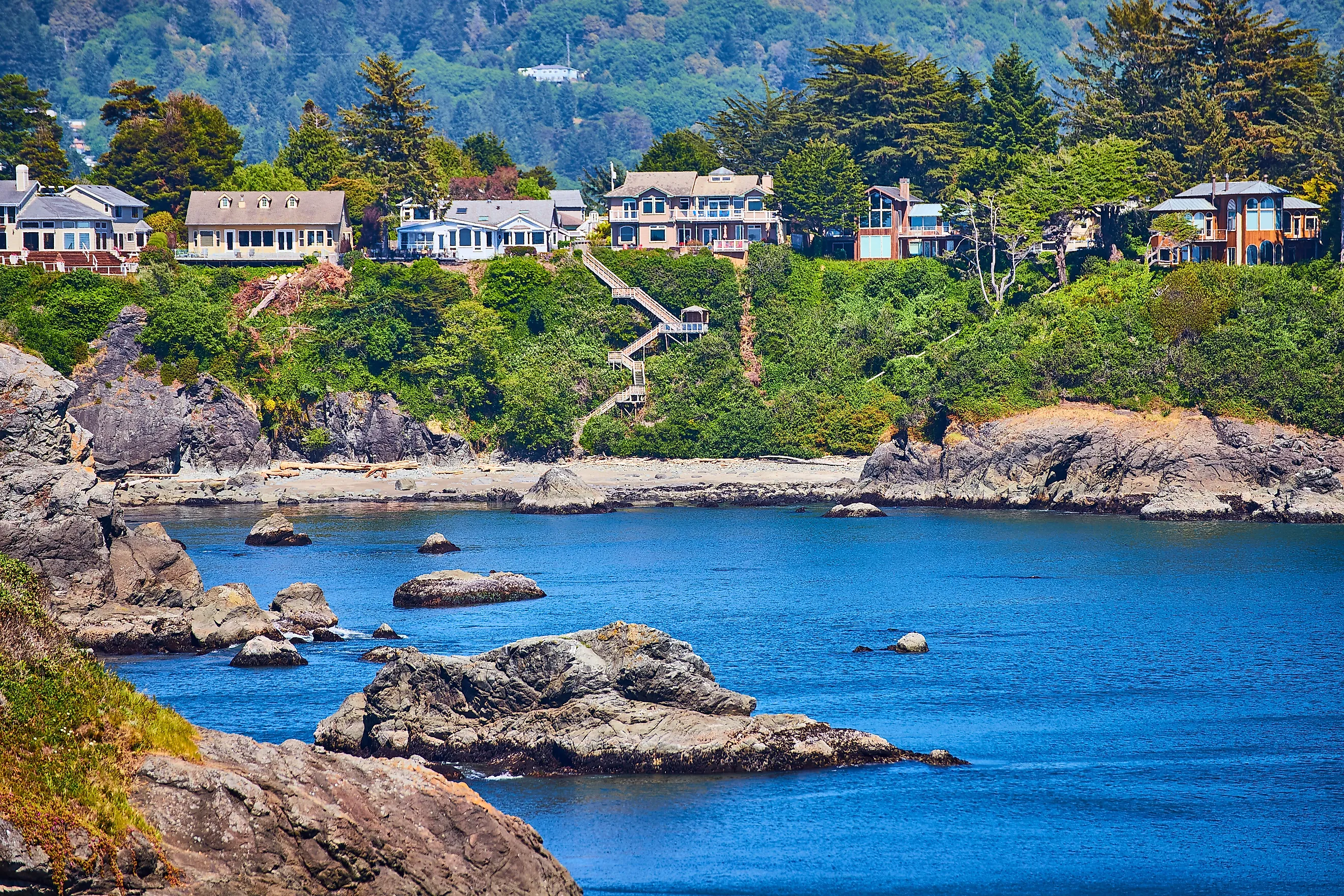
Part of Oregon's "Banana Belt," Brookings, Oregon, has an unusually mild microclimate compared to surrounding areas, with warmer winters, mild summers, and extra sunny days. But what really makes this a can't miss destination is the rocky shoreline's naturally formed stone arches. The Samuel H. Boardman State Scenic Corridor runs 12 miles along the coast between Brookings and Gold Beach, with turnoffs along the route providing viewing points.
Parking at the Arch Rock Viewpoint and Picnic Area, at the north end of the corridor, provides access to views of Arch Rock, a naturally formed stone bridge standing alone in the Pacific Ocean. A looping trail connects the parking lot with the cliff's edge. The Natural Bridges Viewpoint, a few miles south, overlooks a cluster of arched sea stacks, the remnants of collapsed sea caves. Another view can be found at the Cape Ferrelo Viewpoint, where a looping trail leads to the tip of the cape with views of rocky crags sticking out of the ocean and cliffs plunging into the surf. All together, there are more than a dozen trailheads throughout the scenic corridor.
Closer to town, Chetco Point Park includes hiking trails onto the bluff overlooking the harbor. During migration season, it makes a great vantage point for spotting whales. The park also has a sandy beach and picnic tables, and Harris Beach State Park, just north of downtown, has its own Arch Rock sheltering a protected tide pool area at the south end of the beach.
Trinidad, California

On New Year's Eve, 1914, a wave roughly 200 feet high washed across the headland at Trinidad, California, engulfing the 25-foot tall lighthouse perched on the edge of a 175-foot cliff. Lighthouse keeper Fred Harrington happened to be in the lens room when the wave crashed ashore, covering the light entirely, and spilling up toward the peak of Trinidad Head, a rocky promontory along the Pacific Coast. Today, hikers can reach the Trinidad Head Lighthouse on foot along Lighthouse Road.
The Trinidad Head trail goes higher, up to the 380-foot peak of Trinidad Head. On the way to the peak, visitors pass a cross marking the expedition of Bruno de Hezeta, who landed at the bay in 1775. The current granite cross dates to 1913, installed by the Club Women of Humboldt County.
Just to the north of Trinidad, Redwood National Park protects an ecosystem of very tall trees. The Tall Trees Grove is filled with trees as high as 350 feet. The 4.5-mile roundtrip hike can be strenuous and requires a free permit to limit the total number of visitors. The nearby Lady Bird Johnson Grove is easier to reach on a 1.5-mile loop.
Muir Beach, California

The seaside community of Muir Beach sits just 3 miles from Muir Woods National Monument. Congressman William Kent bought the stand of old-growth coast redwoods in 1905 to keep it from being logged, donated it to the federal government, and asked that it be named for naturalist John Muir. President Theodore Roosevelt proclaimed it a national monument in 1908. The tallest tree in the grove stands 258 feet high, and the canopy creates a cool microclimate on the forest floor. The park contains three main loops that connect from the visitor center, with the boardwalk along Redwood Creek the flattest and smoothest of the paths. To reach the grove, the National Park Service now requires reservations for parking or a seat on the shuttle.
Surrounding Muir Woods, Mount Tamalpais State Park has a collection of trails that tend to have fewer visitors, though these can be more challenging than the national monument paths. Hiking to the upper mountain of Mount Tamalpais provides wide vistas overlooking the Farallon Islands and even San Francisco Bay.
Part of the Golden Gate National Recreation Area, Muir Beach includes a sandy cove and connects to the Coastal Trail that crosses the grasslands to the south. A 450-foot pedestrian bridge links the parking lot to the beach and trail system.
Half Moon Bay, California

Visitors to Half Moon Bay come for two reasons, big wave surfing and big pumpkins. Just to the north of Half Moon Bay, surfers at Mavericks ride waves that can top 60 feet in a big winter swell. An underwater rock reef off Pillar Point focuses the energy of North Pacific storms into the break. The invitation-only Mavericks contest, which gave 24 surfers a day's notice to fly in when conditions lined up, has not run since 2016, and the break's best rides are now judged on video through the Mavericks Surf Awards each season. Pillar Point overlooking the surf provides a great vantage point to watch surfers and can be reached on the half-mile West Shoreline Access trail.
The big pumpkins arrive each October for the Half Moon Bay Art & Pumpkin Festival. The festival week opens with the Safeway World Championship Pumpkin Weigh-Off, where the event record of 2,749 pounds was set in 2023. In addition to music, food, and artisan vendors, there is a pumpkin carving contest and costume contest. The Great Pumpkin Parade rolls through town with marching bands, historic cars, and giant pumpkins.
On the edge of town, Repetto's Pumpkin Farm hosts hayrides, a seasonal corn maze, and a pumpkin patch filled with inexpensive pumpkins in a variety of colors and shapes.
Avalon, California

The waitlist to bring a car to Avalon, California, is at least 20 years long, and most residents of Catalina Island get around on golf carts. The island's interior can be toured overland with the Catalina Island Conservancy, whose licensed vehicles cross the rugged backcountry on routes closed to private cars. Catalina Island is also home to a herd of bison, originally brought to the island for a 1924 film shoot, but now managed by the conservancy.
The island is also home to the world's largest circular ballroom without supporting pillars. Measuring 20,000 square feet, the Catalina Casino Ballroom has a 180-foot dance floor, and the record crowd came on May 8, 1940, when 6,200 people danced to Kay Kyser's band. The 12-story art deco building opened in 1929 and hosted big bands throughout the 1930s and 1940s. Today it mainly serves private functions like weddings, but does host public events like the JazzTrax Festival and the Catalina Film Festival.
And yes, there is a Catalina Wine Mixer. Inspired by the movie Step Brothers, the Catalina Wine Mixer launched in 2015 and is now held at the end of May. The weekend includes a screening of the film at the Avalon Theatre inside the Casino, as well as wine tastings, a beach party at Descanso Beach Club, and live music.
Must See Sights Across the Pacific Coast
The best month to visit depends on the town. The Ketchikan lumberjack show only runs during the cruise season, and the Half Moon Bay weigh-off lands on a single October morning, so Alaska is a summer trip and the pumpkins are an autumn one. The whale calendar is the reverse, with the southbound gray whale migration off Depoe Bay peaking in late December and the northbound run in late March, which also happens to be when the Mavericks swells are at their biggest. Trinidad Head, the Umpqua River Lighthouse, and the Catalina Casino are open in any month, and the redwoods at Muir Woods and the Tall Trees Grove look much the same in January as they do in July.