9 Towns In The Ozarks That Transport You To The Past
The Ozarks earned a reputation for natural beauty long before anyone started counting tourist dollars, but the region's small towns hold their own as windows into the American past. Mineral springs drew thousands to Eureka Springs in the 1880s and built the Victorian downtown that still stands today. Carthage and Eminence both got burned during the Civil War and rebuilt with the architecture that survives in their squares now. Branson packs an 1880s-themed amusement park into a town better known for live music. The nine towns ahead pair preserved history with the landscape that shaped it.
Eureka Springs, Arkansas

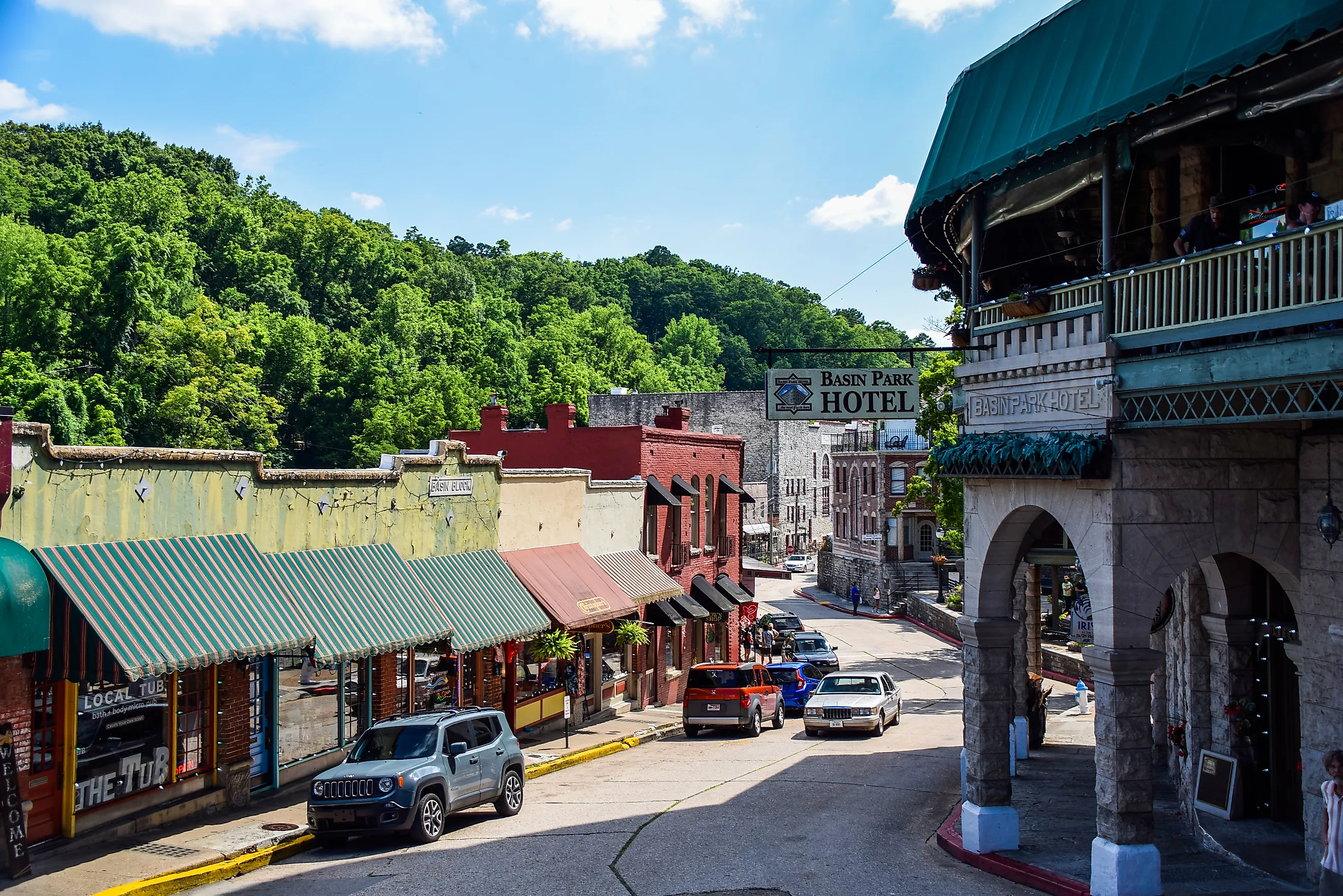
Eureka Springs has been a tourist town since 1879, when word spread that the area's mineral springs held medicinal properties. The springs still feature at Basin Spring Park and other small pocket parks downtown, though the appeal now is more historical than therapeutic. The Basin Park Hotel, one of the town's five hotels predating 1906, still operates on the main square.
The Eureka Springs Historic District holds more than 60 buildings on the National Register of Historic Places, the largest historic district in Arkansas. The district became the first Arkansas historic district listed on the National Register in 1970. Victorian-era homes in the residential districts climb the hillsides above downtown. Open-air trams run regular Eureka Springs Historical District tours, and the 90-minute Downtown-N-Underground walking tour covers the unusual basement-level passageways that connect parts of the historic district, including a former underground bathhouse. The Eureka Springs Historical Museum on Main Street fills in the gaps above ground.
Eminence, Missouri

Eminence in Missouri was founded in 1841 just north of the Current River and burned during the Civil War. The town rebuilt along the Jacks Fork River in 1868 and remains a launch point for the spring-fed waterways that define the Ozark National Scenic Riverways. Big Spring, the largest spring in Missouri at an average daily discharge of 286 million gallons, is one of the largest single-outlet springs in the United States. Round Spring Cave is part of the same National Park Service unit and originally entered Missouri's state park system in 1932.
Alley Spring is the photogenic one in the bunch, with turquoise water and a bright red 1894 grist mill that still stands on the bank. The mill is no longer operational, but interior tours run during the visitor season. Visitors can rent canoes and kayaks from local outfitters in Eminence and drift downstream past additional springs, gravel bars, and limestone bluffs along the Current and Jacks Fork. The town leans hard into horseback tourism too, with the Cross Country Trail Ride and Eminence Trail Ride events drawing thousands of riders to the region each year.
Mansfield, Missouri

Mansfield sits about two hours west of Eminence and runs on a literary anchor that draws fans from across the country. Laura Ingalls Wilder moved to a farm outside Mansfield in 1894 with her husband Almanzo and daughter Rose, and she lived there for the rest of her life. She wrote the entire Little House on the Prairie book series at the Mansfield farm, beginning in the late 1920s when she was already in her sixties.
The Laura Ingalls Wilder Home & Museum preserves the original Rocky Ridge Farmhouse (built and continuously modified by Almanzo) and the Rock House nearby (built in 1928). The museum runs tours of both buildings and houses a substantial collection of Wilder family artifacts including the original manuscript of Little House in the Big Woods. Baker Creek Heirloom Seeds runs Bakersville Pioneer Village a few miles outside town, with a working seed store, a Victorian-style farmhouse restaurant, and a recreated 19th-century village built around heritage farming.
Ozark, Arkansas

Back in Arkansas, Ozark is one of the state's oldest towns. Founded in 1836 at the northernmost bend in the Arkansas River, the name itself comes from the French phrase "Aux Arcs," used by French traders to describe the bend in the river. Union troops burned all but three of the town's homes during the Civil War and Ozark lost its incorporated status, which was restored in 1869. The town rebuilt through the 1870s with banks, general stores, and saloons that occupied the central square.
The Ozark Courthouse Square Historic District covers a two-block-by-two-block area where most buildings date between 1890 and 1930. Brick and quarried-stone construction defines the district, accented by 60 antique-replica streetlights. The Franklin County Courthouse and the Bristow Hotel anchor the square, both built in the early 1900s. The Ozark Lock and Dam (part of the McClellan-Kerr Arkansas River Navigation System) just south of town opens to public tours and runs viewing platforms for watching tow barges work the river.
Siloam Springs, Arkansas

Northwest of Ozark, Siloam Springs had a similar early-1830s settlement and a similar mineral-springs boom. The town incorporated in 1880, and the 1893 arrival of the railroad turned it into a summer-retreat destination for health-seekers from Kansas City and St. Louis. Sager Creek runs through the heart of downtown, and a series of pocket parks now anchor a walking district along the water.
Siloam Springs Kayak Park covers a man-made whitewater feature on the Illinois River downstream from town, with rapids designed for both beginners and competition-level paddlers. The historic district holds a self-guided walking tour that hits the Crown Hotel (1881, the town's oldest surviving building) and the broader post-railroad construction that ran through the early 20th century. The Siloam Springs Museum on Broadway Street fills in the local context with rotating exhibits on Cherokee history, the railroad era, and early commercial development.
Batesville, Arkansas

Batesville claims status as the oldest extant town in Arkansas. The settlement was established in 1821 (a full 15 years before Arkansas became a state) along the White River. The river location turned Batesville into a trading hub before the Civil War, and both Confederate and Union forces occupied the town during the conflict.
Three historic districts cover most of the central town today: a commercial district plus two residential districts. The Garrott House, built in 1842, is the oldest surviving building in town and now houses the Independence County Historical Society. The Melba Theater on Main Street opened in 1875 as an opera house and now runs as a renovated movie theater with first-run films and live performances. Arkansas's oldest Main Street runs the length of the historic district, and Lyon College on the south side of town adds a small-college calendar to the local mix.
Carthage, Missouri

Carthage in Jasper County, Missouri, shares a Civil War history with Batesville. The Battle of Carthage on July 5, 1861, predated the First Battle of Bull Run by 16 days and is often described as the first full-scale land battle of the war. Confederate guerrillas burned the town during the conflict, and the rebuilt Carthage rose on a marble-mining economy that funded the dramatic 1894-95 Jasper County Courthouse with its Romanesque Revival walls of local Carthage marble.
The Battle of Carthage State Historic Site preserves a portion of the battleground. The Carter Spring Trail follows the actual battlefield path past interpretive markers, and the nearby Battle of Carthage Civil War Museum holds artifacts and a wide-angle account of the fight. Red Oak II, a few miles outside town, is a recreated 1920s Ozark village built by artist Lowell Davis on his family land, with relocated and restored buildings including the schoolhouse, gas station, and general store from the original town of Red Oak.
Branson, Missouri

Branson is best known as a live-music destination, but the town runs an unusually deep historical-attraction layer too. The Branson Scenic Railway operates excursion trains over the early-20th-century Missouri Pacific line through the surrounding hills. Talking Rocks Cavern, discovered in 1883 and originally called Fairy Cave, opens to public tours through dramatic limestone formations.
Silver Dollar City is the headline attraction, an 1880s-themed park built on the site of Marvel Cave that opened in 1960 and now houses more than 40 rides alongside its working blacksmith shop, candy makers, wood carvers, glassblowers, and other historical crafts. The Titanic Museum off the main strip presents the 1912 disaster from a survivor-focused angle, with passenger boarding passes and recreations of the grand staircase. Branson's Historic Downtown along Main Street holds older Ozark commercial buildings, including the Owen Theatre, which dates to 1936 and now houses Branson Regional Arts Council productions.
Bentonville, Arkansas

Bentonville's historic identity runs across two eras. Sam Walton opened the first Walmart store in nearby Rogers in 1962, and Walmart has been headquartered in Bentonville since the early 1970s. The original Walton's 5&10 on the downtown square is now the Walmart Museum, with a recreated 1950s storefront, exhibits on the company's origins, and an old soda fountain.
The town's pre-Walmart history shows in the Peel Mansion Museum and Heritage Gardens, the 1875 home of Colonel Samuel West Peel built on Bentonville's original cotton-trade era. Seven themed Victorian gardens surround the house, and the Daisy Airgun Museum a few blocks away covers a different industrial chapter (Daisy moved its BB-gun manufacturing to Rogers in 1958). For something completely different, Crystal Bridges Museum of American Art (opened 2011 and free to enter) holds a major collection across five centuries of American art on a wooded property north of downtown. The town has reinvented itself dramatically in the past two decades, while still holding onto the older 19th-century square at its center.
The Ozarks Hold Their History Better Than Most
Each of the nine towns above tells a slightly different story of the Ozark past. Eureka Springs, Siloam Springs, and Eminence all built on mineral water and natural-spring tourism. Batesville and Ozark hold onto early-frontier Arkansas roots from the 1820s and 1830s. Carthage and Mansfield carry the Missouri Civil War and pioneer-literary heritage in equal measure. Branson and Bentonville show how Ozark towns can reinvent themselves while still preserving the older architecture that anchors them. Whichever direction your interest runs, a long weekend in the Ozarks rewards careful exploration.