The National Parks With Petrified Forests
Petrified wood turns up in many of the 63 US national parks and four of them hold especially large concentrations where the oldest in Arizona predates the youngest in North Dakota by over 150 million years.
The process of wood becoming petrified takes hundreds of thousands of years and starts when a tree falls and gets buried quickly enough that oxygen and decay-causing organisms can't fully break it down. Groundwater carrying dissolved silica then seeps into the wood and fills its microscopic pores in a stage scientists call permineralization. The wood tissue slowly degrades and minerals take its place molecule by molecule in a second stage called replacement. The combination of the two is precise enough to preserve tree rings and bark texture in quartz rather than cellulose.
National parks in Arizona, Wyoming, North Dakota, and Texas each protect a distinct chapter of that process spanning the Triassic through the Paleocene.
Petrified Forest National Park, Arizona

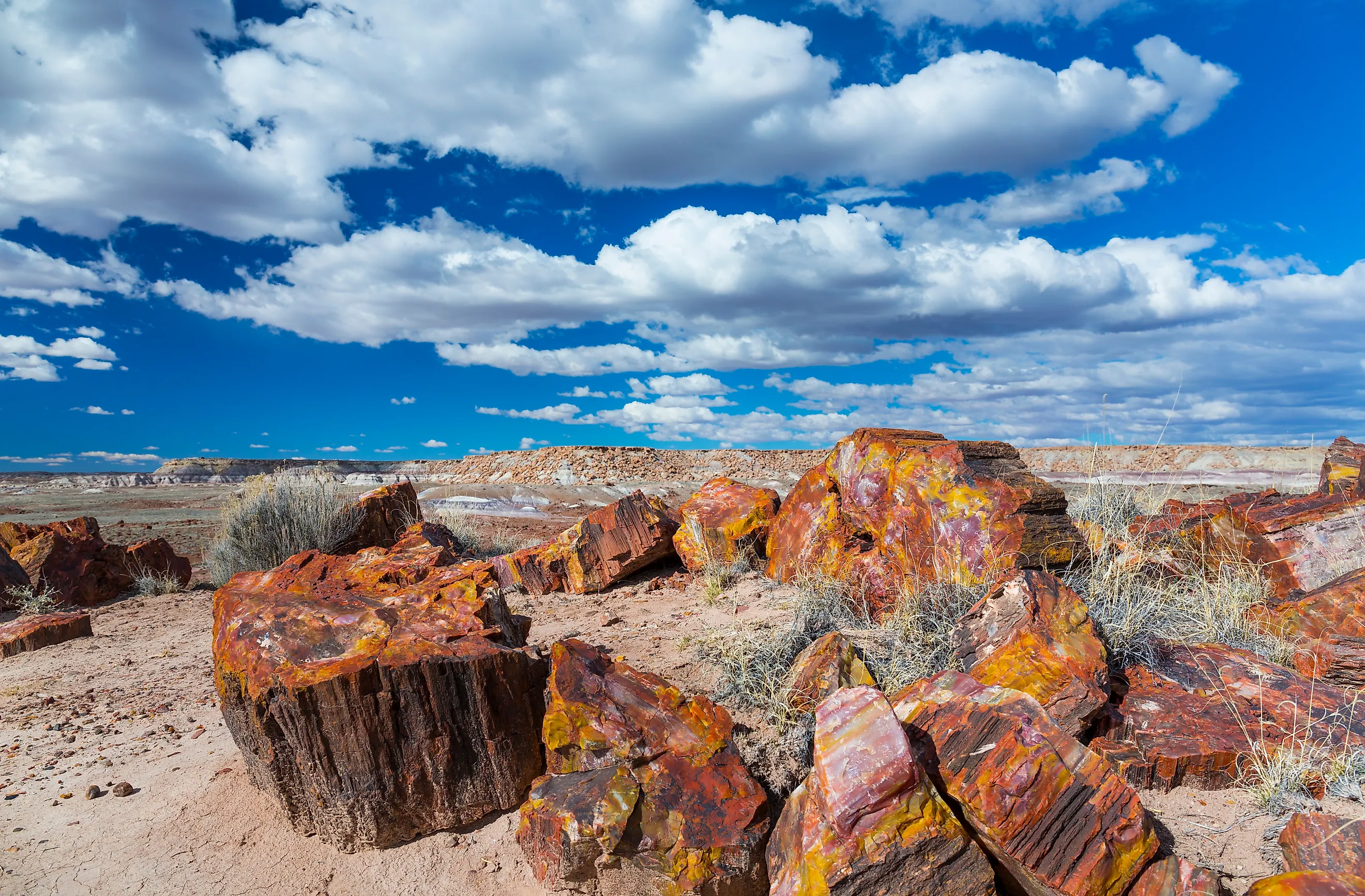
Petrified Forest National Park holds one of the largest concentrations of mineralized fossil wood on the planet, according to the National Park Service, including logs of ancient conifers that measured more than 190 feet long before they fell. The petrified wood here began crystallizing about 225 million years ago.
The park sits within the Chinle Formation, a layer of Late Triassic rock about 208 to 223 million years old, and researchers have logged more than 700 paleontological sites across its 221,390 acres. Congress more than doubled the park's authorized boundary in 2004, and the National Park Service has since worked to acquire private and Bureau of Land Management land within that expanded footprint.
The park's Giant Logs trail, a paved 0.4-mile loop behind the Rainbow Forest Museum, passes some of the largest and most colorful specimens on public display. Their cross-sections show bands of red, yellow, and purple from iron and manganese trapped in the silica during fossilization. Ancestral Puebloan builders later reused broken pieces of that same petrified wood as construction material. Agate House, a partially reconstructed pueblo inside the park, was built primarily from petrified logs about 900 years ago.
Yellowstone National Park, Wyoming

High in the park's northeast corner, far removed from its famous hydrothermal basins, Yellowstone National Park preserves one of the most complex volcanic fossil forests in North America. Separating the Lamar Valley from the Mirror Plateau, Specimen Ridge stretches 8.5 miles across a massive geological record. Embedded within a 1,200-foot-thick layer of volcanic sediment are at least 27 distinct fossil forests stacked on top of one another. These layers, belonging to the Eocene-age Sepulcher and Lamar River Formations, were created over time as successive eruptions from ancient volcanoes repeatedly buried standing trees under waves of ash and debris.
For most of the 20th century, geologists assumed each layer represented a forest that grew, died, and was buried in place before the next one took root on top of it. Research beginning in the 1980s instead points to volcanic debris flows that uprooted trees from higher slopes and transported them downhill before burial, which would explain broken root systems and mixed plant species found within single layers. The strenuous, three-mile Specimen Ridge Day Hike leads to a display of petrified wood.
Theodore Roosevelt National Park, North Dakota

Theodore Roosevelt National Park contains the third-largest concentration of petrified wood in the United States, according to the National Park Service. These specimens are preserved from a swampy delta that covered the region about 65 million years ago, just after the extinction of the non-avian dinosaurs. Sequoia, bald cypress, and magnolia trees grew there alongside a crocodile-like predator called Champsosaurus gigas, and when those trees fell into the delta's slow-moving water, sediment buried them before they could fully decay, allowing silica to replace the wood over time.
The park's Petrified Forest Loop Trail, about 10 miles round trip through the South Unit's badlands, connects two separate concentrations of exposed stumps and logs, reached by a gravel access road outside the park's main entrance. Unlike the polished, jewel-toned wood at Petrified Forest National Park, the specimens here remain scattered across open ground in their original badlands setting, some still showing the pattern of bark and growth rings despite full mineralization. The park asks hikers to stay off the fragile clay surface when wet, since the same badlands terrain that exposed the fossils erodes quickly under foot traffic.
Big Bend National Park, Texas

Big Bend National Park has yielded fossil tree specimens found nowhere else on Earth, including a species named Baasoxylon parenchymatosum, described from petrified logs collected within the park's boundaries. At one site, researchers found 18 stumps belonging to two newly described flowering tree species, Metcalfeoxylon and Agujoxylon, still standing in their original growth position rather than transported and reburied elsewhere. Much of the petrified wood in Big Bend dates back at least 70 million years, to the Late Cretaceous Aguja and Javelina Formations.
Visitors can view Big Bend's petrified wood both on designated trails and in formal exhibit spaces across the park. Eight miles north of Panther Junction, the open-air Fossil Discovery Exhibit displays fossilized log specimens alongside real and cast remains of prehistoric life from the park's Cretaceous and Paleogene layers. For on-trail viewing, the 0.8-mile Tuff Canyon Trail winds through white volcanic rock where petrified logs sit embedded directly in the canyon walls.
Further in the park, remote backcountry routes through the Tornillo Badlands cross open ground scattered with ancient wood fragments. The National Park Service strictly prohibits collecting, picking up, or removing any fossil material to preserve these delicate specimens in place.
The Petrified Wood of US National Parks
Each park preserves petrified wood from a different geological setting and era. Petrified Forest protects Triassic conifers buried in river floodplains. Yellowstone preserves Eocene forests entombed by repeated volcanic mudflows. Theodore Roosevelt seals Paleocene trees beneath slow-moving delta muds.
Big Bend captures 70-million-year-old Late Cretaceous and Paleogene layers featuring unique tree species and fossilized stumps rooted in their original growth positions. Spanning vast differences in geography and time, these fossilized remnants preserve a tangible, crystallized record of ancient forests.