Where People Are Moving To In British Columbia In 2026
Ask anyone who has tried to buy a place in Vancouver lately and you will hear the same sigh. The prices stopped making sense years ago. So people are voting with their moving trucks. They are heading up the valley and across the water and into the interior. Each town on this list is catching a different kind of newcomer for a different reason.
Surrey

Surrey is adding people at a rate almost no other Canadian city can match, growing around four percent a year and picking up just over 28,000 residents in 2025 alone. Provincial estimates now put it near 731,000 people, and forecasters expect it to pass Vancouver as the province's biggest municipality sometime in the coming decades. Most of the newcomers are arriving from Vancouver and Burnaby, chasing a mortgage that leaves room to breathe. What used to be empty lots south of the Fraser are filling with high-density towers, and the SkyTrain line pushing down King George Boulevard means you can still work a downtown Vancouver job without paying downtown Vancouver rent.
Chilliwack

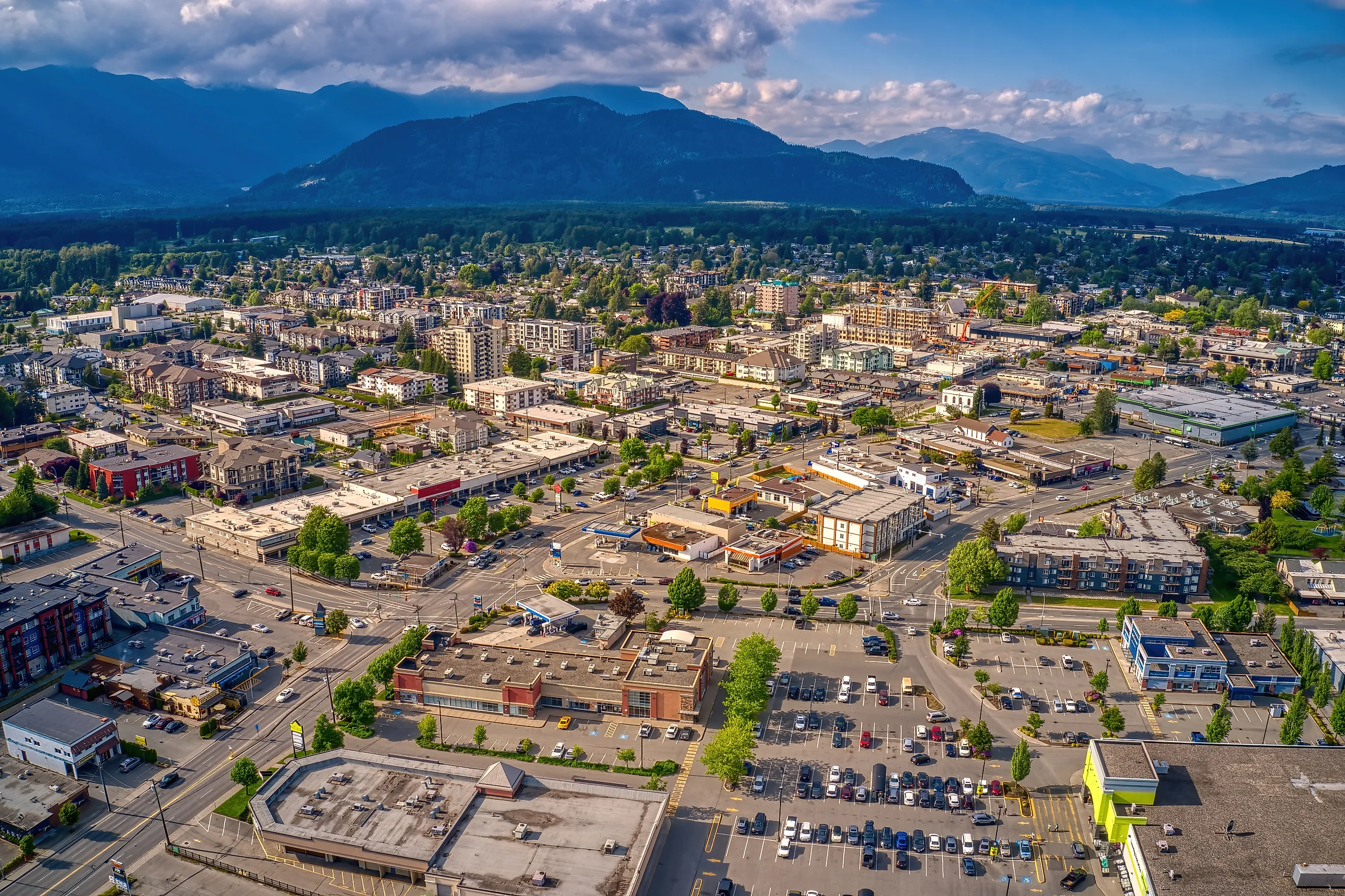
Chilliwack has quietly become the Fraser Valley's clearest example of the whole trend. The city's own numbers tell the story: people moving in from elsewhere in the province made up a quarter of its growth before 2010, and more than half of it by the early 2020s. A detached house here runs closer to $900,000 than the $1.8 million a comparable Vancouver home commands, and that gap is the entire pitch. The city added around 11,700 residents between 2020 and 2025 to reach an estimated 112,500, a pace of 11.6 percent. Most arrivals are young families and priced-out professionals trading a Lower Mainland commute for space, and the city is expanding its urban core from Fairfield Island down to Promontory to hold them.
Coquitlam

The Evergreen SkyTrain extension changed Coquitlam the moment it opened, tying the old mill town straight into the regional rail network and making it an easy sell for anyone leaving Vancouver or Burnaby. The population jumped by almost 25,000 between 2021 and 2025 to reach 173,599. The economy that greets those newcomers looks nothing like the timber days. Coca-Cola, the Oppenheimer Group, and Rolls-Royce all keep operations here, and a local outfit called Moment Energy has built a business turning retired EV batteries into power storage. Film crews love the place too. The old Riverview Hospital grounds have stood in for so many productions that longtime residents can rattle off the shows shot there.
Langford

Langford said yes to housing while much of Greater Victoria was still saying maybe, and the payoff shows in the numbers. Its population climbed 25.2 percent between the last two census counts, one of the steepest jumps in the country. The city is not slowing down either. A freshly adopted community plan lays the groundwork for a future of 100,000 residents, roughly double where it sits now. That building spree brought jobs and services with it, so new arrivals can find work and run errands without the daily drive into Victoria. The crowd moving in skews young, which keeps the average age here among the lowest on Vancouver Island.
Kelowna

Remote work rewrote Kelowna's story. Once people no longer had to live near a downtown office, plenty of them picked a place where the wine country, the ski hills, and the lake are all a short drive apart. The Central Okanagan grew 14.6 percent over four years to reach 246,046 people, powered by retirees cashing out of Alberta and Vancouver and by young professionals from the Lower Mainland and Ontario. More than half of recent newcomers to the region come from Asia, with the Philippines and India leading the way. The jobs have followed the people. Kelowna has turned into one of Western Canada's busiest tech hubs, with the Innovation Centre downtown and UBC Okanagan and Okanagan College feeding it graduates.
Squamish

Squamish sits at the halfway point on the Sea to Sky Highway, close enough to Vancouver for a commute and close enough to the mountains for a lunch-break bike lap. That combination pulls in exactly the kind of resident the town now has plenty of: young, active, and often working hybrid. The population has climbed roughly 20 percent in four years to about 29,752, and the median age hovers under 40. The local economy is leaning into clean technology, anchored by Carbon Engineering, the direct air capture developer now owned by Occidental that keeps its research base in town. Space is tight between the ocean and the peaks, so the latest community plan clears the way for thousands of townhomes and mixed-use blocks.
The Same Move, Six Different Reasons
What ties these six places together is a single decision made six different ways. A family picks Langley for the yard, a coder picks Squamish for the trails, a retiree picks Kelowna for the lake, and all of them are really answering the same question about what a coastal city now costs. The towns that used to be quiet suburbs and farm communities are the ones absorbing the shift, and they are scrambling to build the schools, transit, and housing to match. It is a lot of change to manage at once. It is also, for the people arriving, a rare chance to plant somewhere that still has room to grow.