11 Most Charming Town Squares In Wyoming
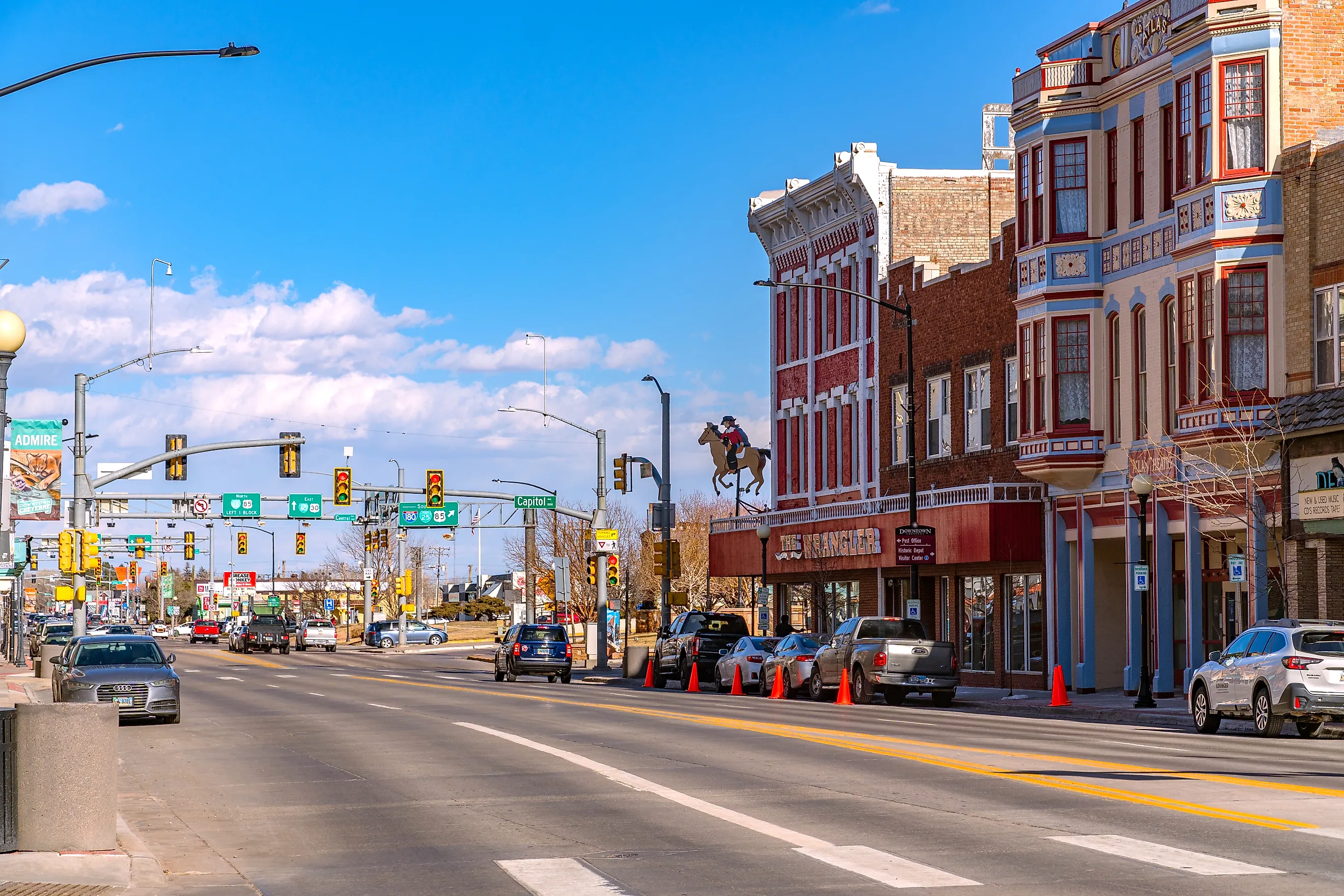
A good Wyoming town square earns its keep by gathering people. Some are formal greens with a name and a dedication date. Others are just the one street where the whole town turns up. Jackson built four arches out of elk antlers and never looked back. Cody settles its differences with a staged gunfight every summer evening. Meeteetse still keeps the wooden boardwalks its ranch hands walked a century ago. The eleven squares and main streets below each hold a town together in their own way.
Cody

Six nights a week through the summer, a staged gunfight fills the street outside the Cody landmark that stands in for a town square. The Cody Gunfighters perform at 6 p.m. Monday through Saturday in front of Buffalo Bill's Irma Hotel, the sandstone-and-river-rock hotel that Colonel William Cody opened on Sheridan Avenue in 1902 and named for his youngest daughter. Sheridan Avenue is Cody's spine, and almost everything worth doing sits along it. The Irma still serves its prime rib buffet beneath the cherry-wood backbar that, by local tradition, came as a gift from Queen Victoria.
The west end of Sheridan Avenue belongs to the Buffalo Bill Center of the West, a Smithsonian-affiliated complex of five museums covering frontier history, firearms, Plains Indian cultures, Western art, and the natural history of the Greater Yellowstone region. A visitor could spend a full day inside it and still leave with rooms unseen. Out on the avenue itself, locally owned shops and the historic hotel give the corridor the feel of a square that simply forgot to enclose itself.
Meeteetse

Wooden boardwalks, hitching rails, and water troughs still line State Street in Meeteetse, thirty miles south of Cody on the Greybull River. The name comes from a Shoshone word meaning "meeting place," and the town has spent more than a century living up to it without modernizing the look of its main drag. A short walking tour takes in the Town Hall, which houses the municipal court and sheriff's office, and the Meeteetse Museums, three small collections within a block of each other that hold the town's ranching and frontier history, including the story of the black-footed ferret rediscovered nearby in 1981.
The square's most famous business is the Meeteetse Chocolatier, founded by a former saddle-bronc rider who traded the rodeo circuit for handmade truffles. Down the street, the Elkhorn Bar serves the kind of burger that anchors a Friday night in a town this size. Visitors who want to stay put for the night can do it at the family-run Meeteetse Inn rather than driving back toward Wyoming's larger towns.
Thermopolis

The name reads like a transplant from another country, and it is: "thermos" for hot and "polis" for city, a nod to the mineral hot springs that made the place. The square that matters here is the Downtown Thermopolis Historic District along Broadway, listed on the National Register of Historic Places. The Hot Springs County Museum sits at its center, with exhibits on local outlaw history, Native American artifacts, and the pioneer families who settled the basin. The collection is dense enough to swallow an afternoon.
Broadway rewards a slow walk. Hazel and Pearl's trades in vintage finds, the Gooseberry Garden Quilt Shop stocks fabric and finished quilts, and the bookshop on the street keeps a coffee bar going for anyone who wants to read a while before moving on. The hot springs themselves, free to soak in at the state bathhouse, are a short distance from the historic core.
Riverton

Riverton makes a case for two town squares and refuses to choose between them. The first is Riverton City Park, a broad green for picnics and pickup games that hosts a community marketplace on summer afternoons, where residents buy, sell, barter, and catch up. The second is Main Street, split into East and West and lined with the stores, restaurants, and old commercial buildings that carry the town's daily business.
The Riverton Branch Library runs a weekly children's reading hour that doubles as a gathering point for young families. A block or two away, the old Riverton railroad depot has been reborn as the Depot Restaurant, where the menu leans into tamales and strong coffee in a building that once moved freight and passengers across the Wind River valley.
Dubois

Ramshorn Street is where Dubois does its gathering, a frontier-style main drag set against the badlands and the Absaroka foothills at the edge of the upper Wind River country. A Thursday farmers market brings out produce, local honey, jams, sourdough, and cider through the warm months, and it functions as the town's weekly social hour as much as its grocery run. The street keeps an unhurried, slightly eccentric character that a chain-store town loses early.
The businesses along Ramshorn match that character. Nana's pairs a bakery with a bowling alley, the old-fashioned Country Store stocks a little of everything, and the Cowboy Café turns out plates big enough to justify a long day outdoors. Dubois sits on the road toward Togwotee Pass and the Tetons beyond, which keeps a steady stream of travelers passing through its small downtown.
Sheridan

Sheridan's Main Street has been called the beating heart of northeast Wyoming, and the title holds up on a busy evening. The WYO Performing Arts and Education Center, a restored 1923 vaudeville theater, runs concerts and stage shows through the year and gives the downtown an arts calendar most towns this size cannot match. Don King's Western Museum, attached to the King's Saddlery on Main, holds a deep collection of working saddles, ropes, and tooled leather from one of the most respected names in the craft.
The street programs its own social life. A street festival takes over downtown on the third Thursday of each summer month with music, food, and crafts, and a wine festival fills an evening in the fall. Between events, the historic storefronts and the saddlery keep Main Street busy on ordinary days.
Worland

Pioneer Square is the rare entry on this list that was built to be a square. It sits in the center of Worland's downtown along Big Horn Avenue, in the heart of the Big Horn Basin, and the town treats it as a gathering place and a memorial to its settler past. Shaded benches, bronze statues, and historical markers make it a quiet plaza for resting more than for crowds, and occasional concerts give it a livelier turn.
Everything civic clusters within a short walk of the square. The Washakie Museum and Cultural Center traces the basin's geology and the people who have lived in it, from Ice Age mammals to homesteaders, and the county library, city hall, and courthouse all stand nearby. The effect is a downtown that keeps its civic life within a few blocks.
Jackson

Four arches woven from elk antlers mark the corners of the most photographed square in Jackson. Formally named George Washington Memorial Park in 1932 and dedicated as a park in 1934, the green is known to almost everyone simply as the Town Square. The Rotary Club built the first arch in the southwest corner in 1953, the other three followed by 1969, and the antlers, gathered after the annual shed at the National Elk Refuge, are rebuilt every few decades. A stone memorial to the explorer John Colter stands at the center.
Restaurants, galleries, and shops ring the park on all four sides, and the square stages the longest-running event of its kind in the state. The Jackson Hole Shootout has played out on the northeast corner at 6 p.m. on summer evenings since 1957, every night except Sunday. After the smoke clears, the Million Dollar Cowboy Bar a block west keeps its saddle barstools full and pours Wyoming whiskey for anyone reviewing the day's photographs.
Laramie

The restored 1924 train depot does the work of a square in Laramie. The Laramie Railroad Depot now holds a museum, a community center, and an adjoining Railroad Heritage Park, all on the edge of a downtown that a university town keeps lively year-round. The historic district just beyond packs galleries, restaurants, and shops into a walkable grid.
The calendar fills out the rest. A farmers market runs downtown through the warmer months, a summer beer festival draws a crowd, and the cafes along the old commercial streets stay busy with students and locals. J's Prairie Rose and its neighbors keep 2nd Street fed well past the dinner hour.
Rock Springs

A national award put Rock Springs' downtown on the map for more than its coal-mining past. The city's Main Street program won the 2018 Great American Main Street Award for transforming a once-avoided district into a thriving one, and the old commercial core now works as the town's de facto square. The Rock Springs Coal sign still arches over Main Street as a reminder of the immigrant miners who built the place.
The square keeps its music going through the summer, with lunchtime Brown Bag concerts in Bank Court and evening Concert in the Park performances midweek. The Rock Springs Historical Museum occupies the 1894 former city hall, a Romanesque sandstone building that tells the story of a town shaped by coal, railroads, and more than fifty nationalities.
Evanston

Depot Square is the focal point of Evanston's historic downtown, five miles from the Utah border. The four-block district holds buildings dating to the 1880s through the 1930s, including the restored Art Deco Strand Theatre, where a film still draws a crowd. The Union Pacific depot at the center fixes the district's identity to the railroad that built the town.
Within Depot Square stands the Chinese Joss House Museum, a replica of the temple that served Evanston's once-substantial Chinese community until fire destroyed the original in 1922. The square's brick pathways, plantings, and benches make it a place to sit as much as to pass through, a working downtown that doubles as a park.
The Last Word On Wyoming's Squares
What links these eleven places is not their architecture but their habit of pulling people together. A square can be a formal green like Jackson's or a single avenue like Cody's, a built plaza like Worland's Pioneer Square or a reinvented depot like Laramie's. The form matters less than the function. Each one gives its town a center, a place where a festival, a gunfight, a market, or a quiet bench does the old work of community in a state with plenty of room to spread out.