9 Scotland Towns Where Time Stands Still
Haggis, kilts, golf, Scotland is known for many things given its long history. Consequently, some places seem like they’ve never aged. From cliff perched castles to medieval cities, the land of Scots has plenty of locales where you swear you’ve stepped onto the set of Braveheart. (Minus all the violence, of course.) In St. Andrews, prepare to dive deep into the history of the land with impressive historical landmarks strewn across the town and also relax at its stunning beach and walk along its harbor with sweeping views of the ocean. Visit the painted paradise of Tobermory and learn about its rich maritime history and admire its natural bounties through woodland walks. Continue reading to find out more about the small towns that time has forgotten and why visiting them should be next on your to do list. Before you know it, you'll be wanting to blow bagpipes to your heart’s content.
St. Andrews

Hugging the eastern coast of Scotland in the Kingdom of Fife, St. Andrews was formerly the ecclesiastical capital of the country, named after Andrew, the Apostle of Jesus. The town’s religious background dates back to the 6th century when a Celtic religious community was believed to have been formed. Centuries later, it's believed the first golf courses were played there. Today, the town is best known as the home of the prestigious University of St. Andrews, a campus well worth seeing for its imposing architecture. Following that be sure to take a walk along the harbor, constructed in the 13th century, and specifically its long pier which has stunning views of the beach. In the shopping mood? Stroll along Market Street to find a mix of souvenir stores, boutique shops and tiny supermarkets. Finally, don’t leave without stopping by St. Andrews Cathedral. Though a shell of its former self, the cathedral’s grandeur can still be appreciated.
Plockton

“The Jewel of the Highlands”, Plockton has a lot going for it; coral beaches, well preserved 19th century architecture and typically dramatic, rugged Scottish scenery are a few of the delights ready to be savored. Founded as a fishing village in the early 1800s to take advantage of the rich, local fishing reserves, the town would be associated with the industry into the 20th century. By the mid-1960s, tourism became a major source of revenue within the area. Speaking of which, as a tourist perhaps the best thing to do is step into the Plockton Visitor Centre. Operating amid the summer months, here you can become well acquainted with the town's history via photographs and displays. Plockton isn’t without culture as well, The Studio showcases original paintings and prints in addition to crafts from local artisans. But to really appreciate the town’s relationship with the water take a boat trip aboard the Sula Bheag, only operating between April and October, which tours the adjoining Loch Carron to spot some seals.
Crail

Not too far from St. Andrews is the hamlet of Crail, recorded as being fully settled in the 800s and becoming a proper town at the dawn of the 1100s. Over time, Crail would develop into a major medieval market town and starting in 1786 served as the residence of the Crail Golfing Society, the seventh oldest golf club in the world. Nowadays, her centuries old cobbled streets still retain Crail’s past where sandstone alleys, quaint cottages and specialty stores can be found. However, another path definitely worth walking is the Coastal Path, a nature trail which stretches over the town’s seaside cliffs and provides spectacular views of Crail. Foodies in particular will be overjoyed to hear that this sleepy village also has a vibrant eating scene; baked delicacies at Barnett’s Bakery, a plethora of ice cream flavors at the Beehive and during summertime grab the catch of the day at the Seafood Shack. Then for lunch or dinner hop into the Honeypot and Shoregate, respectively.
Tobermory

Head to the far opposite side of Scotland on the Isle of Mull and you’ll find yourself in Tobermory, another coastal enclave with vividly painted buildings that practically make it a picture-postcard. Founded in 1788 as a fishing port, Tobermory’s name derives from the Gaelic phrase “Tobar Mhoire”, meaning “the Well of Mary”. But, by the 1820s much of the fishing industry had diminished and the village shifted into tourism for the more affluent. Interested in learning more? Step into the Mull Museum to learn all about the rich local history, from sunken artifacts recovered from the failed Spanish Armada of 1588 to the island’s activities in the Second World War. Though Scotland is known for its dreary weather, you’ll probably hardly notice when exploring Aros Park Walk. The footpath takes visitors through mixed woodland to lovely views of nearby Calve Island and Morvern cliffs. If you’re more of the artistic bent then stop at An Tobar, a renovated Victorian school that's been converted into Mull’s Arts Centre, an institution which hosts a 50 seat performance space, cafe, workshop and dedicated art gallery.
Lerwick

At the northern tip of Scotland lies Lerwick, the chief town of the Shetland archipelago situated between the mainland of the United Kingdom and Norway. Known as a jumping off point for Vikings while on their way to raid the British Isles, the Shetlands were absorbed in the mid-15th century following an agreement between the Kingdom of Norway and James III of Scotland. Lerwick in turn grew into a fishing village and eventually a crucial herring port in the 1800s. Like many small Scottish towns, its long history is enshrined, literally, at the Shetland Museum and Archives. Here you can gaze upon collections from prehistoric eras to how the community’s daily folklife went about. Then buy a ticket to board a ferry to the neighboring island of Bressay to enjoy a more isolated, meditative side of the Shetlands, complete with gorgeous landscape. And those making the trek to Lerwick in late January will be able to experience Up Helly Aa, a winter fire festival celebrating the Norse culture of the Shetland Isles by lighting a life-size replica of a Viking longship ablaze. You shan't forget.
Culross

Culross, up the Firth of Forth west of Edinburgh, is a village where it truly feels like stepping into the 1600s. Long a center of religious life, Culross saw the establishment of a Cistercian abbey in 1217. However, the town is best recognized for its 16th and 17th century architecture that’s been remarkably preserved the many years since. Culross Palace is the prime specimen, constructed in 1597 by Sir George Bruce and brandishing a striking yellow exterior along with painted ceilings on the interior. But Culross isn’t without a dark side. The Fife Witches Trail lets you relive the Scottish Witch Hunts which enraptured the populace. Hungry? Once you’re done gazing at the beautiful buildings, walk on to Bessie’s Cafe, managed by the National Trust, to sample the delicacies available. Your palate will thank you.
Falkland

No, not the islands that were the crux of a war between Argentina and the United Kingdom, the tiny Scottish village replete with 16th century stone palaces and charming cottages. Falkland, inhabited in one form or another since prehistoric times, owes its origins to the medieval Falkland Castle of the MacDuff clan. By 1458, the village was granted a Royal Burgh status, officially establishing it as a town. Falkland Palace and Garden, smack dab in the middle of the town, best exemplifies the rich history of the area. The relatively restored Renaissance residence is also complete with the oldest tennis court in Great Britain. For a more rural bucolic setting the Lomond Hills Regional Park doesn’t disappoint. Ideal for hikers, dog walking and mountain biking, the park’s fresh air and handsome environs will leave you exhilarated. Then end the day with a cup of chamomile (or cake) at the Hayloft Tearoom.
Portree

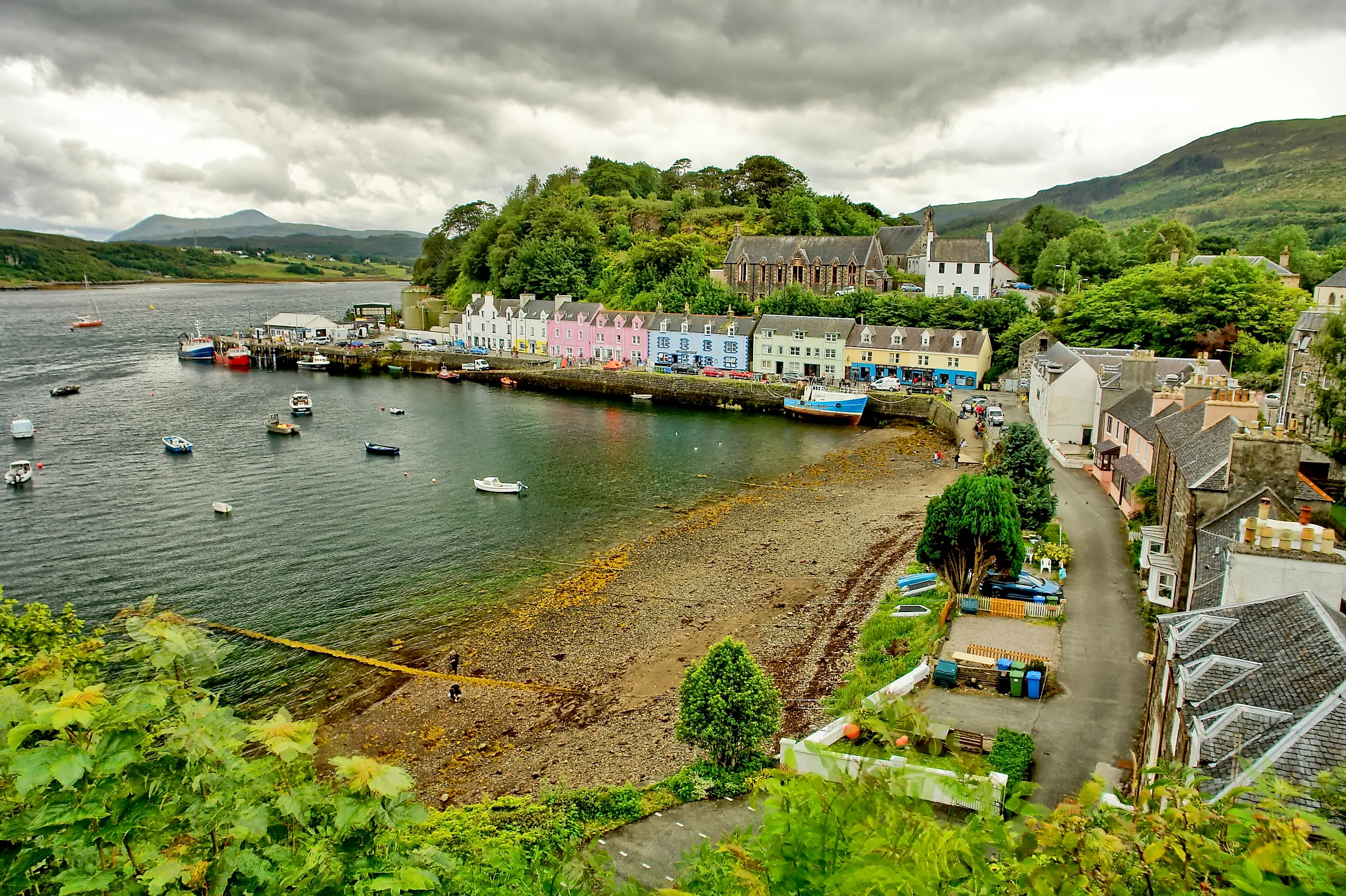
Almost hidden away on the Isle of Skye you’ll find Portree, a town considered “the heart of Skye”. Tradition contends that the town acquired its name after King James V traveled to the isolated hamlet in 1540. Throughout the 18th and 19th centuries, Portree was a central hub for Scots immigrating to North America to seek a better life. First and foremost, the Isle of Skye Candle Company Visitor Centre welcomes you when entering Portree and also offers fragrance products inspired by the island to be bought. Somerled Square in the middle of town is its commercial center, where during the summer months a market is set up for anyone to purchase local crafts and produce. Overlooking the harbor is a grassy hill colloquially named the Lump in which the Apothecary Tower can be found. Serving as a sign to ship sailors that medical help was available, the tower now allows tourists to climb its narrow stairs to witness, along with the Lump itself, superb views of the bay and Portree.
Killin

When reaching the end of the Falls of Dochart, be prepared to find yourself in KiIllin. Once dominated by the MacNab clan, in 1694 the 1st Earl of Breadalbane, Sir John Campbell, gave Killin the title of burgh of barony. While passing through, give serious thought to the Ben Lawers National Nature Reserve, presenting all the wonders of natural Scotland. Killin also holds the remains of Moirlanich Longhouse, a true life, preserved Scottish longhouse watched over by the National Trust, for those interested in traditional Scottish culture. Then two-step to the Old Mill Heritage Centre and leave with locally crafted goods to remember Killin for long after you leave.
Scotland may be part of a greater British kingdom, but her unique culture and history wouldn’t make you think so. The vertical land, epic architecture and accommodating people will cause Scotland to be embedded into your being. Maybe brush up on your Gaelic, Scotland’s waiting.