9 Best Downtowns In Tasmania
Many of Tasmania's downtowns still look like they did in the 1820s and 1830s. Travellers might encounter old bridges built by convicts, sandstone churches, and shopfronts that haven't changed in 200 years. Some towns stayed this way by accident. A highway or railway got built somewhere else, and the town just never had to grow. Others grew around busy harbours or got squeezed in next to old volcanic hills. Here are nine of those towns, each one holding onto a piece of Tasmania's early history.
Richmond

Bridge Street is the heart of Richmond, lined with dozens of Georgian buildings, some dating back to the 1820s. Many have been turned into cafes, galleries, and craft and antique shops that visitors can wander in and out of. The Richmond Bridge, built by convicts and completed in 1825, remains Australia's oldest stone span bridge still in use. Just off Bridge Street, the Richmond Gaol, built in the same year, is Australia's oldest intact gaol and now has a self-guided tour and gift shop.
Stanley

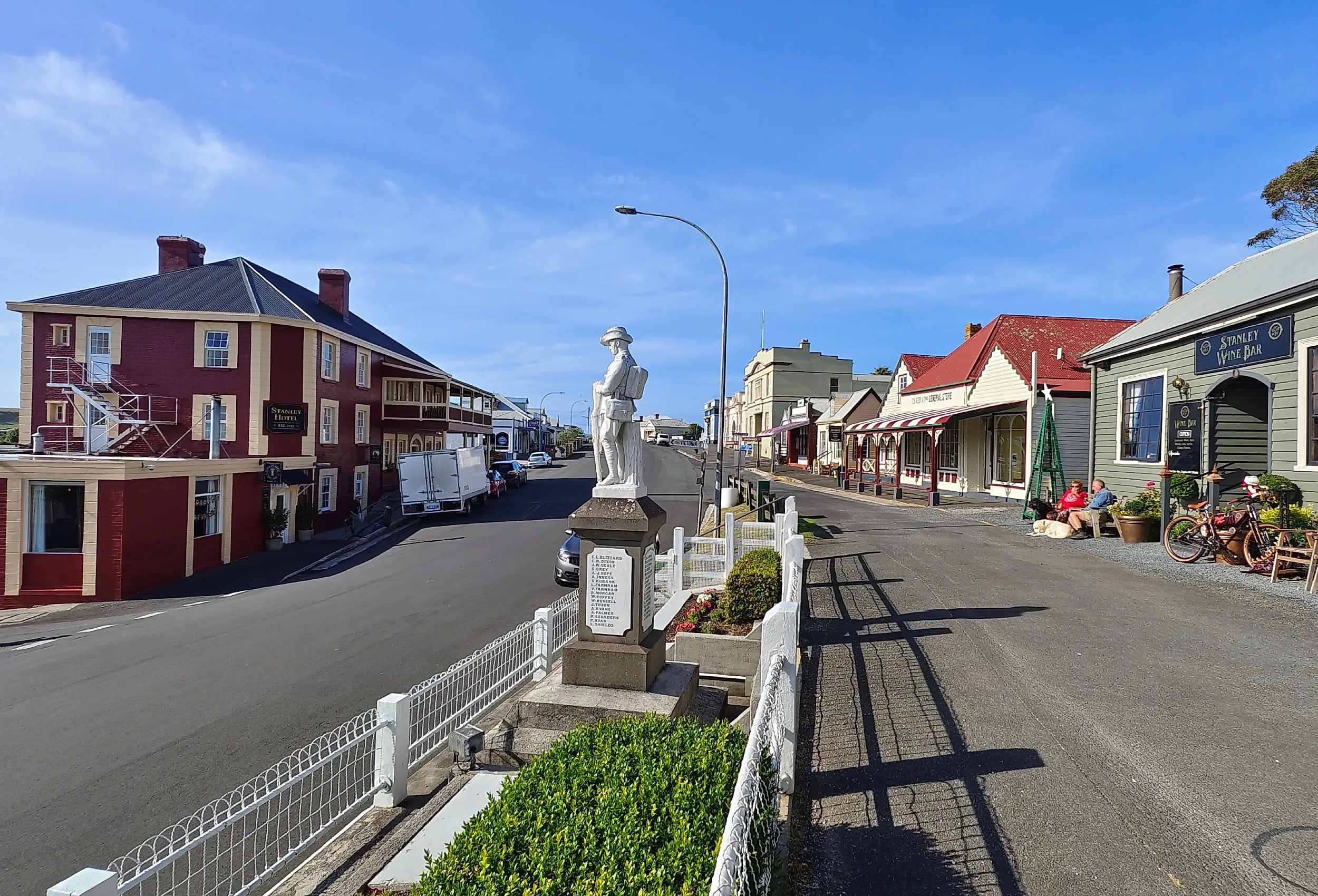
The Nut, a 143-meter volcanic hill, rises nearby above Church Street, the heart of Stanley's cottage-lined main strip. Nearby, you'll find a penguin viewing platform just around the corner at Godfreys Beach. Small shops fill Church Street, from Providore 24, which sells Tasmanian food and gifts, to Crossland Antiques, set inside an old cottage. The Stanley Post Office is easy to spot thanks to its bright red phone box out front, and the historic Stanley Hotel has its own shop. Cafes and galleries sit between the stores, making Church Street an easy place to stroll and browse.
Strahan

The Esplanade curls around the harbour and forms the heart of downtown Strahan, lined with cafes looking out over the water. Heritage buildings from the town's mining and logging boom still stand along the street, including the old Customs House, now used by the Parks and Wildlife Service. Morrison's Huon Pine Sawmill sits right on the waterfront, where a fourth-generation family business still mills the timber that built the town, and visitors can watch the process or pick up something from the gift shop. Hamer's Bar and Bistro, on the Esplanade, serves fish and chips with a harbour view. Strahan also serves as a gateway to rail adventure, with the rebuilt West Coast Wilderness Railway running through the rainforest toward Queenstown.
Ross

Ross is situated mostly on a single street, with no strip malls or even a traffic light. At the main crossroads, local lore gives each corner character: temptation at the Ross Hotel, salvation at the Catholic Church, recreation at the town hall, and damnation at the old jail. The Ross Bakery Inn, set inside a convict-built Georgian house on that same street, still bakes its vanilla slice fresh each day. The Ross Bridge sits at the edge of downtown and carries 186 carved figures, cut into the sandstone in 1836 by a convict named Daniel Herbert, who won his pardon for the work.
Deloraine

Georgian and Victorian storefronts line Emu Bay Road, well-preserved enough to earn National Trust recognition, and in 2025 the Tourism Industry Council Tasmania named Deloraine the winner of the state's Top Small Tourism Town category. Each November, the Tasmanian Craft Fair takes over the town for four days, filling halls along the main street with stalls, dyed wool, and hand-thrown pottery. The aptly named Meander River runs close to the town centre, while Yarns Artwork in Silk, displayed inside the visitor centre, adds another local craft landmark to a main street already known for its handmade goods.
Bicheno

Local shops and cafes sit within a short walk of Waubs Bay in the heart of Bicheno. Little Bay Patisserie draws a steady line for pastries, and Waubs Harbour Distillery pours whisky tastings a few doors down. Lobster Shack Tasmania serves rock lobster fresh off the boats, with a deck that looks out over the harbour. Each November, the Bicheno Food and Wine Festival takes over the town's waterfront, pairing local seafood with Tasmanian wine, and a monthly community market fills Lions Park with local produce and handmade crafts. A few minutes from the shops, the Bicheno Blowhole sends spray over the granite shore, while evening penguin tours add a wildlife stop to the town's coastal downtown appeal.
Sorell

St George's Anglican Church on Gordon Street anchors Sorell's historic centre, replacing an earlier church built on the same site between 1825 and 1827. It is one of three old churches within a few blocks, giving the town centre more colonial character than its modern highway frontage first suggests. Nearby on Walker Street, the 1827 Barracks, once used to house soldiers, is one of the town's oldest buildings and now operates as colonial-style accommodation. The church's own graveyard holds headstones dating back to Sorell's earliest settlers, from when the district was first settled in 1808, with the town formally established in 1821. The town's Pioneer Park makes for a relaxing gathering point after a cafe lunch.
Oatlands

More than 150 sandstone buildings line Main Street, one of the largest groups of colonial architecture in any Australian town. Callington Mill turns its sails at the edge of town, the only working Lincolnshire-style windmill in the Southern Hemisphere, grinding flour the way it did when it opened in 1837. Callington Mill Distillery pours single malt whisky from a viewing platform overlooking the mill's original stonework, with a cellar door open for tastings right in town.
George Town

A full-size replica ship of the Norfolk sits inside the Bass and Flinders Maritime Museum in the town centre. Explorers George Bass and Matthew Flinders sailed the original Norfolk around Tasmania in 1798, proving Van Diemen's Land was an island rather than part of the mainland. Nearby, The Watch House adds another colonial-era stop, while York Cove gives the town centre a waterfront edge. Grab a pie or a doughnut from Tamar River Bakery, a downtown staple, before continuing toward Low Head's lighthouse and pilot-station precinct.
Tasmania's Living Past
Downtowns are a way to see a town's past and its present at the same time, and Tasmania's still let you touch both. Some of these towns can be walked in an hour, strolling from a sandstone church to an old bridge to a harbour, then back to your car. Others like Deloraine or Strahan are worth clearing a full day for, to fully enjoy nearby waterfalls, wildlife, or the small museums off a town's main street. All you have to do is show up.