The Most Charming River Towns In Michigan
The best river towns in Michigan give you a reason to get down to the water. Cheboygan puts paddlers on a blueway that runs out to a Lake Huron lighthouse. Roscommon sits on the Au Sable near some of the best trout water in the state. Alma throws the state's biggest Highland games in a town on the Pine River. Lowell floats a summer concert crowd past a showboat on the Flat. Marine City serves fresh walleye on a deck over the St. Clair.
Cheboygan

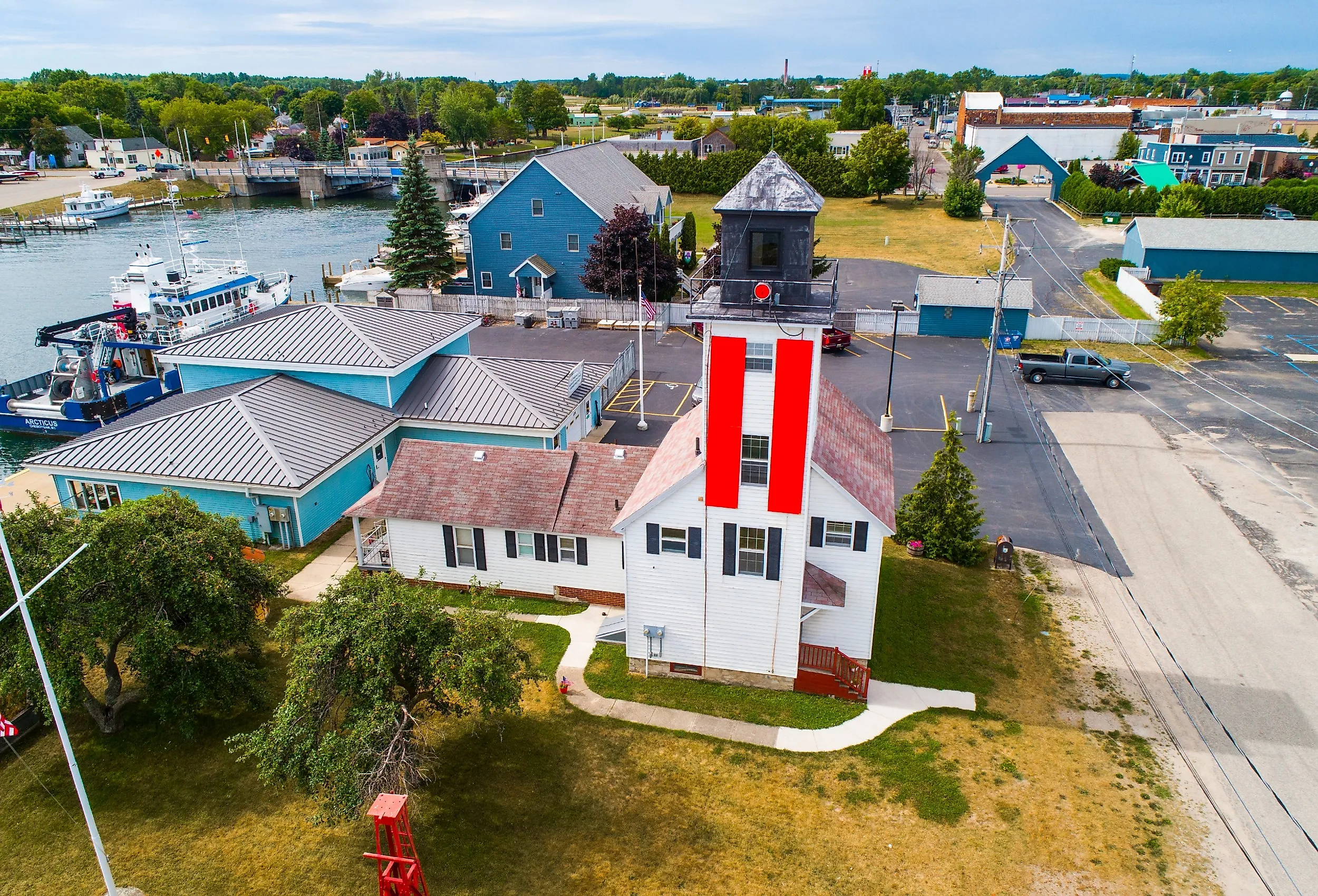
The Cheboygan River empties into Lake Huron at the top of the Lower Peninsula, and the town grew up along its banks in the mid-19th century. The self-guided Cheboygan Historic Walking Tour is the quickest way into that history. It passes the Carnegie Library, a domed Greek-style building from 1913 that now serves as a community center, and the 1871 Newton-Allaire House, where the interiors still carry their original wallpaper, curtains, and light fixtures. The route ends at the Cheboygan Opera House, a brick 1904 hall that still seats audiences under its classic proscenium.
The state Department of Natural Resources named Cheboygan a Pure Michigan Trail Town, and the designation shows in how much of the place you can reach by water or on foot. Paddlers take the Cheboygan River for the waterfront view of downtown or follow the Cheboygan Area Blueway out toward Lake Huron and the Cheboygan Crib Rear Light. Walkers cross the boardwalks of the Duncan Bay Nature Preserve, where trails thread the wetlands and forest out to Duncan Bay itself. Every August the Cheboygan County Fair fills the fairgrounds with food vendors, a livestock barn, a rodeo, and dirt-track racing.
Roscommon

Roscommon sits in north-central Michigan on the South Branch of the Au Sable River, a stretch of water that draws anglers and paddlers through the warm months. The bigger draw is a mile away at South Higgins Lake State Park, which holds an entire mile of shoreline on Higgins Lake. The lake runs more than 15 square miles and drops past 100 feet, clear enough that boaters and swimmers can see well down into it.
The park keeps campsites and cabins for anyone staying past a single afternoon. Nearby, the Marguerite Gahagan Nature Preserve carries trails for biking, hiking, and cross-country skiing, while the Higgins Lake Trailhead turns over to ATVs and snowmobiles once the snow sets in. The Roscommon Zoo spreads tigers, peacocks, and kangaroos across 20 acres, and the Roscommon Historic Model Train Museum runs model trains of every size on routes that wind through its rooms, with a rideable miniature train in summer. For dinner, Fred's of Roscommon plates Great Lakes walleye alongside older Midwestern standbys like liver and onions.
Big Rapids

The Muskegon River runs straight through the middle of Big Rapids in central Michigan, and the Big Rapids Riverwalk follows it for more than three miles. The path carries bridges, viewing platforms, and benches out over the water, and in the warm months tubers use the same current to cool off. Away from the river, the Hungerford Recreation Area opens 35 miles of horseback trails and another 10 for mountain bikers and hikers.
The town's most serious stop is the Jim Crow Museum, set for a grand reopening in fall 2026, which traces African American segregation from the late 19th century into the mid-1960s through cartoons, comics, pottery, and dolls. Michigan is one of the country's leading craft-beer states, and Cranker's Brewery keeps that tradition close to the water with a lineup of IPAs, pilsners, and stouts served with pretzels and beer-cheese dip.
Alma

Alma calls itself "Scotland USA," and the title earns itself each Memorial Day weekend when the Alma Highland Festival and Games take over the town on the Pine River. The festival stacks rugby matches, axe-throwing, blacksmith demonstrations, and enough bagpipes to carry across the water. The paved Fred Meijer Heartland Trail runs through town on its way to neighboring communities, and it turns bright in autumn. Downtown Alma still holds buildings tied to its late-19th-century boom, including the former site of the Alma Springs Sanitarium. The Alma Riverwalk offers a slower look at the same water, best paired with a coffee from Next Level Espresso and a pint of Highlander Scottish Ale from Alma Brewing Co.
Ionia

The Grand River runs along the south edge of Ionia, about an hour southwest of Alma. The John C. Blanchard House anchors the town's history, an Italianate mansion with a late-19th-century Victorian interior of ornate light fixtures, patterned carpets, shuttered windows, and porcelain lamps. Its museum covers the area's military, Native American, and settler past. A few miles out, Hanulcik Farm Market and Orchard opens its rows for u-pick apples, peaches, strawberries, raspberries, and sunflowers from June into October, with a farm store selling pies, honey, cheeses, wine, and hard cider.

Bertha Brock Park covers almost 200 acres of hills and forest, its paved and dirt trails crossing stone bridges and a trout stream, with campsites in summer and sledding in winter. The town's biggest week is the Ionia Free Fair, first held in 1915, a 10-day run of music, food, and carnival rides that also makes room for a reptile show, a circus, and a demolition derby.
Lowell

Lowell sits where the Flat River meets the Grand, and the town has built much of its identity around that industrial past. The Lowell Area Historical Museum has spent 25 years telling it, with displays on fur trading, a button factory, logging, and milling, plus a preserved 1870s Victorian dining room and a new military-history exhibit. Just north, Fallasburg Village preserves a 1830s pioneer settlement across 20 acres of cemetery, barns, a schoolhouse, and homes, reached by a 100-foot covered bridge built of white pine in 1871 that still carries cars over the Flat. The Orchards at Red Barn keeps the season turning year-round with fall apple and pumpkin picking, a barnyard petting farm, and Painted Turtle Hard Cider pressed from its own fruit.
For ten summer weeks the free Sizzlin' Summer Concert Series plays within sight of the Lowell Showboat, a riverboat approaching its hundredth year on the Flat. The river threads through the town's parks as well: Scout Park keeps a 1950s Boy Scout cabin on its bank, and the 4,800-mile North Country Trail passes through on its way between North Dakota and Vermont.
Marine City

On the far eastern edge of the state, Marine City faces Ontario across the St. Clair River, at the point where the Belle River flows in between Lake Huron and Lake St. Clair. The 50-mile Bridge to Bay Trail strings together bike paths, riverwalks, and boardwalks along all three waters, passing a run of historic buildings on the way. Among them stand the Gothic-style Holy Cross Catholic Church from 1903, the brick Marine City Historic City Hall with its rectangular and cylindrical towers, and the Lester House, once home to Captain David Lester, the town's first president in 1865 and a builder who left behind marble fireplaces, detailed woodwork, and a mix of architectural styles. The Marine City Fish Company sends out chowder, smoked salmon, and other seafood with a view of the river. It stands near the Peche Island Rear Range Light, a 66-foot lighthouse built in 1908 and moved here after its 1983 deactivation.
Following The Water Through Michigan
Michigan holds more than 300 named rivers, and the towns that grew along them still take their character from the water. The mills and log drives are gone, but the current remains the reason to visit: walleye pulled from the St. Clair, a showboat on the Flat, a covered bridge over the Fallasburg stretch, bagpipes carrying across the Pine. Each of these seven towns turned a river into something a visitor can still walk up to, whether that means a Highland festival in Alma or an orchard afternoon outside Ionia. The rivers built the towns, and the towns learned to make the most of them.