9 Most Charming Town Squares In Georgia
In most Georgia county seats the courthouse still sits dead center in the square. Dahlonega packs gold rush relics into the oldest courthouse standing in the state. Covington drew film crews to its 1884 square to shoot Mystic Falls. Thomasville plants a downtown greenspace with roses each spring. All nine squares still function as working county seats. Judges hear cases upstairs while the cafes below fill by noon.
Covington

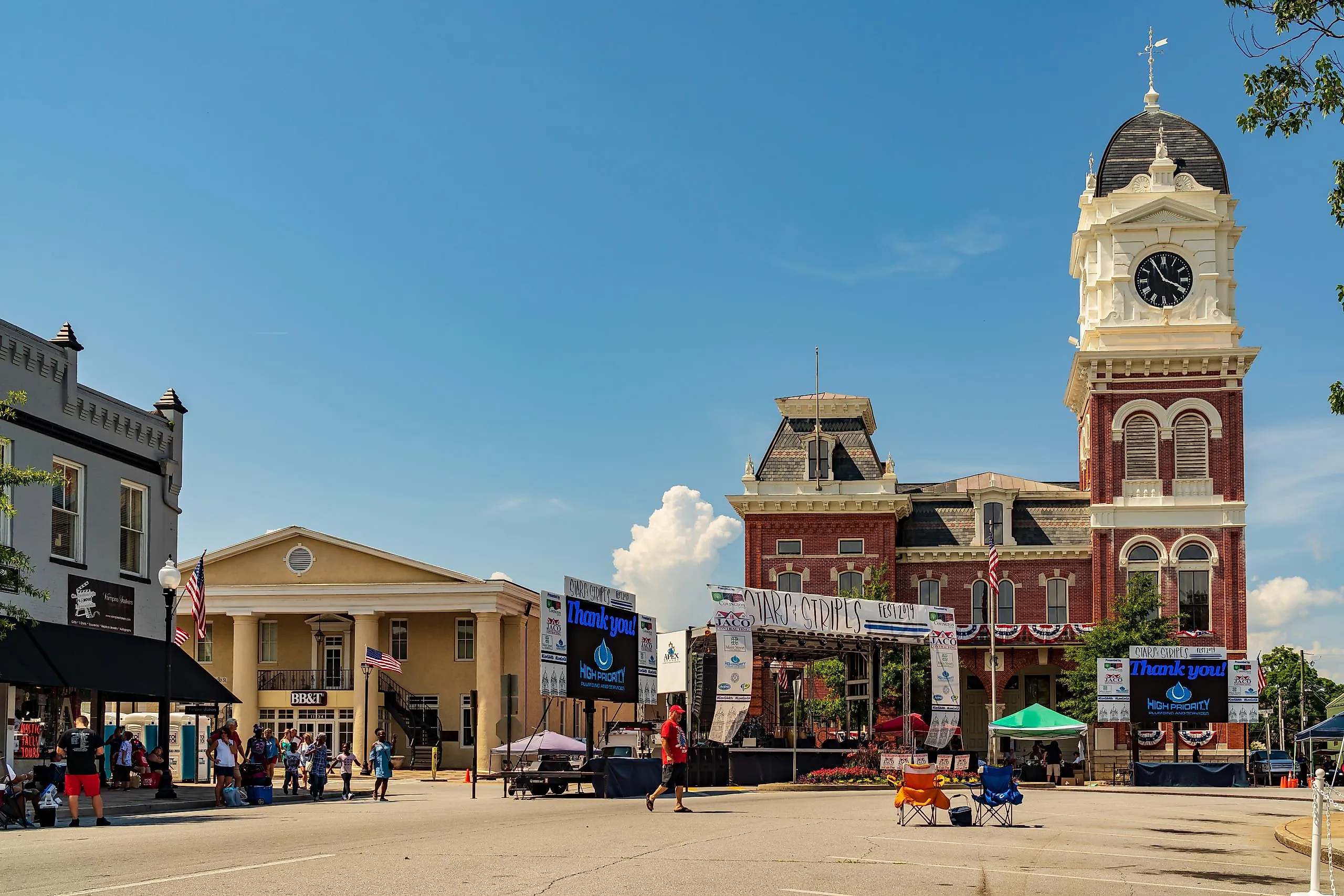
This town has logged more screen time than most working actors. Covington has trademarked the nickname Hollywood of the South, and the resume seriously backs it up. The courthouse square stood in for Mystic Falls through all eight seasons of The Vampire Diaries, and In the Heat of the Night shot here for years before that. Fans clock the Mystic Grill immediately, the show's go-to hangout spot pulled into real life, now dishing up a clock tower burger and sweet tea fried chicken for people who drove in from hours away. The 1884 Newton County Courthouse presiding over the square was built in Second Empire style, its mansard roof and clock tower framing shot after shot. Part of the draw for crew is geography, since Atlanta is barely 35 miles west, which is close enough to base a production here and still reach the soundstages. When the cameras are off, City Pharmacy serves oysters and grits with shrimp inside a former drugstore, and Bread and Butter Bakery handles the morning shift with scones and strong coffee.
Monroe

Drop down out of gold country, and the land smooths into rolling Piedmont, where Monroe has turned a century of leftover furniture into a whole identity. Named for President James Monroe, the town bills itself as the Antiques Capital of Georgia, and the claim honestly has some teeth here, since the old Monroe Cotton Mills now hold rows of dealer booths with Vintage Revival Antiques. The square itself earns the stop for the Historic Walton County Courthouse, an 1883 Second Empire landmark whose mansard-roofed clock tower rises over downtown. A few blocks off the square, the McDaniel-Tichenor House, home of Henry McDaniel, Georgia governor in the 1880s, keeps its doors open for limited public tours. When you need to take a little breather from the hunt, Coffee Camper Co. pours fresh espresso on North Broad Street.
Dahlonega

Dahlonega built its public square around the oldest surviving courthouse in Georgia, and the building earns the drive up into the mountains. Gold turned up in these hills around 1828, setting off one of the first gold rushes in the country and pulling thousands of prospectors onto Cherokee land. The 1836 brick courthouse at the center of the square now holds the Dahlonega Gold Museum, where you can see nuggets pulled from local creeks and hear how assayer Matthew Stephenson stood on these steps in 1849 and swore there were still millions in the ground.
The frontages ringing the square have always stayed busy, as Paul Thomas Chocolates rolls caramel apples to taste like apple pie, and Picnic Cafe & Dessertery bakes its own bread for lunch just a few doors down. For an older vibe, the Smith House dates to 1899 and has served family-style dining since 1922, sitting on a gold vein that the owners later mined right under the dining room. Come the third full weekend of October, Gold Rush Days pulls thousands of people onto the square.
Madison

Keep east through the courthouse towns, and you end up at Madison, which trades on a story it cannot fully prove but tells anyway, that General Sherman spared the place on his Civil War March to the Sea. Believe it or not, Madison kept nearly 100 antebellum homes, one of the largest such collections in Georgia. The Morgan County Courthouse sits in the middle of the square, a 1905 domed landmark with colossal Corinthian columns that have stood in for film backdrops in Guardians of the Galaxy Vol. 2. A few steps off the square, Heritage Hall opens up its 1811 Greek Revival rooms for tours, while the Madison-Morgan Cultural Center fills an 1895 Romanesque schoolhouse with galleries, a restored Victorian classroom, and a performance hall. When the touring party works up an appetite, the Madison Chophouse Grille dishes out prime rib downtown.
Greensboro

Southeast of Madison, Greensboro rests near the shores of Lake Oconee, but its square leans on history older than that water by well over a century. The town took its name from Revolutionary War general Nathanael Greene and laid out its grid in the 1780s. The Greene County Courthouse, which presides over the square, was built in 1848, making it one of the oldest courthouses still serving a Georgia county. The courthouse is Greek Revival, with a columned front.
The oddest building in town stands a block off the square. The Old Gaol went up around 1807, a granite fortress with two-foot walls and a trap-door gallows on the second floor, modeled on the old bastilles of Europe. It is the oldest masonry jail in Georgia. It held prisoners until the 1890s, and it now opens for tours behind the courthouse. The Yesterday Cafe on North Main has built its name on buttermilk pie. For something heavier, Holcomb's Bar B Que smokes pork and Brunswick stew a few blocks west.
Washington

Washington is often cited as the first chartered town in the country named for George Washington, and the town wears that claim as proudly as a town can. The streets around the Wilkes County Courthouse hold more than 100 antebellum and Victorian buildings, several of them open to the public. In 1865, the last full cabinet of the Confederacy gathered here before the government dissolved, a story the Washington Historical Museum lays out room by room inside an 1835 house packed with war relics.
A couple of buildings off the square make the case for staying. The Robert Toombs House was home to the Confederate secretary of state who refused to ask for a pardon, and the Mary Willis Library, the first free public library in Georgia, glows with a Tiffany memorial window below a Queen Anne roofline. The 1779 Battle of Kettle Creek was fought just outside town. For lunch, Miller's Bistro serves chicken picatta and molten lava cake over the square.
Greenville

The warm springs that drew Franklin Roosevelt to Meriwether County for the last two decades of his life sit fifteen miles southeast, but Greenville, the county seat of under a thousand people, trades on the building at the center of its square. The Meriwether County Courthouse rises over Court Square behind sixteen fluted Corinthian columns of solid limestone, topped by an octagonal dome, a half-ton French bell, and a statue of Justice lifting her scales above the rooftops. J.W. Golucke, who designed courthouses across Georgia, drew it in 1903 to replace an earlier courthouse a tornado destroyed in 1893, and when a 1976 fire gutted the interior, the county rebuilt inside the original brick walls and kept it standing. Traffic loops around the building on a roundabout, keeping the square in slow, constant motion.
The storefronts facing the courthouse have been filling back in, with new shops, galleries, and cafes moving into the old buildings. Artisans on the Square gathers work from local makers a few doors off the courthouse, and The Print Shop Gallery brings more local art into a storefront near the square. When the afternoon runs long, Aude's Ice Cream Bar pours coffee and wine right on the square.
Newnan

The same J.W. Golucke who raised Greenville's courthouse built Newnan's, too, but the building this town shows off is a different one. On the square, the Carnegie Library wears a rooftop sign spelling out City of Homes, the nickname Newnan took from the mansion-lined streets fanning out from downtown. A local teenager wrote to Andrew Carnegie in 1901 to ask for the money, and the result still stands, likely the oldest surviving Carnegie library in Georgia. Those houses outlasted the Civil War for a grim reason: Newnan spent the war as a hospital town, packed with the wounded of both armies, worth more to either side standing than burned.
The town's name goes back to General Daniel Newnan, a Georgia militia leader from the War of 1812. The streets he lent his name to still fill up after dark, with the Newnan Theatre Company staging shows just off the square. By noon the next day, the block outside Goldens on the Square smells like frying chicken, and the reuben line at Redneck Gourmet starts before the courthouse breaks for lunch.
Thomasville

Drop down toward the Florida line, and the live oaks get older. Thomasville keeps its courthouse a block off Broad Street, on a greenspace that William Miller laid out as a square in 1887 with a fountain at the center. The Thomas County Courthouse itself dates to 1858, gray brick under an octagonal cupola and clock, designed by John Wind, and it still hears cases in the heart of town. Broad Street carries the rest, more than a hundred boutiques, antique shops, and cafes filling the old storefronts, a downtown good enough to win Thomasville an early Great American Main Street Award.
At the corner of Monroe and Crawford, the Big Oak has stood since about 1680, sixty-eight feet tall with limbs reaching more than a hundred and sixty feet across, now held up by cables strung through the branches. The town added it to the Live Oak Society in 1936 and still treats it as a civic elder. Thomasville answers to the City of Roses as well, and has thrown a Rose Show downtown every spring since 1922. Wealthy Northerners came south by rail in the 1870s and 1880s for the mild winters and pine-scented air, which doctors of the day sold as a cure for weak lungs. One of them, a Chicago shoe merchant named C.W. Lapham, put up the Lapham-Patterson House in 1885 as a winter cottage, a yellow Queen Anne sided in fish-scale shingles with forty-five exterior doors and a floor plan where almost nothing lines up. When the tours let out, people drift back to the bricks of Broad Street, past the cheese counter at Sweet Grass Dairy and the steaks at Chophouse on the Bricks, to the long line at Jonah's Fish & Grits for fried green tomatoes and hush puppies.
Where Georgia's Downtowns Still Circle The Square
None of these towns turned their squares into museums. Traffic still circles the Greenville courthouse on a roundabout, and Redneck Gourmet in Newnan starts filling up before the courthouse crowd breaks for lunch. Fans still drive hours to Covington to eat clock tower burgers at Mystic Grill, and Thomasville's Big Oak has shaded the same street since about 1680. Pick a Saturday, park once, and start at the courthouse steps.