The Oldest Resort Hotels Still Operating In America
When Henry Sawyer opened The Chalfonte Hotel in Cape May as a boarding house in 1876, he likely never imagined his resort would still be welcoming guests 150 years later. Having taken in guests every summer since, The Chalfonte deserves the title of the oldest resort hotel still operating in the United States based on the year the oldest guest building still in use first opened its doors. Opening dates come from National Register of Historic Places and National Historic Landmark nomination documents where they exist and from the hotels' own records where they don't. Every hotel on the list was built for leisure travelers and offers recreation on the property. Each has also never closed to guests for longer than a wartime requisition.
The Chalfonte Hotel, Cape May, New Jersey (1876)

Colonel Henry Sawyer, a Union cavalry officer captured at Brandy Station in 1863 and exchanged for a son of Robert E. Lee, opened The Chalfonte in 1876 as a boarding house two blocks from the beach. The National Park Service nomination for the Cape May Historic District describes it as the oldest and most ornate large hotel in the town, and it is the oldest building in Cape May to operate continuously as lodging.
When the Great Fire of 1878 struck Cape May, The Chalfonte escaped, and Sawyer added a 100-foot wing with a dining room, a two-story colonnade, and 19 guest rooms the following year. The footprint reached its present shape by 1909. Its longest-serving owners include the Satterfield family, who bought it in 1911 and kept it in the family for seven decades. Rooms still have no televisions or telephones, and the Magnolia Room serves fried chicken and spoon bread. The hotel is open to guests each summer season.
Mohonk Mountain House, New Paltz, New York (1879)

Twin brothers Albert and Alfred Smiley, Quaker schoolteachers, bought a ten-room tavern and 300 acres beside Lake Mohonk in 1869 and opened to 40 guests the following June. That tavern was absorbed and replaced as the hotel grew, and the oldest surviving part of the present structure is the four-story Rock Building, completed in 1879.
The Central Building followed in 1888, the Grove buildings and dining room in 1893, the stone castle section in 1899 and 1902, and the Parlor Wing, cantilevered over the lake on steel trusses, in 1901. Nothing was added to the main house between 1910 and the spa wing of 2005. Six generations of the Smiley family have run the property. Located on the Shawangunk Ridge 90 miles north of New York City, rates include three meals a day and afternoon tea, and the resort is open year-round.
The Claremont Hotel, Southwest Harbor, Maine (1884)

Jesse Pease, a retired sea captain from Rockland, hired a contractor in 1883 to build a hotel on a rise above Somes Sound. The Claremont Hotel opened for business in the summer of 1884 with 146 names in its register by the end of that first season. The National Register nomination refers to it as one of the first large Victorian-era resort hotels on Mount Desert Island, and one of the last surviving examples of its type.
In 1911, the owners moved the Pemetic, a rooming house built in 1878, over the hill and attached it to the Claremont as a wing. Three families owned the hotel in its first 136 years. These were the Peases, the Phillips family from 1908 to 1968, and the McCue family from 1968 to 2020. Claremont Hospitality of Kennebunkport bought it in 2020, and it now has 34 rooms in the main building, along with four suites and 12 cottages. It's open from mid-May to mid-October and is only a five-minute drive from Acadia National Park.
Basin Harbor, Vergennes, Vermont (1886)
A retired teacher from Iowa, Ardelia Beach bought 200 acres of farmland on Lake Champlain at a tax sale in 1882 to build a summer resort. The result, Basin Harbor, opened for business in 1886. The original farmhouse became the main lodge, and the first guests arrived by horse and boat to a property that raised its own cows, pigs, chickens, and sheep.
Five generations of the Beach family have run it since, and as with Mohonk, it has never left the family that founded it. Today, the resort covers 700 acres with 77 cottages, three guest houses, an 18-hole golf course, and a 3,200-foot grass airstrip, and it shares its shoreline with the Lake Champlain Maritime Museum. It's open from mid-May to mid-October.
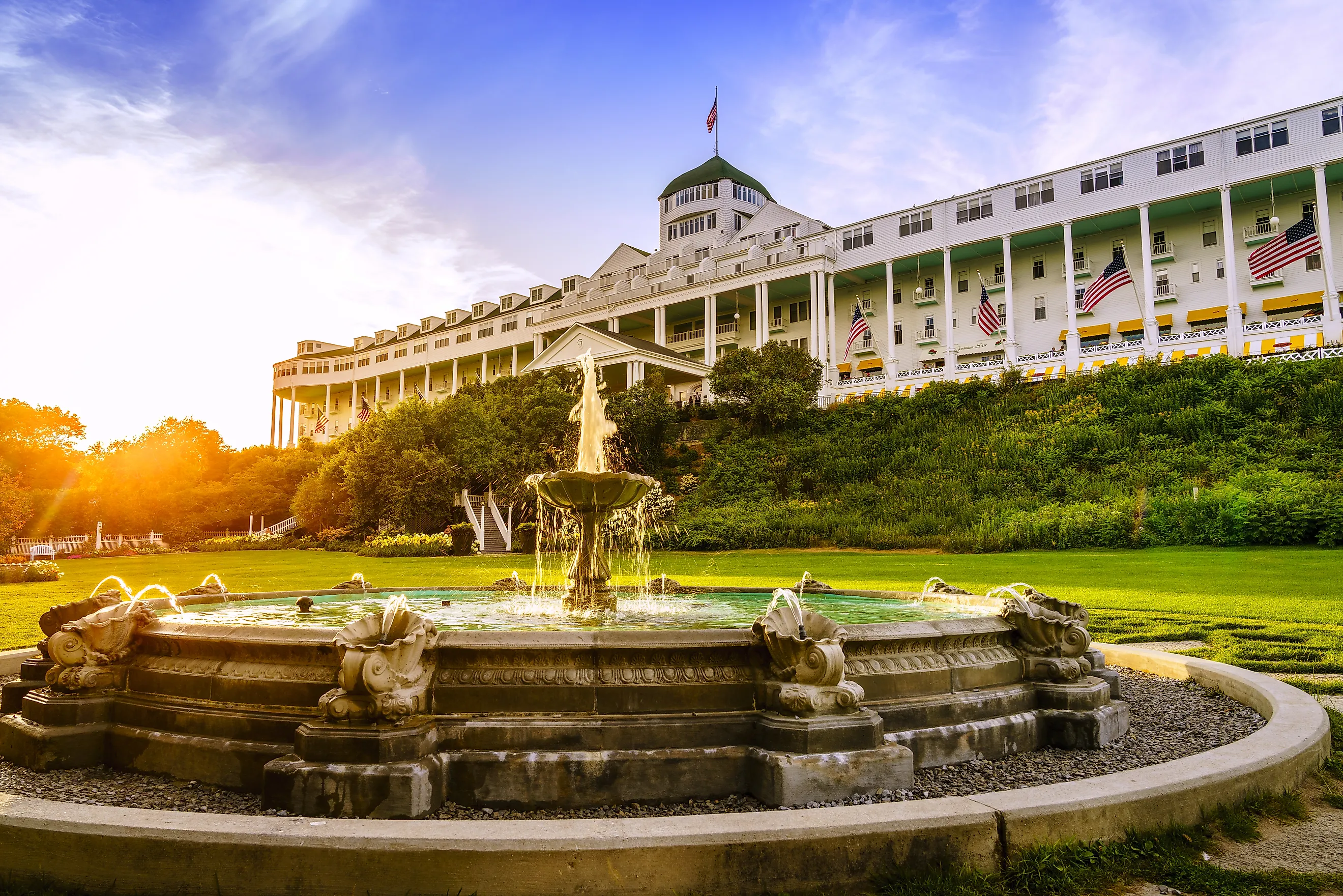
Grand Hotel, Mackinac Island, Michigan (1887)

Two railroads and a steamship line formed the Mackinac Island Hotel Company in 1886, and their property on Mackinac Island opened in July 1887 after just 93 days of construction. The hotel was built of Michigan white pine, and a 1958 state historical marker describes its front porch as the longest in the world. Rooms cost $3 to $5 a night that first summer, and guests arrived by lake steamer from as far afield as Chicago, Detroit, and Montreal.
The hotel passed through receivership in 1933, when William Stewart Woodfill bought it as sole owner, and the Musser family has managed it since 1951. It has always been a summer hotel, closing each fall, and arrivals still come by ferry and horse-drawn carriage on an island without cars. The hotel was designated a National Historic Landmark in 1989, and the Millennium Wing added 42 rooms at the east end in 2001.
Hotel del Coronado, Coronado, California (1888)

Elisha Babcock and Hampton Story bought the undeveloped Coronado peninsula in 1885 and set about building their hotel on a sandspit across the bay from San Diego. Construction began in March 1887, the first guests signed the register on January 29, 1888, and the main dining room served its first meal on February 19, the date the hotel keeps as its birthday. Its National Historic Landmark citation describes it as the first hotel in the world to use electric lighting.
Its wartime record adds to the hotel's character. The US Navy leased blocks of rooms from 1942 to 1946 for officers, and civilian guests were accommodated throughout the period as the hotel was never commandeered. The original five-story Victorian building remains in use alongside newer beachfront wings, and the Crown Room ceiling of sugar pine is still held together with wooden pegs.
The Omni Homestead Resort, Hot Springs, Virginia (1902)

The Homestead's history actually begins in 1766 when Captain Thomas Bullitt built an 18-room wooden hotel beside the hot springs in what is now Bath County. It stood on land granted for his service in the French and Indian War, and while the hotel's owner, Omni Hotels & Resorts, markets it as America's first resort, the building guests stay in isn't as old.
A fire that started in the pastry kitchen destroyed the hotel's original buildings in 1901, and the red brick Georgian Revival Great Hall that replaced them opened in 1902. This was followed by the West Wing in 1904, the East Wing in 1914, and the Tower in 1929. The Casino, built in 1893 for indoor badminton and golf lockers, rather than gambling, survived the fire and is now a restaurant.
Thomas Jefferson spent three weeks soaking in the nearby Warm Springs pools, now called the Jefferson Pools, in 1818, and the resort counts 23 U.S. presidents among its guests. Today, the resort covers more than 2,000 acres in the Allegheny Mountains with two golf courses, including the Old Course, home to what the resort calls the oldest first tee in continuous use in the country.
Old Resorts That Didn't Make The Cut
Although several properties claim to be older than our selection above, they fall outside the rules we've applied to this list. And hey, we think we're fair. Omni Bedford Springs in Pennsylvania keeps the Stone House of 1806, but the main hotel is the Colonial Building from 1829, and the resort closed in 1986 and didn't reopen until July 2007.
Congress Hall in Cape May traces its name back to a boarding house from 1816, but the present brick building dates from 1879. Guest rooms were closed by 1994, and it only reopened as a hotel in June 2002. The Omni Mount Washington in Bretton Woods, New Hampshire, opened in 1902 but closed in 1942 and only reopened in 1947, a gap longer than our wartime allowance.
Still Open After All These Years
The hotels included above share several things in common. Not only are they among the oldest still operating resorts in the country, but every one of them has kept its doors open through fires, world wars, the Great Depression, or changes in how people traveled, closing only when a war demanded it. These classic old resorts have kept on doing what they were created for. And that's welcoming folks like us.