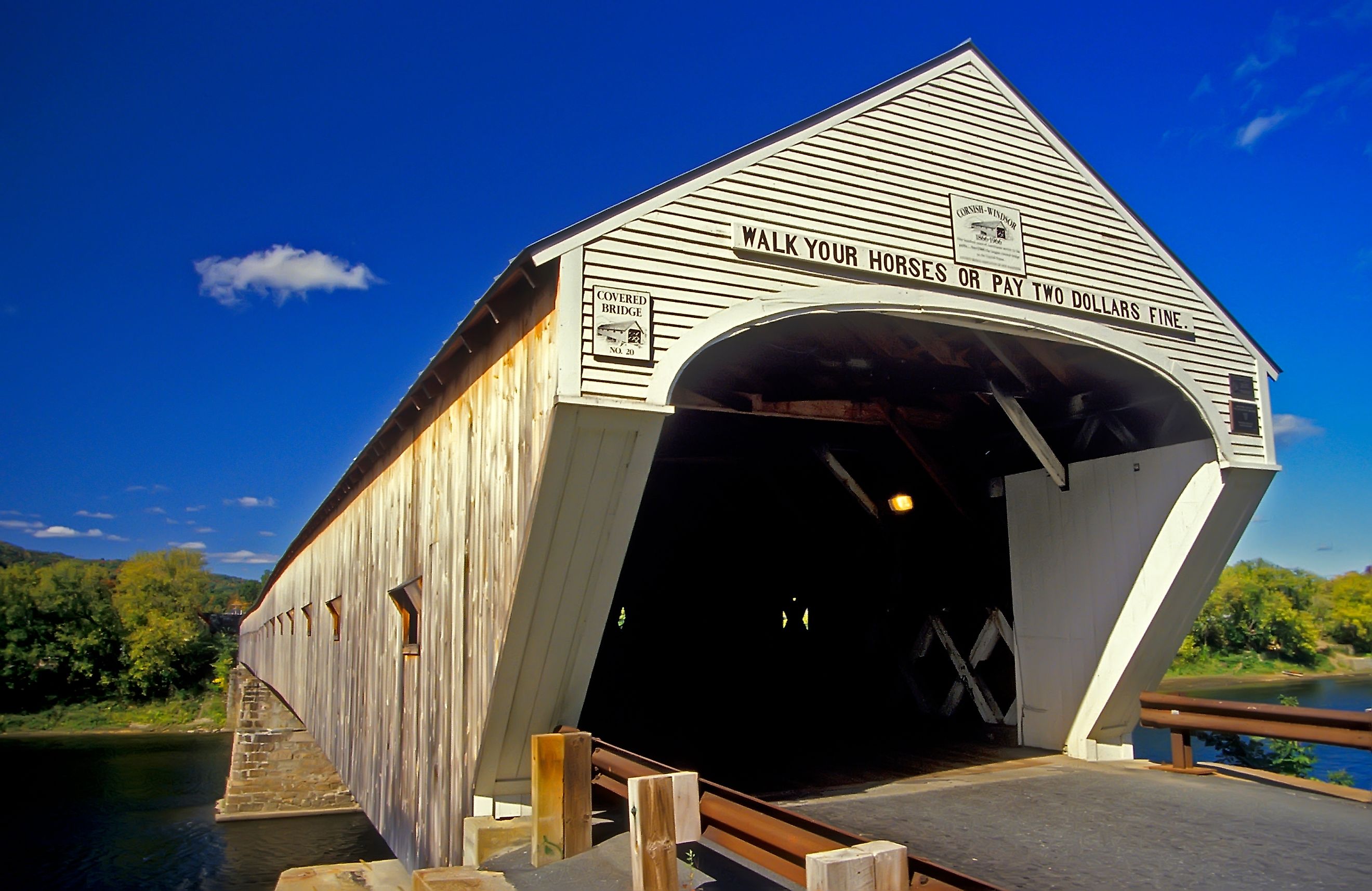
The Longest Wooden Bridge In America
The 460-foot (140-meter) lattice truss Cornish-Windsor Covered Bridge is America's longest wooden bridge. It links Cornish, New Hampshire, with Windsor, Vermont, as it stretches across the Connecticut River. Three bridges stood in its spot in 1796, 1824, and 1849. Floods washed them all away.
Deciding On The Top Rank

The Cornish-Windsor Covered Bridge gets the top spot, being the longest wooden trusswork bridge in the country. The bridge's lattice timber trusses are made entirely of wood and are load-bearing. Other bridges can rank first if the definition of "longest wooden bridge" changes. For instance, the 613-foot (187-meter) Smolen-Gulf Bridge in Ohio is the longest covered bridge, but it combines timber with steel. The Bridgeport Covered Bridge in California takes the title of longest clear single wooden span without middle river piers.
Building Towards A Lasting Legacy

Before the Cornish-Windsor Bridge was constructed, three other bridges washed away from the same spot. Each one was built higher than the last, to no avail. At the time, there was an abundance of timber in America and more than enough carpenters. This resulted in a bridge with load-bearing joints fastened with wooden pegs and a lattice pattern that distributes the load.
The bridge uses a lattice truss design patented by architect Ithiel Town, and it was built in 1866 by James Tasker and Bela Fletcher. It has two spans, each measuring around 204 feet (62 meters) lengthwise. The bridge features a stone pier at its center for support. The wood includes spruce and pine sourced from local forests. Constructed as a toll bridge for a modest $9,000, the bridge would eventually be purchased by New Hampshire in 1936. It was made toll-free in 1943. The original sign telling people to "walk your horses or pay a two-dollar fine" is still up on the bridge, making for a great photo backdrop.
Restoring The Cornish-Windsor Covered Bridge

In 1980, it became clear that the bridge needed a renovation. The wooden planks were sagging on both ends of the stone pier, and the wood was also becoming thin. By 1983, hearings were held to discuss the repairs and renovation costs, with a goal set for 1987. Nothing much happened until 1985, when officials abandoned the project due to a lack of funds.
Two New Hampshire state representatives intervened at the start of 1986. Merle Schotanus and Sara Townsend proposed a highway amendment bill that would set aside funding for the renovation. The problem was far from over, however, since preservation groups could not agree on building methods or materials. There was also a major argument about who would be selected to complete the project. In the end, Chesterfield Associates served as general contractor, with David C. Fischetti as engineer and Jan Lewandowski as timber framer. Milton and Arnold Graton, well-known covered bridge builders, took part in the preservation discussions.
It took around two and a half years to complete the rehabilitation and renovation. During that time, motorists had to take a long detour through West Claremont and Ascutneyville. On a freezing December 8, 1989, a crowd made its way to the bridge to witness its reopening.
Is The Cornish-Windsor Covered Bridge Still In Use Today?

The Cornish-Windsor Covered Bridge is still fully operational. However, as of this writing, motorists are expected to detour around the bridge yet again. The bridge will be closed between 7:00 a.m. and 3:00 p.m. on weekdays for deck plank repairs, and it is expected that the closures will last until the end of November 2026. It will be open on weekends throughout the repair period.
Wooden Bridge Contenders

As mentioned earlier, the criteria for longest wooden bridges are not static. If it changes to hybrid designs, Ohio's Smolen-Gulf Bridge takes top honors. At 613 feet (187 meters), the bridge with its wood and steel design is the longest overall covered bridge in the US. California's Bridgeport Covered Bridge spans the South Yuba River and is 230 feet (70 meters) long. It is the longest wooden span without a central pier in the country. California boasts another impressive wooden bridge with the Knights Ferry Covered Bridge crossing the Stanislaus River. Built in 1864, in the years after the Gold Rush, the bridge is 330 feet (101 meters) long with a Howe truss framework. It also holds its own record as the longest historic covered bridge west of the Mississippi River.

The Medora Covered Bridge in Indiana spans 431 feet (131 meters) across the East Fork of the White River. It was built in 1875 using a triple-span Burr arch truss system. The bridge carried vehicles for nearly 100 years before closing to traffic and allowing only pedestrians to cross it. Another contender is New Hampshire's Bath Covered Bridge. Built in 1832, it still stretches 375 feet (114 meters) across the Ammonoosuc River. It was built using a Burr truss framework, reinforced with supplemental arches, and features four spans. The bridge is one of the oldest surviving long-span timber bridges in the country. It has its own historic sign too, stating "one dollar fine to drive any team faster than a walk on this bridge."
How Wooden Bridges Survive The Elements

Keeping a wooden bridge standing across a river for more than a hundred years is not easy. Wooden bridges are highly susceptible to moisture, so rain and snow will rot the joints and beams. Sloped roofs and side walls help keep water, snow, and sun off the wooden frame and the roadway. Flooding is also a major problem, but stone piers and foundations help keep bridges above flood levels. The wood is also treated with chemicals and flame retardants, which help prevent fire damage and rot. Wooden bridges also have weight limits that keep trucks from damaging their frames.
The Epitome Of America's Wood Construction Era
The Cornish-Windsor Covered Bridge still relies on its historic timber lattice trusses. It has stretched across the Connecticut River without major failure for about 160 years. It still carries daily traffic between two states, when not closed for maintenance, and stands out as a prime example of America's timber era.