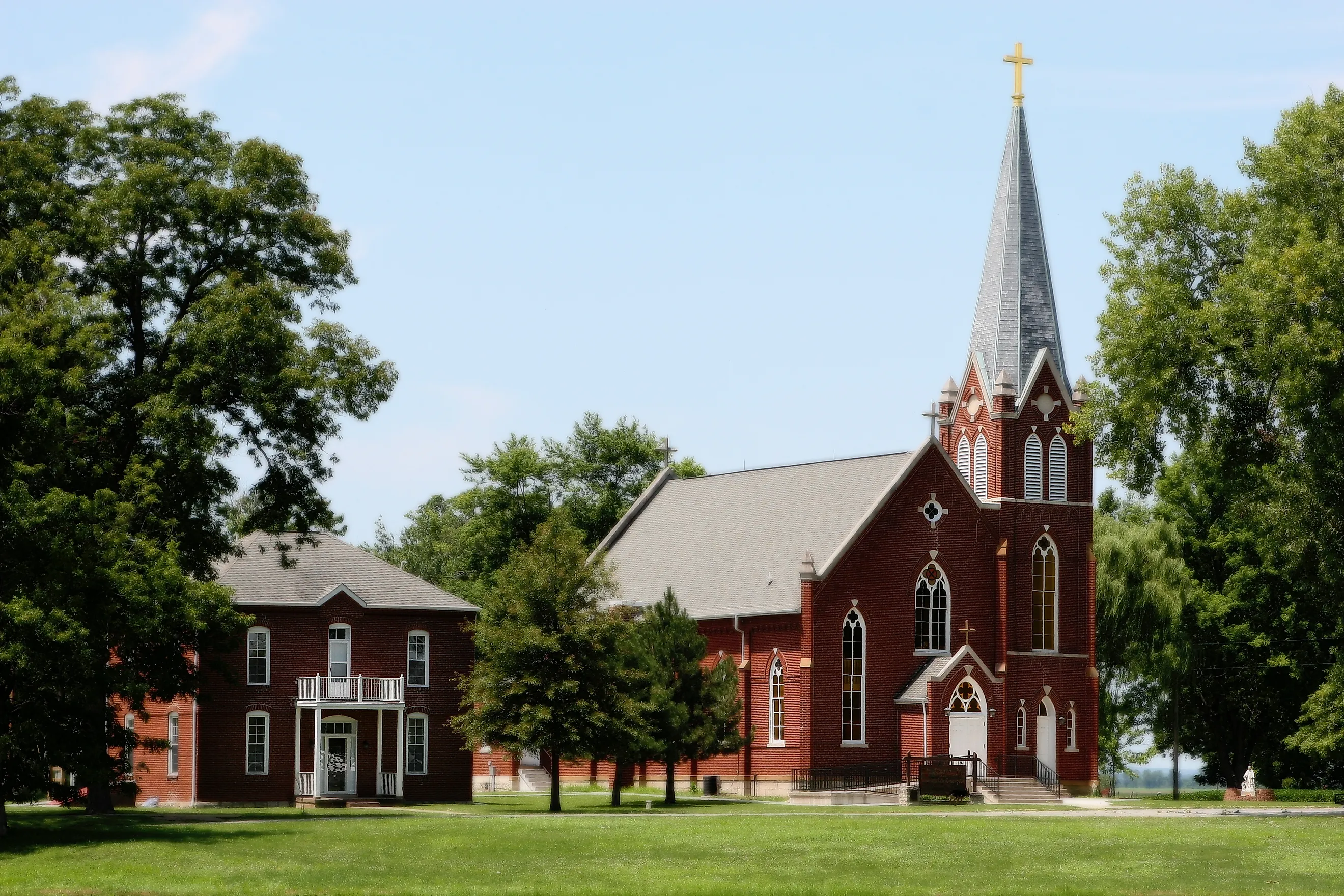
8 Oldest Founded Towns to Visit in Illinois
Illinois's oldest towns go back to 1699. French missionaries built the state's first permanent European settlement at Cahokia. Kaskaskia came next in 1703 and became the first state capital. Prairie Du Rocher followed in 1722. River trade pulled later settlers toward the Ohio and the Mississippi. Each one opened its first chapter before Illinois became a state.
Alton

Rufus Easton founded Alton in 1818. The town climbs the Mississippi bluffs about 15 miles north of St. Louis. It packs in a wild roster. Jazz trumpeter Miles Davis was born here in 1926. Robert Wadlow was born here in 1918. Guinness World Records lists him as the tallest person ever at 8 feet 11.1 inches. The final Lincoln-Douglas debate happened here on October 15, 1858. Bronze statues mark the downtown spot today.
Alton also ranks among the most haunted towns in the country. Ghost tours visit the McPike Mansion from 1869, the Mineral Springs Hotel from 1914, and Milton School from 1904. Spirits are not the only draw. The Alton Marina, the Jacoby Arts Center, and the Melvin Price Locks and Dam make an easy afternoon. The Argosy Casino overlooks the waterfront.
Edwardsville

Thomas Kirkpatrick built the first log cabin here in 1805. Madison County formed in 1812. It made his farm the county seat. The town took the name Edwardsville in 1815. The name honored Ninian Edwards, the only territorial governor Illinois ever had. He served from 1809 to 1818. He returned as state governor from 1826 to 1830. Edwardsville now counts as the third oldest city in Illinois.
Historic US Route 66 ran through here on its 1926 alignment. The Wildey Theatre opened downtown as an opera house in 1909. A full restoration brought it back. It books live music and films today. More than 30 buildings carry historic designations across three local districts. Abraham Lincoln passed through often in the 1840s and 1850s. He came as a circuit-riding lawyer and stump speaker. Markers around town point out where.
Carmi

Carmi rose along the Little Wabash River in White County. Families from Kentucky and Tennessee settled the ground between 1809 and 1814. The town dates to 1814. It was chartered in 1816. Politics goes deep here. Four members of the US House came out of Carmi. They include John M. Crebs, James Robert Williams, and Roy Clippinger.
The first White County courthouse still stands here too. It is a double-pen log cabin built in 1814, now a museum. US Senator John M. Robinson later lived in it. The Ratcliff Inn put up Abraham Lincoln for the night in 1840. He came through stumping for the Whig ticket that fall.
Peoria

Native people named this lake Pimiteoui, or fat lake, for its endless fish and game. Louis Jolliet and Father Jacques Marquette paddled past in 1673. Henri de Tonti and François Daupin de La Forest built Fort Pimiteoui in 1691. The fort marked the site of modern Peoria. American settlers arrived in 1819. Peoria became a city in 1845.
History stacks up fast in Peoria. The Peoria Riverfront Museum, the Springdale Cemetery, and the Peoria Historical Society all dig into the region's past. Guided bus tours roll along the riverfront. They stop at the John C. Flanagan House, the oldest home in town from 1837. They also visit the Civil War-era Pettengill-Morron House.
Prairie Du Rocher

The name means prairie by the rock. Prairie Du Rocher has worn it since 1722. French colonists settled it as the fourth village in the Illinois Country. Fort de Chartres had gone up nearby two years earlier as the regional command post. The town did well as a Mississippi trade stop. Boats linked New Orleans with the French settlements up in Quebec. Wheat and other crops floated downriver from these bottomlands.
Some families here still trace their roots to those first French settlers. The town's old landmarks mix French Colonial and early American styles. The Creole House on Main Street dates to around 1800. It serves as a museum now. It shows off the vertical-post construction the French favored in Illinois. St. Joseph Cemetery includes the graves of French Colonial settlers. A memorial stone marks the early French Illinois community.
Shawneetown

Shawneetown lines the Ohio River in Gallatin County. It lies in the state's southeast corner. A Shawnee village and burial grounds stood here first. Settlers established the town in 1810. The place boomed as a center of trade, banking, and migration. It ranked alongside Kaskaskia as one of territorial Illinois's two most important towns.
The Ohio flooded it again and again. The worst hit in 1937. Fifteen feet of water poured through the streets. The state moved the whole town three miles northwest to higher ground. The move started in 1938 and took years. Whatever remained became Old Shawneetown. Walking tours pass the Bank of Illinois there. It was completed in 1841 as the oldest bank building in the state.
Kaskaskia

Kaskaskia counts among the oldest communities in Illinois. The Illinois and Iroquois peoples lived here first. Jesuit priests set up the Mission of the Immaculate Conception in 1703. Fertile bottomland and the Mississippi River fed the village. It grew into a hub for farming and fur trading. Its population reached around 7,000 by the early 1800s. The town incorporated in 1818. It became the first capital of Illinois that same year.
Then the river turned on it. A major flood in 1881 cut a new channel. It stranded Kaskaskia on the wrong side of the Mississippi. The town remains the only piece of Illinois west of the river. You reach it only through St. Mary, Missouri. The Church of the Immaculate Conception, rebuilt in 1894, still shelters the 1741 bell. People call it the Liberty Bell of the West. The church and the Kaskaskia Bell State Memorial stand as state historic sites today.
Cahokia

Cahokia takes the title of first permanent European settlement in Illinois. French missionaries from the Seminary of Quebec founded it in 1699. The town stood along the Mississippi in what is now St. Clair County. The name comes from the Cahokia people, a sub-tribe of the Illinois Confederation. It translates as wild geese. The village served for decades as a center of French influence along the upper Mississippi Valley.
The town no longer exists on its own. Cahokia merged with Centreville and Alorton on May 6, 2021. The three formed the new City of Cahokia Heights. Its deepest roots still stand. The Holy Family Catholic Church on First Street dates its parish to 1699. It counts as the oldest continuously operating Catholic parish west of the Allegheny Mountains. A wooden log church from around 1799 still hosts services.
Bonus Spot: Cahokia Mounds

The Cahokia Mounds rise a few miles from Collinsville. They predate every town here by centuries. This UNESCO World Heritage Site was the largest pre-Columbian settlement north of Mexico. The city spread across about 2,200 acres. Its population peaked between 10,000 and 20,000 around 1100 CE. By about 1250, more people lived here than in London.
The Cahokia Mounds State Historic Site protects the central ceremonial complex. That complex thrived between about 1000 and 1350 CE. You can climb the 100-foot Monks Mound. It is the largest prehistoric earthwork in the Americas. The Interpretive Center lays out life-sized scenes of Mississippian life, a film, and the Tunica Stone collection. Trail maps, guided tours, and a gift shop round out the visit.
Older Than The State Itself
Illinois history goes a lot deeper than the Chicago skyline lets on. The Holy Family log church in Cahokia has served its parish since 1699. The Liberty Bell of the West rests on Kaskaskia Island. A French king ordered it cast in 1741. Monks Mound rises over the ground of a city that once outgrew London. A short loop south of St. Louis ties these places together. Every one opened its doors before Illinois was a state.