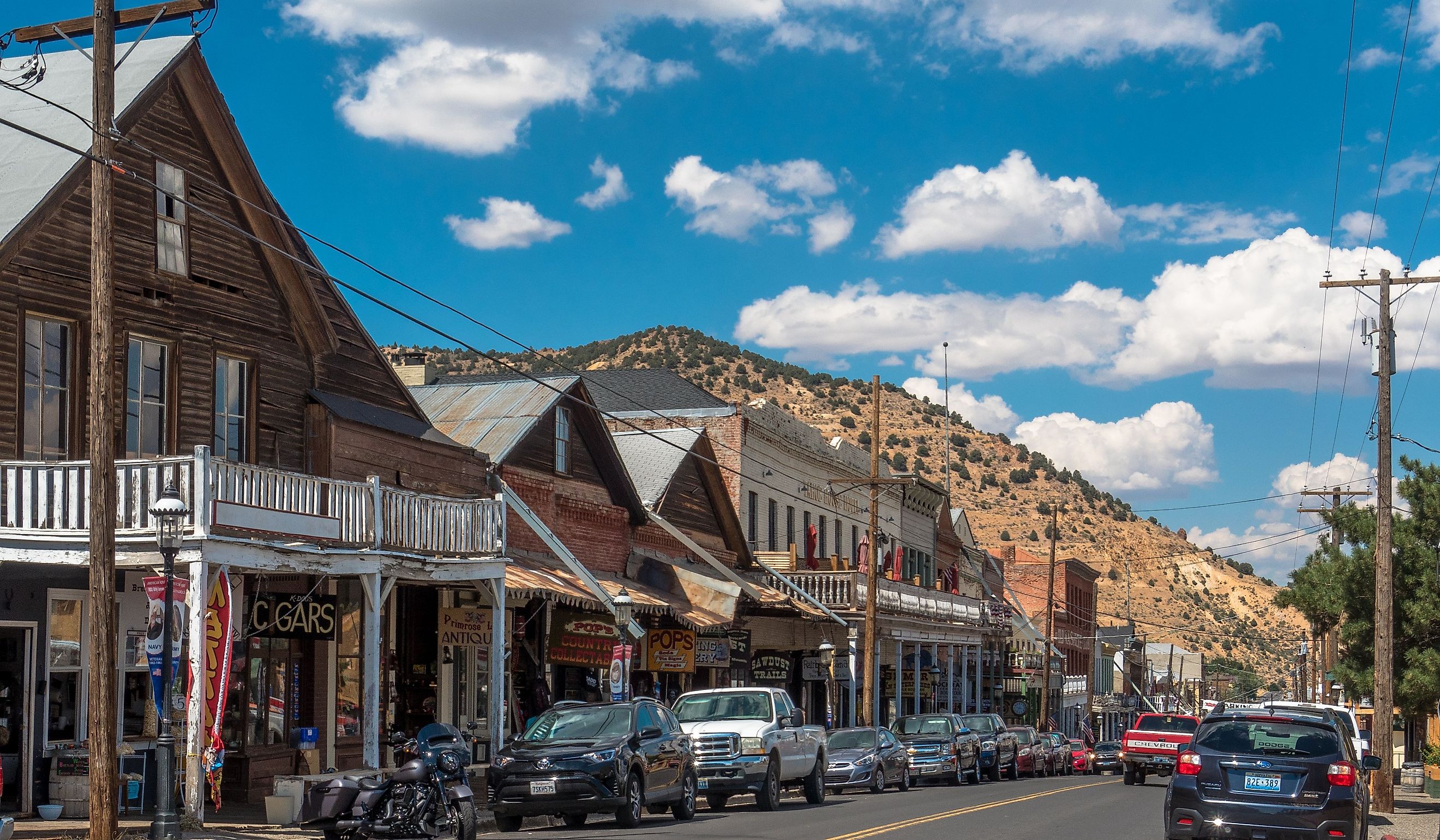
9 Most Charming Town Squares In Nevada
A town square in Nevada does not always look like a town square. Some are courthouse blocks. Some are old mining streets running uphill. Some are roughly two intersections of brick and neon under a desert sky. The nine ahead each gather around something a visitor can stand in front of and remember. Show up before nine on a weekday and you can see why people who live here stay.
Virginia City

Virginia City sits about half an hour south of Reno on Sun Mountain, with the kind of main street that holds together because nobody got around to tearing it down. C Street runs through the center with wooden boardwalks, balconied saloons, and brick fronts that date to the silver-rush years between 1859 and the late 1870s. At its Comstock-era peak the town held roughly 25,000 people. The current count is under 800.
The Virginia City Historic District covers most of what a visitor sees. Piper's Opera House on B Street has been hosting performances since 1885 and still does, with the original maple stage floor and slope. The Way It Was Museum holds the Comstock mining tools and equipment in one room, including hardware that worked the Big Bonanza ore body. The Fourth Ward School at the south end of town, four stories of clapboard, ran classes from 1876 to 1936 and now operates as a museum that does not pretend it is anything else.
Genoa

Genoa lies in the Carson Valley at the foot of the eastern Sierra and was the first non-native settlement in what later became Nevada. Mormon Station opened as a trading post on the California Trail in 1851 and the reconstructed buildings sit on the original site at the center of town, surrounded by lawns, mature oaks, and a fence of split rails that the state park service maintains.
The Genoa Bar and Saloon down the block has poured drinks since 1853, which makes it the oldest continuously operating saloon in Nevada and one of the oldest in the country. The walls hold the original lighting fixtures and a mirror that was hauled around the Horn in the 1860s. The Genoa Courthouse Museum across the street covers local history through the territorial years and statehood. Dangberg Home Ranch Historic Park, two miles north, runs tours of the ranch house that the Dangberg family lived in from the 1850s through the 1970s. The valley has not changed much in any direction.
Boulder City

Boulder City was built in 1931 to house the workforce constructing Hoover Dam, on a planned street grid laid out by the federal government with no saloons, no casinos, and no commercial alcohol allowed for the duration of the project. The gambling ban stuck. Boulder City and the unincorporated town of Panaca remain the only two communities in Nevada where gambling is illegal.
The Boulder City Historic District covers the downtown of stucco shopfronts, shaded courtyards, and a city park that doubles as the front yard for most of the buildings around it. The Boulder Dam Hotel, built in 1933 for visiting dignitaries during dam construction, still operates as a hotel and holds the Boulder City Hoover Dam Museum on its upper floors. The Boulder Theatre on Arizona Street opens for the Dam Short Film Festival in February and a regular calendar of showings through the year. Las Vegas sits about 25 miles west, but the city limits feel longer than that.
Ely

Ely sits at the eastern end of US-50, the stretch of road that Life Magazine called the loneliest road in America in 1986 and that the state of Nevada has been advertising as such ever since. The town is the county seat of White Pine County and runs about 3,800 people. Aultman Street is the main commercial block, with brick storefronts, neon signs from the casino era, and the Ely Renaissance Project murals filling the walls between them.
The Nevada Northern Railway Museum sits at the north edge of downtown on the original 1907 rail yard, with three working steam locomotives, the depot, the machine shops, and excursion rides into copper country. The Ward Charcoal Ovens State Historic Park is about 20 miles south, with six beehive-shaped ovens built in 1876 to make charcoal for the silver smelters. Renaissance Village covers a row of restored ethnic miners' homes from the early 1900s on the town's east side.
Gardnerville

Gardnerville lies just south of Minden in the Carson Valley, with US-395 running through the middle of downtown. The valley keeps it agricultural in feel, with ranches and hayfields running out from the edges of town in every direction. The Carson Valley Museum and Cultural Center on Highway 395 holds Washoe Tribe history, ranching history, and the Basque sheepherding history that ran through these hills.
The Basque connection is the one to follow. The valley took in shepherds from the Pyrenees through the late 1800s and the families stayed. The J&T Basque Bar and Dining Room on Main Street has been serving family-style meals since 1947, with picon punch, lamb stew, and beans on a fixed-price menu that does not change much. Sharkey's Casino down the block ran the same family ownership for decades and still keeps a small museum on the walls. The Heritage Park Gardens at the south end of town keeps the rest of the agricultural history in a row of interpretive panels.
Winnemucca

Winnemucca lies along the Humboldt River on Interstate 80 in north-central Nevada, halfway between Battle Mountain and Lovelock, and very much a working town rather than a tourist stop. The Humboldt Museum on the west side of downtown covers the local history through the Paiute presence, the Central Pacific Railroad arrival in 1868, and the long ranching years that followed. The Buckaroo Hall of Fame in the same building documents the cowboy tradition of the northern Great Basin.
Winnemucca picked up its own Basque population at the turn of the twentieth century and the Martin Hotel on Railroad Street has been serving family-style meals since around 1898. The dining room runs picon punch, soup, salad, beans, and a choice of lamb shanks or sweetbreads or steak under one fixed price. The Winnemucca Historic Walking Tour links the older brick blocks downtown, including the early hotels along Bridge Street and the railroad-era buildings that still hold the commercial district together.
Lovelock

Lovelock built one of two round courthouses still in use anywhere in the United States. The Pershing County Courthouse, designed by Reno architect Frederic DeLongchamps and completed in 1921, sits in the center of town inside a Greek Revival circular plan. The courtroom is in the round and the judge's bench sits at the geometric center of the building.
Lovers Lock Plaza behind the courthouse picked up its name from the chain installations that couples attach padlocks to with their names and dates. The tradition borrows from older European versions and the locks are now heavy enough that the town has to clear them every few years. The Marzen House Museum a few blocks away, in the 1874 Italianate ranch house of George Marzen, runs Lovelock's local history through agriculture and mining.
Eureka

Eureka also sits on US-50, about 80 miles west of Ely in the kind of high desert valley where you can see the next mountain range while still standing in this one. The town has fewer than 500 people and is the county seat of Eureka County. The Eureka Opera House on the main block opened in 1880, closed for decades, and reopened in 1993 after a full restoration. It still books touring acts and the kind of community theater that the county turns out for.
The Eureka County Courthouse next door dates from 1880 and runs court and county business out of the same building it always has. The Eureka Sentinel Museum sits in the 1879 building of the local newspaper, with the original presses, type cases, and back issues intact. The Eureka Historic District extends along Main Street for about two blocks of brick fronts that quit pretending to be anything other than themselves.
Pioche

Pioche is a hillside town in Lincoln County built on silver mining, and its violent reputation through the 1870s outpaced even Virginia City for a stretch. The town's most famous building is the Lincoln County Courthouse, locally known as the Million Dollar Courthouse, which was originally budgeted at about $26,400 in 1871 and ended up costing close to a million dollars by the time the bonds and interest finally cleared in 1937, fifty-six years after the building had been abandoned as unsafe.
Boot Hill Cemetery up the slope above town holds roughly 100 graves, and the wooden markers note that most of the early occupants died with their boots on. Thompson's Opera House, restored and reopened in the 1990s, runs as a venue and museum on Main Street. The Pioche Aerial Tramway above the streets is the remnant of the gondola buckets that carried ore from the hillside mines down to the mill at the bottom of town. The cables still hang over Main Street, with a couple of original buckets parked at each end.
Nine Nevada Downtowns That Stayed Themselves
Nine downtowns, nine different reasons to stop. The mining towns kept the look they had when the mines were running. Genoa kept the trees and the lawn. Gardnerville and Winnemucca kept their valleys and their family-style dining rooms. Boulder City kept the planned street grid and the no-casino rule. None of these town centers feels staged, because none of them was built for the visitor. They were built for the people who already lived here, and they still are.