8 Small Towns on the Pacific Coast to Visit for a Weekend Getaway
Haystack Rock stands 235 feet out of the Pacific at Cannon Beach, Oregon, close enough to the sand to reach on foot at low tide. Friday Harbor, Washington, is the main town on San Juan Island, where Lime Kiln Point is one of the best places in the country to watch orcas from shore. Just up the coast from Cambria, California, Hearst Castle looks down from the hills above San Simeon, its 165 rooms built for William Randolph Hearst by the architect Julia Morgan. The road to Anacortes crosses the Deception Pass bridge high above a channel that churns when the tide turns.
Anacortes, Washington

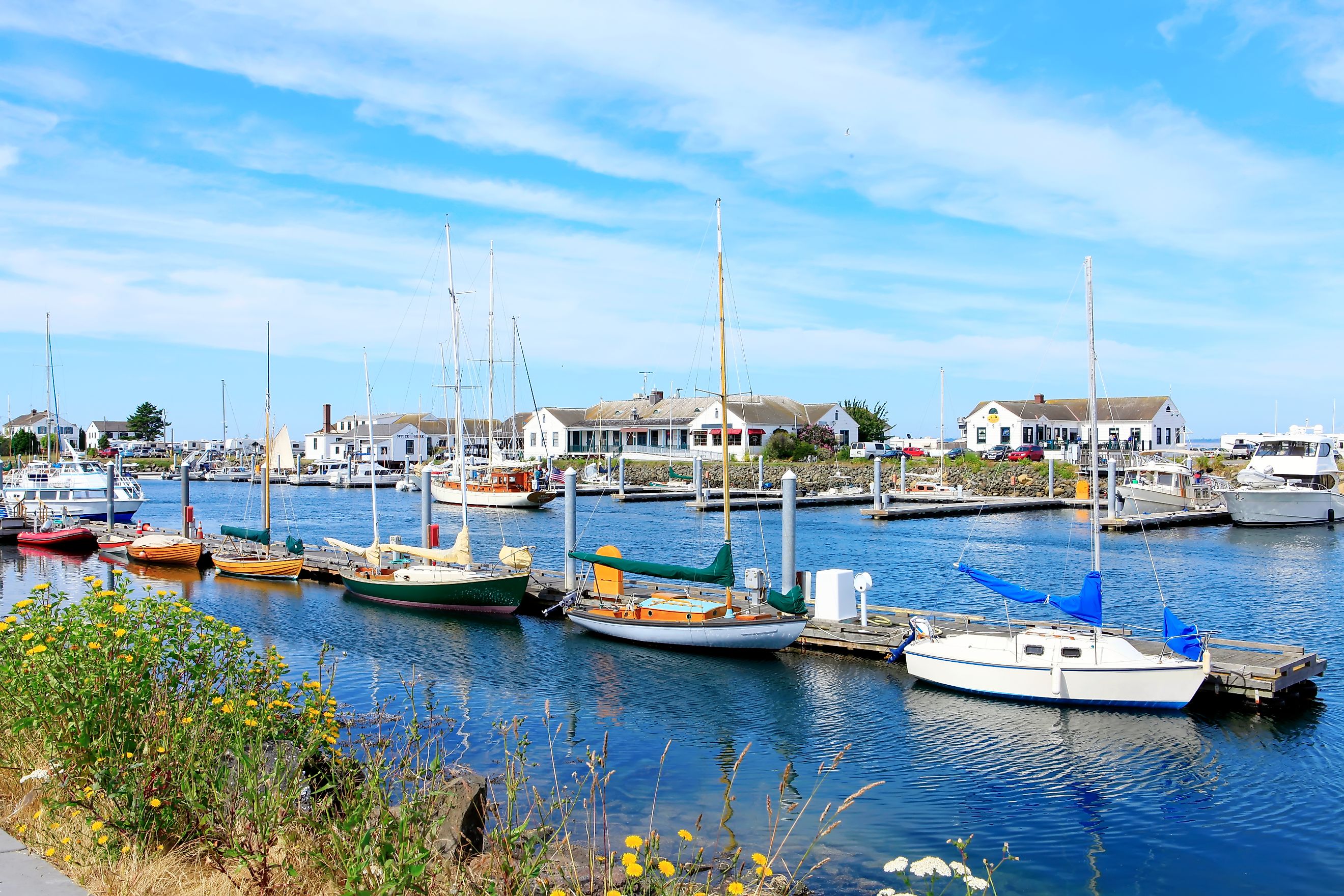
Anacortes is on Fidalgo Island in Washington, at the northern edge of the Salish Sea. It is the departure point for the state ferries that cross to the San Juan Islands, and a working town with a long fishing and shipbuilding past. The W.T. Preston, a retired sternwheel snagboat that once cleared debris from Puget Sound rivers, rests on the waterfront as a museum.
Deception Pass State Park, one of the busiest in Washington, spans the channel between Fidalgo Island and Whidbey Island, crossed by a pair of high bridges above the swirling tidal current. Mount Erie, the high point of the island, gives a view over the water and the San Juans on a clear day. A short ferry crosses to Guemes Island, quieter still, with forest trails and a small year-round community.
Friday Harbor, Washington

Friday Harbor is the main town of the San Juan Islands, on San Juan Island, reached only by ferry or small plane. The ferry pulls in at the center of town, and the waterfront crowds with sailboats and whale-watching boats through the summer. Resident and transient orcas pass through the surrounding waters, along with humpbacks and minke whales.
Lime Kiln Point State Park, on the island's west side, is one of the best places in the country to watch orcas from shore, named for the old kilns that once supplied the island's main industry. The lighthouse there marks the edge of Haro Strait. In town, the San Juan Islands Museum of Art shows regional and visiting work, and kayaks launch from the harbor for trips along the forested shore.
Port Townsend, Washington

Port Townsend stands at the northeast tip of the Olympic Peninsula, where the Strait of Juan de Fuca meets Puget Sound. A building boom in the 1880s left it with blocks of ornate brick and Victorian buildings, and when the railroad went elsewhere and the boom collapsed, the buildings simply stayed. It is now one of only three Victorian seaport districts in the country, and the best preserved on the West Coast.
The Jefferson County Historical Society Museum, in the 1892 city hall, lays out that history. Fort Worden, a decommissioned coastal artillery post north of town, is now a state park, its gun batteries and parade ground open to walk, with the Point Wilson Lighthouse at the water's edge. The Wooden Boat Festival each September brings traditional craft into the harbor.
Cannon Beach, Oregon

Cannon Beach stretches about four miles along the northern Oregon coast, its low cedar-shingled buildings set back behind the dunes. The town took its name from a cannon that washed ashore from the wreck of the USS Shark in 1846. Haystack Rock, the 235-foot basalt monolith offshore, dominates the view from almost everywhere in town.
At low tide the rock's base opens into tide pools of sea stars and anemones, protected as a marine garden where climbing is banned to spare the nesting puffins. Ecola State Park, just north around Tillamook Head, has the forest trails and headland overlooks that Lewis and Clark reached in 1806. Hemlock Street, a block off the sand, is lined with the galleries and cafes the town is known for.
Bandon, Oregon

Bandon stands at the mouth of the Coquille River on the southern Oregon coast, a town of about 3,300 rebuilt in the late 1930s after a fire leveled the old downtown. Its Old Town now has galleries, a cranberry-candy shop, and a working harbor. Cranberry bogs spread across some 1,800 acres in the country around it.
Bandon Dunes Golf Resort, opened in 1999 on the cliffs north of town, brings golfers from around the world to its links-style courses along the ocean. South of town, Face Rock State Scenic Viewpoint looks out on a sea stack that a Coquille story tells of as a chief's daughter turned to stone. The Coquille River Lighthouse stands across the water at Bullards Beach State Park.
Cambria, California

Cambria is a village on the California central coast, between San Simeon and Morro Bay, built in two halves a mile apart, the inland East Village and the seaside West Village. It started in the 1860s as a mining and timber town, and one of the last native stands of Monterey pine grows on the hills behind it. Galleries and cafes occupy the old storefronts of the East Village now.
Moonstone Beach, on the western edge, has a boardwalk above the tide pools and the rocky shore. Just north, Hearst Castle stands on a hilltop above San Simeon, the estate William Randolph Hearst and the architect Julia Morgan built between 1919 and 1947, with 165 rooms and 127 acres of gardens, pools, and terraces. It now belongs to the state and is open for tours.
Mendocino, California

Mendocino stands on a headland above the Pacific in California, about 155 miles north of San Francisco. Lumber money built it in the 1850s and 1860s in the style of New England, with white clapboard houses, a steepled church, and wooden water towers, and that look has put it on screen for decades, standing in for coastal Maine and places it is not. The whole village fits on the bluff.
Mendocino Headlands State Park wraps the village on three sides, with trails along the cliffs and down to the coves. The Ford House, an 1850s home on Main Street, serves as the town's museum and visitor center. South of town, the Mendocino Coast Botanical Gardens run down to the ocean bluffs, and the Point Cabrillo Light Station, a 1909 lighthouse, stands on the headland to the north.
Carmel-by-the-Sea, California

Carmel-by-the-Sea is a one-square-mile town on the Monterey Peninsula, an artist colony since the early 1900s and incorporated in 1916. It still follows a set of old rules, no street addresses, no traffic lights, and no chain stores, and its center is a walkable grid of stone-and-timber cottages, galleries, and restaurants. A white-sand beach closes off the foot of Ocean Avenue.
The Carmel Mission, formally San Carlos Borromeo de Carmelo, was moved to the site in 1771 by Junipero Serra, who is buried there. The Carmel Art Association, founded in 1927, shows work by local painters and sculptors, part of the gallery scene at the center of the town. Point Lobos, a state reserve of coves and cypress just south, ranks among the most painted stretches of the California coast.
The Pacific On A Long Weekend
None of these towns takes more than a weekend to get the measure of, which is the point. Port Townsend trades on its Victorian streets, Bandon on links golf above the surf, Mendocino on a New England village that wandered west, Carmel on an old mission and a mile of galleries. The water shifts along the way, calm island channels in the north, open ocean on the California coast, but the appeal does not change, a small town, a short stay, and the Pacific a few steps from the door.