10 Strangest Landmarks in The United States
In Casey, Illinois, there is a rocking chair that weighs 46,200 pounds, and it is not even the strangest thing on this list. The United States has produced a building shaped like a picnic basket, a palace redecorated annually in corn, a stone circle nobody can explain, and a government facility everybody explains constantly. None of it was inevitable, and most of it was somebody's entirely serious idea. These ten landmarks are what happens when a big country has spare time, spare steel, and a healthy disregard for the question "but why."
World's Largest Rocking Chair, Casey, Illinois

The World's Largest Rocking Chair stands 56 feet tall, weighs 46,200 pounds, and took the title in 2015 from the previous champion in Cuba, Missouri, because in the world of giant chairs there is always a bigger throne. Local businessman Jim Bolin built it, and Guinness rules required one inconvenient thing: a rocking chair has to rock. It does, provided enough people push. The chair is also not alone. Casey, a town of a few thousand, has committed fully to the genre, with the world's largest wind chime, mailbox, and pitchfork among its collection, making it possibly the only place in America where the water tower is the understated part of the skyline.
Bubblegum Alley, San Luis Obispo, California

Bubblegum Alley in downtown San Luis Obispo, California, is a passage about 70 feet long with 15-foot walls coated in tens of thousands of pieces of chewed gum, contributed one mouth at a time by decades of visitors. Accounts of its origin vary: some trace it to graduating high school classes after World War II, others to a rivalry between local students and California Polytechnic State University. The city has scrubbed the walls clean more than once over the years. The gum always wins. Today it stands as a monument to collective effort, in the medium the public apparently had on hand.
America's Stonehenge, Salem, New Hampshire

Spread across 30 acres in Salem, New Hampshire, America's Stonehenge is a maze of stone chambers, walls, and standing rocks with a genuinely disputed past. The attraction points to radiocarbon dates and argues the site is up to 4,000 years old, with theories crediting everyone from ancient Native peoples to wandering Norsemen and Celts. Mainstream archaeologists are less romantic, attributing most of the structures to colonial-era farmers and to heavy rearranging by a 1930s owner. The centerpiece "Sacrificial Table" carries a groove around its edge that closely resembles the lye-leaching stones colonial households used for making soap, which means the site's most sinister artifact may actually commemorate laundry. Nobody has settled the argument, which is precisely why people keep coming.
Mystery Spot, Santa Cruz, California

In the redwoods above Santa Cruz, the Mystery Spot has been disorienting visitors since 1941 with a tilted cabin where balls appear to roll uphill, people lean past their toes without falling, and everyone in your group changes height depending on where they stand. The effect is a masterclass in visual illusion: the crooked building removes every level reference your brain relies on, and your eyes do the rest. California made it official in 2014, designating the Mystery Spot a California Historical Landmark, giving the state the distinction of formally protecting a place whose entire purpose is convincing you that gravity is negotiable.
Area 51, Lincoln County, Nevada

Area 51 is a classified Air Force installation inside the Nevada Test and Training Range, formally known as Homey Airport, and for decades the government's position on it was that there was nothing to have a position on. The CIA only publicly acknowledged the base in 2013. The secrecy fed generations of UFO lore, though the agency's own declassified explanation for the 1950s sighting wave is almost better: the U-2 spy plane, tested at the site, flew so much higher than anything else in the sky that startled airline pilots reported it as otherworldly. Claims of stranger things, including a former worker's story of an underground facility near Papoose Lake, keep the folklore healthy. Whatever actually happens there, Area 51 remains the only landmark on this list you cannot visit, which has done wonders for its reputation.
The World's Largest Thermometer, Baker, California

The World's Largest Thermometer in Baker, California, stands exactly 134 feet tall, and the number is the entire point: it honors the 134 degrees Fahrenheit recorded in nearby Death Valley on July 10, 1913, still the hottest air temperature ever officially recorded on Earth. Local businessman Willis Herron put it up in 1991 as a beacon for travelers on the way to the hottest place in America. The tower went dark in 2012 when the electric bills got the better of it, an irony Death Valley itself has never had to face, but it was restored and shines again today, gift shop at its base, faithfully reporting temperatures that make everyone glad the car has air conditioning.
Four Corners Monument, Arizona

The Four Corners Monument marks the only place in the country where four states meet: Arizona, New Mexico, Colorado, and Utah. The monument sits on Navajo Nation land, which manages the site and collects admission from the roughly quarter-million visitors who arrive each year to plant a limb in each state, photograph the moment, and occasionally position a patient dog with one paw in each. The best part is a surveying footnote: modern measurements found the marker sits some 1,800 feet from where the boundaries were originally intended to cross. It does not matter. Under long-settled law, the monument itself defines the corner, making Four Corners the rare American landmark that is officially in the wrong place and legally incapable of being wrong.
The World's Only Corn Palace, Mitchell, South Dakota

Mitchell, South Dakota, has maintained a palace decorated in corn since 1892, and the current building, topped with Moorish domes and minarets, gets its exterior murals redesigned every year using thousands of bushels of corn, grains, and native grasses, all grown by a local farmer. The building works for a living, hosting concerts, exhibits, and basketball inside while the artwork ripens outside. The annual redecoration is not purely artistic ambition: birds eat the murals, which is why locals cheerfully describe the Corn Palace as the world's largest bird feeder. The Corn Palace Festival celebrates the new murals each August, and the Corn Palace Stampede Rodeo rides every July.
Carhenge, Alliance, Nebraska

Jim Reinders lived in England long enough to study Stonehenge properly, then came home to the Nebraska plains and rebuilt it in 1987 as a memorial to his father, using 39 American cars planted in the earth and stacked overhead in the same proportions as the original. The whole assembly is sprayed flat gray so the sedans read as megaliths, and the family dedicated it at the summer solstice, because if you are going to build a henge, you follow henge protocol. The site has since grown a collection of other car sculptures and a gift shop, and it remains open daily, having achieved in one Nebraska field what took the original builders centuries.
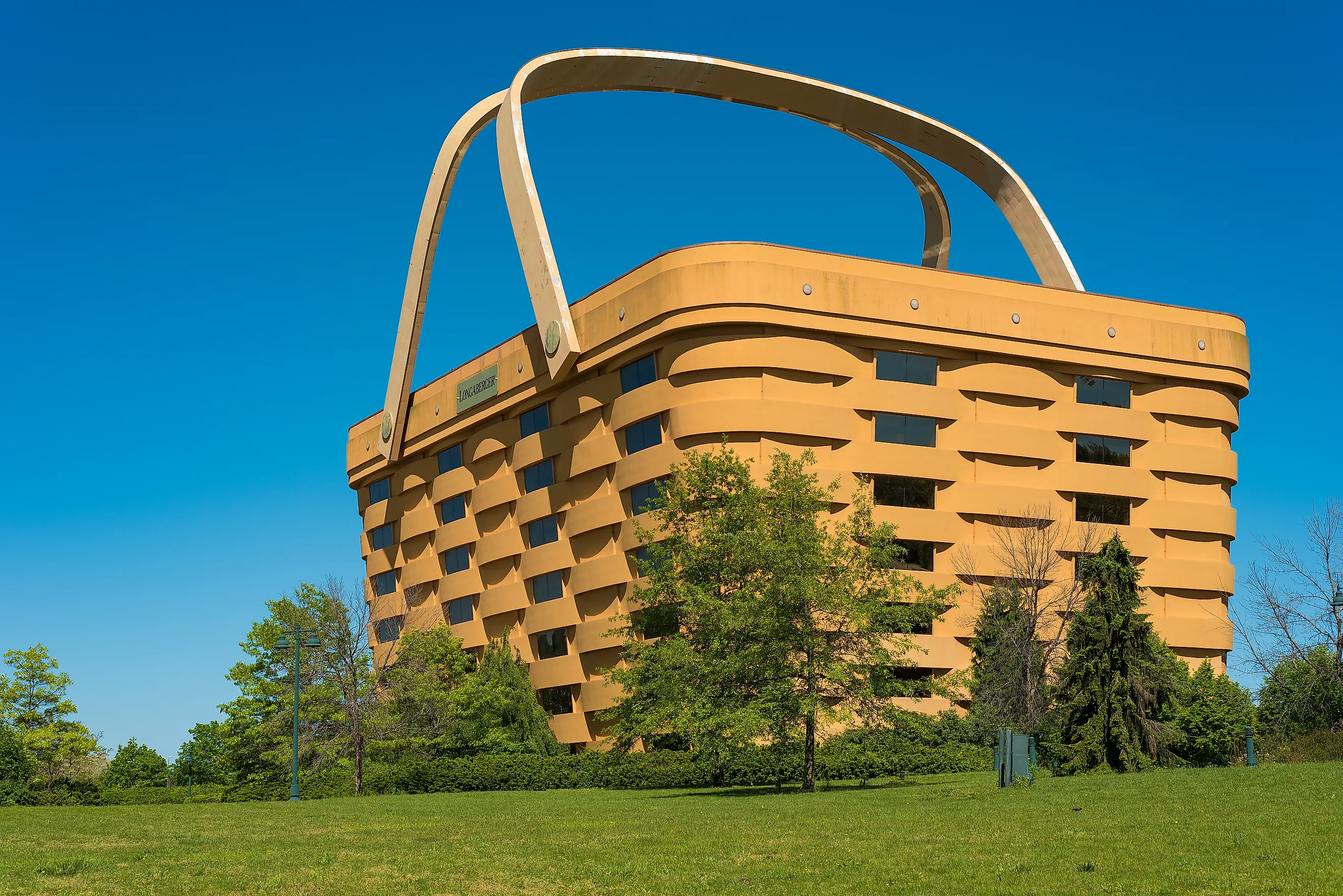
The Basket Building, Newark, Ohio

When the Longaberger Company built its headquarters in Newark, Ohio, in 1997, it did not settle for a tasteful nod to its handwoven basket business. It built the basket: a seven-story, $30 million replica of its best-selling Medium Market Basket, enlarged 160 times, complete with two handles weighing about 75 tons apiece. The handles are heated in winter so ice cannot form on them, a problem ordinary baskets rarely face. The company wove its last basket in 2018, and the building has sat empty since 2016 while its future stays in flux: a luxury hotel plan collapsed during the pandemic, and as of 2026 the Big Basket is back on the market for 8.5 million dollars, waiting for a buyer with the right sense of occasion.
Strange, But Sincerely
The through line of these ten places is that nobody involved was kidding. A man built a 46,000-pound chair and made it rock because the rules said so, a town has repainted a palace in corn annually since 1892, and a family observed solstice protocol over 39 gray sedans. America's strangest landmarks were all built or defended in complete earnestness, and that sincerity is what separates a genuine roadside wonder from a gimmick. See the famous parks another year. The corn is fresh every August.