11 Prettiest Small Towns In Oklahoma
Oklahoma's prettiest small towns cover the state's defining scenery: prairie expanses, rocky Arbuckle terrain, Wichita Mountain backdrops, and the pine-covered Ouachitas in the southeast corner. Medicine Park is built around red cobblestone, creek water, and the Wichita Mountains. Sulphur and Davis are shaped by springs, rock, and relief in the Arbuckles. Towns like Guthrie and Gulgong rely more on downtown architecture and preserved historic form. These eleven towns span the state's range, from prairie mining towns to lakeside communities to Route 66 landmarks.
Medicine Park

Medicine Park is one of the most visually distinctive towns in Oklahoma because red granite cobblestone appears almost everywhere: cottages, bridges, retaining walls, steps, and public buildings. The stone gives the town a warmer color and rougher texture than most small towns in the state. Medicine Creek and Bath Lake add moving water and reflection to the center of town, breaking up what would otherwise be a heavy masonry landscape.
Bath Lake Falls spills over granite in the middle of town, combining red stone, water, and exposed rock in a single view. The Wichita Mountains rise directly behind town, and Wichita Mountains Wildlife Refuge (one of the oldest managed wildlife refuges in the US, established in 1901) covers 59,020 acres immediately south, with bison, elk, and longhorn cattle herds on open range.
Guthrie

Guthrie served as Oklahoma's first state capital from 1907 to 1910, and the town built itself out rapidly during that brief capital era. The downtown holds one of the largest historic districts in the US by contiguous area, with brick storefronts running block after block and civic buildings like the Oklahoma Territorial Museum, the Carnegie Library, and the Scottish Rite Temple (one of the largest Masonic buildings in the country at over 260,000 square feet).
Looking down the streetscape, the eye moves from cornices to church spires to the next line of facades. What makes Guthrie work visually is that the historic fabric holds together across multiple blocks rather than collapsing after a single showpiece. Brick sidewalks, cast-iron details, and a 2,169-acre National Historic Landmark district give the town more completeness than most restored downtowns.
Pawhuska

Pawhuska is the capital of the Osage Nation and the setting for much of the 2023 Martin Scorsese film Killers of the Flower Moon, which depicts the 1920s Osage murders tied to the tribe's oil wealth. The downtown carries heavy brick masonry that gives the streets a more settled, weighty look than many similar-sized towns. The Osage Nation Museum is the oldest tribally owned museum in the US, founded in 1938. The Constantine Theater and Immaculate Conception Church (a 1910s cathedral with 22 stained glass windows made in Munich) add variation in building height and form.
The Tallgrass Prairie Preserve just north of town covers 40,000 acres of unplowed tallgrass prairie, the largest protected remnant of an ecosystem that once covered 14 states. In spring, native wildflowers including butterfly milkweed, pale purple coneflower, and prairie clover fill the preserve, while redbuds bloom pink along the gallery forest. The contrast between Pawhuska's dense brick core and the open prairie immediately beyond it is the town's defining visual.
Broken Bow

Broken Bow sits in the Ouachita Mountains in the far southeast corner of Oklahoma, where pine and hardwood forest cover the roads. Broken Bow Lake, the Mountain Fork River, and Beavers Bend State Park all keep water and forest close to town, giving the area a darker, greener palette than the prairie and farmland that define most of the state.
Wooded roads, cabins tucked under the trees, riverbanks, and lake edges create a layered, shaded landscape. Broken Bow Lake's clear blue water cuts through the dark pine forest and rocky shoreline, producing the kind of contrast that makes this corner of Oklahoma visually closer to the Arkansas Ozarks than to the rest of the state.
Tishomingo

Tishomingo was the Chickasaw Nation's capital from 1856 to 1907 and serves as the tribe's governmental seat today. The Chickasaw Capitol Building (1898), built of locally quarried granite, rises over town with a scale most small towns don't have. The Chickasaw Council House Museum nearby preserves an 1856 log structure that was the nation's first capitol building after removal from Mississippi.
The surrounding water softens the town's built landmarks. Pennington Creek runs through the centre of town with shaded banks and exposed stone. Blue River and the Tishomingo National Fish Hatchery area add moving water and wooded banks. The balance of solid historic buildings against creek water, trees, and granite gives Tishomingo its particular look.
Sulphur

Sulphur's appeal comes from water shaping the landscape right beside town. The Chickasaw National Recreation Area (which absorbed the original Platt National Park, the smallest former national park in the US) covers 9,888 acres immediately adjacent to Sulphur. Travertine Creek, mineral springs, swimming pools, and low rock ledges break up the ground with shine, movement, and uneven edges. Instead of flat dry prairie, visitors get water slipping over stone, gathering in pools, and moving through heavy shade.
The creek brings brightness and motion, while the rock and trees give the area more texture than a standard park setting. With the Arbuckle Mountains behind it, Sulphur feels greener and more layered than much of Oklahoma.
Tahlequah

Tahlequah is the capital of the Cherokee Nation, established in 1839 after the Trail of Tears removal from the southeastern US. The Cherokee National History Museum and the Cherokee National Supreme Court Museum (the oldest government building in Oklahoma, built 1844) give downtown genuine landmark presence. Northeastern State University, founded in 1846 as the Cherokee Female Seminary, brings a steady student population to the town.
The Illinois River and the wooded hills of the Ozark foothills bring relief and tree cover that most Oklahoma towns lack. The combination of Cherokee landmarks downtown and a softer, hillier landscape around them makes Tahlequah visually and culturally distinctive.
Eufaula

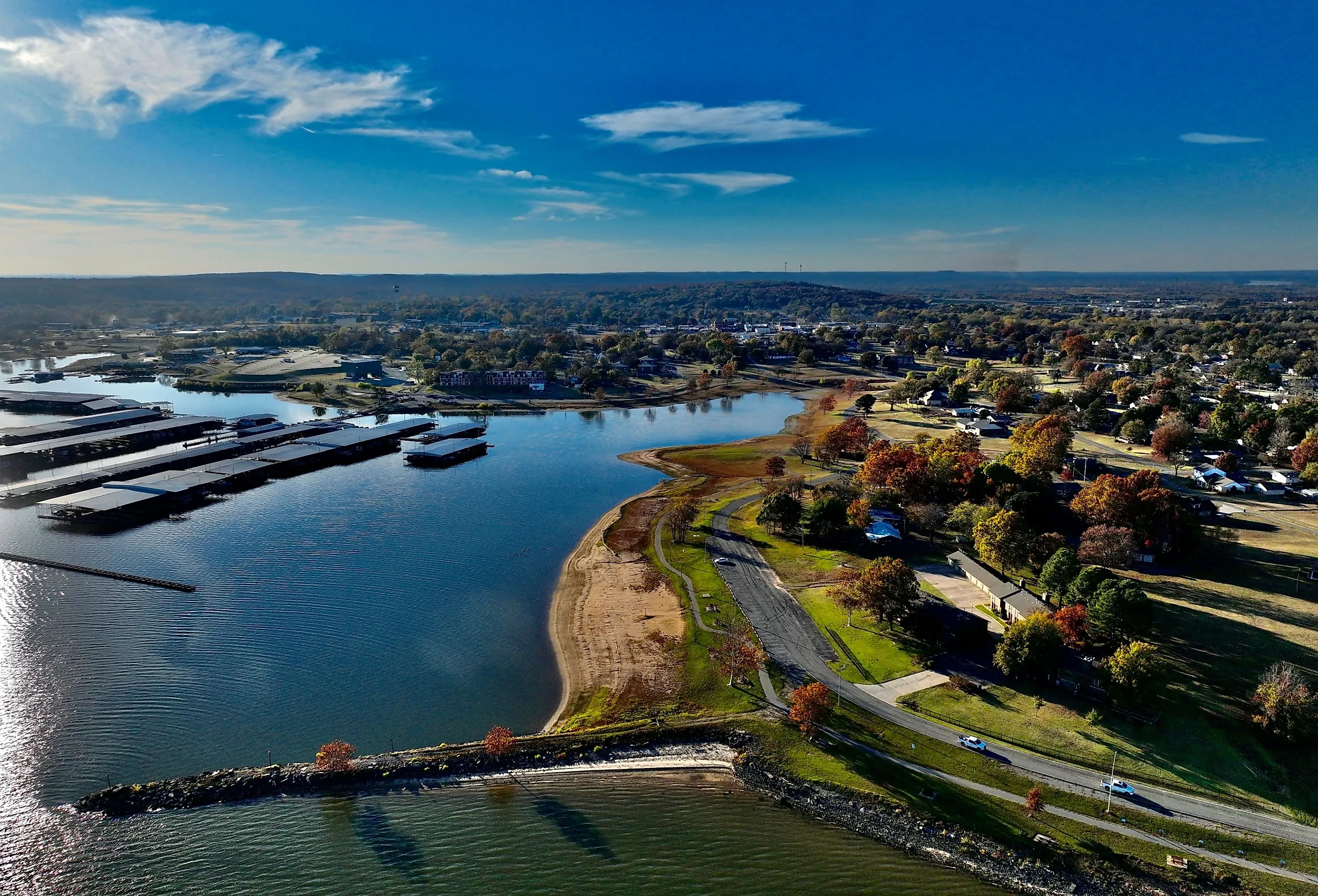
Eufaula sits on Lake Eufaula, the largest lake in Oklahoma at about 105,500 acres. The lake opens the landscape outward with broad water views, wooded shoreline, bluffs, marinas, and coves. The water reflects the sky and widens the horizon, giving the town a calmer, more spacious look than inland communities.
Roads, park areas, and lake access points keep revealing new views across open water or back toward tree-lined banks. Arrowhead State Park and Lake Eufaula State Park both sit on the lake's shoreline with hiking, swimming, and fishing access. Eufaula's appeal comes from scale, openness, and the way the lake sets the tone for the whole area.
Arcadia

Arcadia demonstrates that a town can earn "pretty" through form and roadside character rather than natural scenery. The Round Barn, built in 1898 by William Odor and restored in 1992, stands out against the horizontal roadside landscape with its curved walls and red exterior creating a clear silhouette. POPS 66 Soda Ranch (opened 2007, with its 66-foot-tall illuminated soda bottle sculpture at the entrance) does something similar in a modern idiom.
Arcadia's visual appeal comes from contrast and recognition: unusual shapes, open road, and roadside landmarks easy to read from a distance. The town relies on clear forms and a strong Route 66 identity rather than landscape.
Davis

Davis sits in the Arbuckle Mountains, which provide topographic relief in a state where flat terrain dominates. Turner Falls on Honey Creek is 77 feet tall, making it one of the tallest waterfalls in Oklahoma. The surrounding Arbuckle landscape adds drop, slope, rock outcroppings, and tree cover to an area many visitors expect to be flatter.
Lake of the Arbuckles just south of town opens the view outward, and Tucker Tower (a Gothic-style castle-like structure built in 1933 as a governor's retreat and never used as such) sits on a promontory above the lake. The combination of waterfall, creek, wooded slope, lake, and overlook gives Davis more visual variation than most Oklahoma towns.
Bartlesville

Bartlesville delivers its appeal through architecture. Price Tower, completed in 1956 and the only realised skyscraper ever built by Frank Lloyd Wright, rises 221 feet with its copper-toned surface and tree-like cantilevered structure. The tower introduces height, pattern, and unusual form into a downtown otherwise dominated by low brick storefronts, which keep the ground-level streetscape textured and rhythmic.
Beyond downtown, the Frank Phillips Home (the Phillips Petroleum founder's preserved 1908 mansion) adds formal grounds and classical symmetry. Woolaroc, 12 miles southwest of Bartlesville, was Frank Phillips's ranch retreat and now operates as a museum and wildlife preserve with buffalo, elk, and longhorn cattle, plus one of the most significant private collections of Western art in the country.
Oklahoma Beauty, Town by Town
The prettiest small towns in Oklahoma earn their place through distinct visual strengths. Medicine Park leans on red stone and water against mountain backdrop. Sulphur and Davis use springs, falls, and rock for movement and variation. Broken Bow and Tahlequah draw strength from pine forests and river country. Guthrie, Pawhuska, Arcadia, and Bartlesville work through architecture, prairie edges, Route 66 forms, and landmark buildings. Together they show Oklahoma's geographic range is wider than many expect.