10 Of The Most Adorable Small Towns In Portugal
Portugal's most adorable destinations are found in small communities scattered throughout the country. Some sit along the Atlantic coast while others rest beside winding rivers or high on mountain slopes. In Aveiro, brightly painted boats drift through a network of canals. Óbidos hides behind preserved medieval walls, and Monsaraz looks out over a vast inland lake. The towns ahead each preserve distinctive traditions and landscapes that have drawn visitors for generations.
Aveiro

Aveiro's canals wind through the city center, where colorful moliceiro boats, once used to harvest seaweed from the nearby lagoon, now carry visitors past Art Nouveau buildings and waterfront promenades. Among its many highlights, Aveiro is famous for ovos moles, a traditional confection with a rich orange egg-yolk filling enclosed in delicate white wafer shells. Try them with a cup of um café at Confeitaria Peixinho, the oldest bakery in Aveiro. Just west of town, the striped houses of Costa Nova create one of Portugal's most recognizable coastal scenes. Visitors often continue to nearby Praia da Barra, where a red-and-white lighthouse rises above one of the longest sandy beaches on Portugal's central coast.
Tavira

Stretching along the Gilão River in the eastern Algarve, Tavira combines coastal scenery with a historic center shaped by Roman and Moorish influences. The Roman Bridge remains one of the town's most photographed landmarks, connecting both sides of the waterfront district. Above town, the ruins of Tavira Castle offer elevated views of church towers, tiled roofs, and the surrounding countryside. Ferries and water taxis connect visitors to Ilha de Tavira, where long sandy beaches extend along the barrier islands of the Ria Formosa Natural Park. Back in town, dozens of churches, plazas, and riverside cafés encourage leisurely exploration. Tavira offers many of the Algarve's attractions while maintaining a quieter character than the region's larger resort destinations.
Ponte de Lima

Claiming to be Portugal's oldest chartered town, Ponte de Lima sits beside the Lima River in the country's lush Minho region. The Ponte Romano-Medieval, which gives the town its name, remains the defining landmark, spanning the river with a combination of Roman and medieval construction. Nearby, the riverside Parque do Arnado showcases themed gardens inspired by Portuguese, Roman, Japanese, and labyrinth designs. The Museu do Brinquedo Português has an endearing collection of historic Portuguese toys, while the historic center preserves narrow lanes lined with stone buildings, cafés, and traditional shops. Food lovers can sample the region's famed Arroz de Sarrabulho, a rich pork-and-spice rice dish closely associated with Ponte de Lima, often paired with local Vinho Verde.
Óbidos

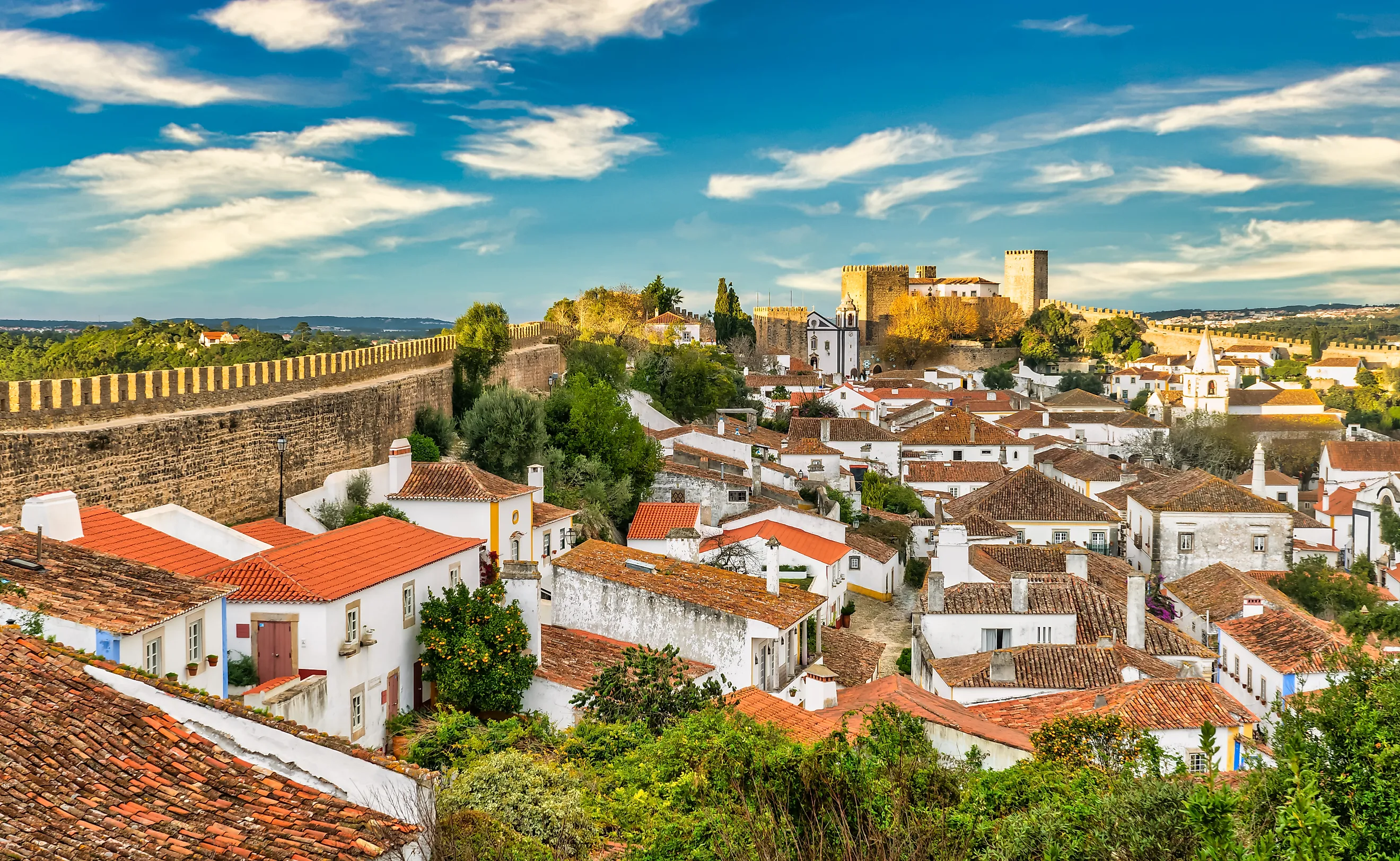
Encircled by remarkably preserved medieval walls, Óbidos, designated a UNESCO Creative City of Literature, looks much as it did centuries ago. Whitewashed houses trimmed with blue and yellow accents line cobbled streets leading toward the Castle of Óbidos, now operating as a historic pousada hotel. Visitors can walk the medieval ramparts for wide views of rooftops and surrounding countryside. The former church of Livraria de Santiago, transformed into a bookstore, reflects the town's reputation as a literary destination. Along Rua Direita, shops serve ginjinha de Óbidos, the region's famous sour-cherry liqueur, served poured into little chocolate cups. Annual chocolate, literary, and medieval festivals add extra energy to this exceptionally pretty town.
Monsaraz

Perched above the vast waters of Alqueva Lake near the Spanish border, Monsaraz boasts dramatic scenery as a backdrop to centuries of history. Narrow stone lanes and centuries-old homes are still enclosed within medieval walls tracing the contours of the hilltop. The Castle of Monsaraz provides sweeping views across the reservoir and surrounding Alentejo countryside, making it one of Portugal's most scenic viewpoints. Below the village, Alqueva Lake, one of Europe's largest artificial lakes, offers boating, kayaking, and exceptional stargazing within the internationally recognized Dark Sky Alqueva reserve. Nearby wineries welcome visitors for tastings amid the Alentejo countryside. Few Portuguese villages pair lake views, history, and rural landscapes so memorably.
Piódão

Hidden among the mountains of central Portugal, Piódão appears almost to emerge from the hillside itself. The village is known for its unusual schist houses, whose dark stone walls contrast with bright blue doors and window frames. Walking through the narrow lanes reveals viewpoints overlooking forested valleys and steep mountain slopes. The Igreja Matriz de Piódão stands at the heart of the village and serves as one of its most recognizable landmarks. Just below the village, the Praia Fluvial de Piódão offers a scenic river pool fed by clear mountain waters. Beyond the settlement, hiking routes lead into the Serra do Açor landscape, where streams and wooded terrain dominate the scenery. Piódão's relative isolation has helped preserve a character unlike that of Portugal's larger towns and cities.
Azenhas do Mar

Few Portuguese villages occupy a more dramatic setting than Azenhas do Mar. Built directly into Atlantic cliffs north of Sintra, the village overlooks crashing waves and a rugged shoreline. The Piscina Oceânica de Azenhas do Mar, a natural seawater pool at the base of the cliffs, is especially popular during calmer weather. Visitors gather at the Miradouro de Azenhas do Mar for panoramic views of the village cascading toward the sea. Nearby, the coastal trail connecting Azenhas do Mar with Praia das Maçãs reveals additional vistas of beaches and headlands. Restaurants such as Azenhas do Mar Restaurante take full advantage of the setting, pairing Atlantic seafood with unforgettable ocean views. Despite its small size, the village leaves a lasting impression through its striking relationship with the Atlantic.
Viana do Castelo

Located where the Lima River meets the Atlantic Ocean, Viana do Castelo combines maritime history with impressive scenery. The hilltop Sanctuary of Santa Luzia overlooks both the town and coastline, rewarding visitors with some of northern Portugal's best views. Below, Praça da República anchors the historic center, where ornate architecture and lively cafés encourage lingering. Along the waterfront, Gil Eannes, a former hospital ship, now serves as a museum exploring Portugal's maritime heritage. Nearby Cabedelo Beach attracts surfers and kiteboarders, while local restaurants serve fresh seafood alongside the region's celebrated Vinho Verde. The mix of river, ocean, history, and coastal culture helps make Viana do Castelo one of northern Portugal's most beloved destinations.
Tomar

Tomar's history is inseparable from the Knights Templar, whose influence continues to shape the town today. The Convent of Christ, a UNESCO World Heritage Site, stands as one of Portugal's most important historic monuments and showcases centuries of architectural evolution. Below the hilltop complex, the Nabão River flows through town past the leafy Mouchão Park, a popular gathering place connected by footbridges and shaded walking paths. Visitors often gather around Praça da República, where outdoor cafés spill onto the square beneath the tower of the Church of São João Baptista, while the Pegões Aqueduct showcases the engineering achievements that once supplied water to the convent. Although its historical significance draws many visitors, Tomar is approachable and easy to explore, mixing monumental history with inviting riverside scenery.
Caminha

Occupying a prime location at the mouth of the Minho River, Caminha sits near Portugal's border with Spain. The town's waterfront setting allows visitors to watch boats move between river and ocean while enjoying views across the estuary. The historic center features narrow streets and traditional houses centered around the Gothic Igreja Matriz de Caminha. Nearby Moledo Beach attracts surfers and beachgoers with broad stretches of sand and views toward the offshore Ínsua Fort. Just south of town, Mata do Camarido offers walking trails through coastal pine forests and dunes. Ferries connect Portugal and Spain across the river, reinforcing Caminha's unique cross-border character and relaxed coastal appeal.
Castelo de Vide

Set within the hills of the Alto Alentejo, Castelo de Vide blends mountain scenery with one of Portugal's most appealing historic centers. Granite homes and flower-filled lanes climb the hillside toward the Castle of Castelo de Vide, which overlooks the surrounding countryside. The castle walls provide expansive views across the Serra de São Mamede region, while nearby trails explore forests and rocky terrain. Nearby, the Fonte da Vila, an ornate square-shaped, sixteenth-century fountain, remains one of the town's most recognizable landmarks. Visitors can also sample regional specialties such as boleima, an apple-and-cinnamon pastry, alongside Alentejo olive oils and wines, at old-fashioned eateries such as Casa de Cha Belmira. Together, the mountain setting, layered history, and local flavors make Castelo de Vide one of Portugal's most enchanting small towns.
Clifftops, Castles, and Canals
Whether cruising through Aveiro's canals, exploring the medieval streets of Óbidos, admiring the lake views from Monsaraz, or wandering the stone lanes of Piódão, visitors will discover communities that continue to preserve the landscapes and cultural heritage that make Portugal such an endearing destination. Atlantic cliffs and riverfront promenades, mountain villages, historic market squares, and bakeries serving ovos moles and ginjinha in chocolate cups all show the remarkable diversity packed into one relatively small country.