11 Offbeat Germany Towns To Visit In 2026
Germany is home to some quirky towns that don't always get the attention they deserve. Nördlingen is a Bavarian town built inside a 15-million-year-old meteorite crater. In Halberstadt, an organ composition has been playing without pause since 2001. And Büsingen am Hochrhein is a German town completely surrounded by Switzerland, with two postal codes and two local currencies in daily use. "Offbeat" might not be the first word that comes to mind when most people think of Germany, but these 11 towns prove the country has plenty of playful corners worth visiting in 2026.
Idar-Oberstein

While most towns of Europe have a church at their center, the town of Idar-Oberstein's church is built directly into a cliff face. The Felsenkirche was carved into a natural cave between 1482 and 1484, and today it can only be reached by a tunnel and over 200 steps from the market square. Before it was a church, it was a cave castle, Burg im Loch, part of a series of three castles in the immediate area. Above Burg im Loch, another castle named Bosselstein Castle was built. And above that one, Oberstein Castle. Over the years, Burg im Loch became the Felsenkirche, Bosselstein became ruins, and Oberstein Castle is still standing and open for visits every day of the week.
During the church's excavation in the 1400s, amethyst and agate were found and began a gemstone-cutting heritage that continues to the present. To learn more about this heritage, the Deutsches Mineralienmuseum (German Mineral Museum) is near the town center and has displays of gems and minerals from around the world as well as jewelry made over the decades in Idar-Oberstein. Just north of town is the Historische Weiherschleife (Historic Pond-Powered Grinding Mill), showing an active gemstone mine and explaining to visitors how gemstones are formed.
Nördlingen

The medieval town of Nördlingen is built entirely inside the 24-kilometer-wide Nördlingen Ries, a 15-million-year-old meteorite impact crater. The discovery wasn't confirmed until 1960, when scientists found shocked quartz in the town's buildings. The crater rock, called suevite, is embedded with an estimated 72,000 tons of microscopic diamonds. Many parts of the town are built from this diamond-bearing stone, like the 90-meter Daniel Tower at St. George's Church. The spire is made of the suevite and is also an observation deck, a perfect place for a 360 degree view of the town and its wall.
The medieval city wall is completely intact, making Nördlingen one of only a few German towns with a fully walkable circuit wall. While making the circuit, visitors can stop at the Rieskrater Museum. They have guided tours, exhibits about the Nördlingen crater meteorite impact, and even a lunar sample from Apollo 16. Apollo 14 and 17 astronauts trained here in 1970 because the terrain resembles the Moon's impact geology.
Trendelburg

For those who like fairy tales, Trendelburg Castle in the town of the same name is the real-world site of Rapunzel's tower. Now a hotel, the castle has an almost 40-meter-tall Rapunzel Tower with walls up to 7 meters thick. A room in the tower is available for booking, but be aware of the over 130 steps up the tower. The castle also has a Torture Museum, a Fear Hole chamber, and a Frimm's Floor of fairy-tale silhouette art by Albert Völkl. At the top of the tower there's also a viewing platform overlooking the Diemel Valley.
The medieval castle walls are open to the public, and walking along them gives you perfect views of the historic town. Whether walking down Am Rathaus or Zur Burg, visitors will end up at the Rathaus (town hall). Here, the Historische Stadterkundung, a self-guided walking tour, starts and ends. The tour brings visitors by 30 marked stations detailing Trendelburg's medieval and regional heritage. The walk covers about 3.8 kilometers and should take around 1.5 hours, unless a few stops are made at the local Bäckerei Amthor or the Gasthaus Brandner restaurant for an afternoon Kaffee und Kuchen (traditional coffee and cake).
Bad Karlshafen

About 13 kilometers down the road, still on the Diemel River, is the town of Bad Karlshafen. Both Trendelburg and Bad Karlshafen are on the Deutsche Märchenstraße (Germany Fairy Tale Road), and both towns look like it. But while Trendelburg fits the other towns in the area, with its half-timbered buildings, Bad Karlshafen was built in white Dutch/French Baroque style. Founded in 1699 to resettle French Huguenot refugees, the town was laid out as a planned grid around a harbor basin. This Baroque harbor basin is still the structural centerpiece of town, connected to the Weser and Diemel rivers by canal.
The Baroque architecture continues along the streets near the harbor, with rows of matching stone Baroque houses with their uniform five-axis, two-story design. One of these buildings, the Deutsches Hugenotten-Museum, houses picture archives and family histories of the Huguenot refugee community, telling the story of why the town looks like it does, and who it was for. Closed on Mondays and Thursdays, the museum is the best place to learn about this odd Baroque town amongst medieval villages of half-timbered homes.
Halberstadt

The longest-running musical performance on Earth can be found in the town of Halberstadt. On September 5, 2001, using a specially built organ in St. Burchardi Church, the performance of John Cage's Organ²/ASLSP ("As Slow As Possible") began. This piece of music is scheduled to run for 639 years, finally finishing the performance in the year 2640. Chord changes happen so rarely that each one draws a crowd. The most recent just happened in early August 2026, but before that, the last chord change was in February 2024.
The town's organ history continues at the Halberstadt Cathedral. The first organ with the modern keyboard layout that's still used today was installed here in 1361. Near the cathedral are numerous museums worth visiting. The Städtisches Museum across the street has exhibitions detailing 1,200 years of local history, housed inside the historic Spiegelsche Kurie (Spiegel Palace). Right next door in a side wing of the same palace is the Museum Heineanum, a natural history museum focused primarily on ornithology, the study of birds. And just a few doors down is the Gleimhaus, the Museum of the German Enlightenment, established in 1862 and recognized as one of the oldest literary museums in Germany.
Wernigerode

Thirteen or so minutes on a train from Halberstadt brings riders to Wernigerode, a town built at the foot of the Brocken. Brocken is the Harz Mountains' highest peak and is the legendary gathering place for witches on Walpurgisnacht (April 30) in German folklore. This legend was made famous by Goethe in his play Faust, and Wernigerode leans into it: pedestrian crossing signals show a flying witch for "go" and a red devil for "stop". The Brockenbahn is a historic steam railway connecting the town to Brocken, taking passengers through the Harz National Park on a scenic route. The narrow-gauge train begins at the Wernigerode Hauptbahnhof and takes about one hour and 40 minutes to get to Brocken.
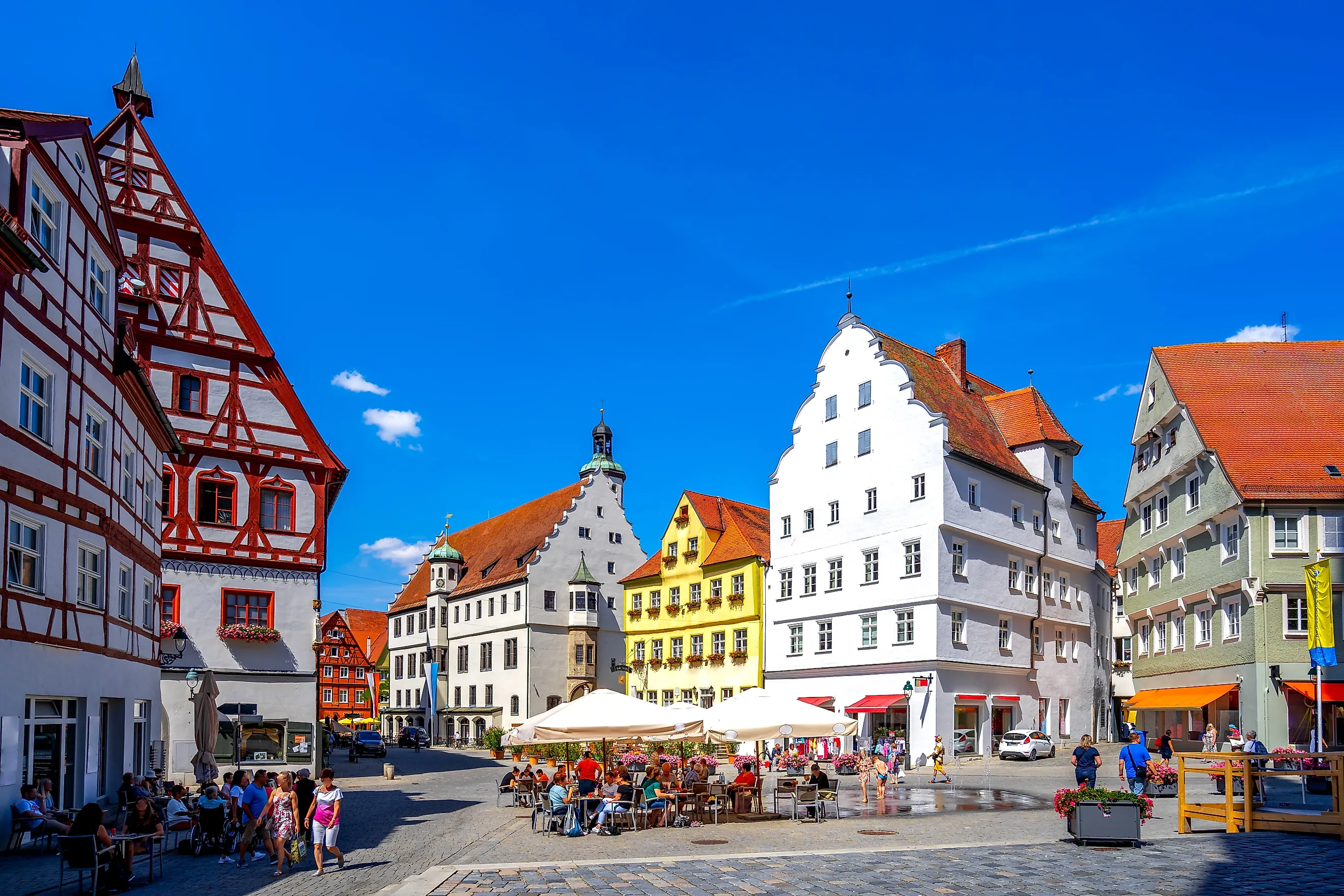
The town offers other odd attractions. The Schiefes Haus (crooked house) is a local history museum housed in half-timbered former cloth mill that leans at a 7° slope, more than the Tower of Pisa. Just down the street is the Kleinstes Haus (smallest house), now a folklore museum inside a tiny 1792 house. Both of these sit in Wernigerode's multi-hued historic town center. The many colors of the town culminate in the vibrant color palette of the Marktplatz (Market Square) and Rathaus (Town Hall).
Beelitz

For urban explorers, the town of Beelitz is a unique, offbeat destination. Beelitz-Heilstätten was a 60-building sanatorium complex built between 1898 and 1930, ultimately being abandoned in the 1990s. Since then, the sanatorium has been reclaimed by the forest, with trees now growing directly out of some rooftops. Previously, explorers hopped fences and wandered freely through the ruins, but that is no longer possible/legal. Now, visitors can walk across treetop walkways suspended over the complex or take official guided tours through surgical pavilions and sanatorium wings.
A completely different vibe, but still a bit odd, is Beelitz's other identity as Spargelstadt (Asparagus Town). It produces close to half of the state of Brandenburg's white asparagus harvest and also marks the end of the 750-kilometer Asparagus Road, a scenic driving route starting in Bruchsal and cutting through a large portion of Germany. Make time for the Beelitzer Spargelmuseum, an asparagus museum celebrating the region's massive agricultural connection to white asparagus.
Bad Frankenhausen

Another leaning building is in Bad Frankenhausen, but this time it's a church tower. The Oberkirche's spire, at 56 meters, tilts 4.93°, which is about a degree more than the tower in Pisa. The leaning is caused by gypsum and salt leaching in the ground beneath it. After years of complex engineering and millions of euros, a new visitor center and viewing platform at the Oberkirche (known as Der Schiefe Turm von Bad Frankenhausen) officially celebrated its grand opening in June 2026. At the top, engineers installed a retractable glass-bottomed viewing platform (Skywalk) that extends outwards from the spire and offers panoramic views extending all the way out to the Kyffhäuser Mountains.
Just north of the town is its second, somewhat startling oddity: a 14-meter-high, 123-meter-long circular painting by Werner Tübke. Found in the Panorama Museum, the painting depicts the German Peasants' War and features more than 3,000 individual figures. The museum also has exhibits on the creation of the painting, from its first drafts, and a documentary film running on a continuous loop. This windowless, brutalist museum sits atop the Schlachtberg (Battle Mountain) ridge, where a 1525 massacre of 6,000 peasants occurred. The ravine running down the hill below the museum is still officially named the Blutrinne (Blood Gutter) because it ran red with the blood of slaughtered peasants.
Triberg im Schwarzwald

The town of Triberg makes big claims that other towns tend to dispute, but that doesn't make it any less worth a visit. One claim that's true is Triberg being home to Germany's highest waterfall, the Triberg Waterfalls. This 163-meter waterfall drops over seven different cascades and has three marked trail options to explore: a 15-minute, a 40-minute, and a full hour-long climb. The other claim that's up for dispute is having the world's largest functioning cuckoo clock. Whether it's the world's largest or not, it's still a huge clock on a 60:1 scale, built into a house facade with the largest internal gear wheel at 2.60 meters in diameter and the swinging pendulum spanning 8 meters.
Triberg also claims to holding the world's smallest mechanical cuckoo clock as well. Measuring just 13.5 centimeters tall, it can be found at the Schwarzwaldmuseum (Black Forest Museum). Here, visitors can also see a full-scale 19th-century farmhouse kitchen replica and learn more about clockmaking history. Clockmaking continues throughout the town center, with numerous workshops like the House of 1000 Cuckoo Clocks where visitors can watch wooden gears and pinecone-weight mechanisms being carved by hand. For those looking to buy, the workshops offer hundreds of authentic, certified clocks ranging from traditional hand-carved hunting scenes to modern geometric designs.
Manderscheid

The Lieser River, running through the town of Manderscheid, was the border between the Electorate of Trier and the Duchy of Luxembourg for centuries. Reflecting this border, the town has two rival medieval castles glaring at each other across the narrow valley. The Oberburg (Upper Castle) and the Niederburg (Lower Castle) sit on opposite hilltops, separated by the river, and the two castles' occupants were bitter enemies for generations. Now, both castles are ruins connected by a short valley walk with a meadow in between. The Oberburg is freely accessible with a five-story keep, while the larger Niederburg can be explored independently for a small entry fee or via guided options, including atmospheric night tours.
Even though Manderscheid is the smallest town on this list, its historic valley is the stage for the massive Historisches Burgenfest (Manderscheid Castle Festival). Taking place annually on the last weekend of August, this medieval spectacle draws thousands of visitors to the Niederburg and its adjacent tournament meadow. The two-day celebration features jousting tournaments, authentic knight camps, and traditional craft markets, all culminating in an evening display where the lower castle ruins are dramatically illuminated by fire.
Büsingen am Hochrhein

The small town of Büsingen am Hochrhein is entirely surrounded by Switzerland, both a German exclave and a Swiss enclave. The town is cut off from the rest of Germany by a 680-meter-wide strip of Swiss territory, using two postal codes, participating in the Swiss customs union, and having most residents pay in Swiss francs despite being German citizens on German soil. To understand all this, visitors can hike the Büsinger Exklavenweg, a seven-kilometer exclave trail with 11 marked stops explaining the town's unusual status, answering questions about the dual postal code system, why they use the Swiss franc, and how the soccer team plays in the Swiss league.
Beyond the informational plaques, the path takes visitors to other fun highlights of the city. It passes Restaurant Waldheim, where the international border cuts directly through the outdoor dining terrace, allowing guests to sit at a table with one foot in Germany and the other in Switzerland. The pathway also passes historic landmarks like the Rheinmühle (Rhine Mill), the Junkerhaus (Squire's Mansion), and the Romanesque Bergkirche St. Michael (Mountain Church), which offers panoramic views of the Rhine. Hikers will also pass several of the 123 physical stone border markers enclosing the territory.
Where Germany Gets A Bit Strange
While most people think they know what to expect in Germany, the country's smaller towns hold strange stories: a meteor crater, a centuries-long organ performance, a border that splits a restaurant, and a church carved into a cliff. These 11 towns embraced their oddity rather than downplaying it. Wernigerode has their witch and devil crosswalk signals. Bad Frankenhausen spent years and money to bring visitors for their leaning tower. Büsingen embraces both their Swiss and German civic identities. Europe's big cities might have big stories, but that doesn't mean small towns have small stories. And maybe the stories being larger than their population makes it worth the focus.