8 Germany Towns Where Time Stands Still
Some German towns wear their history lightly while others seem to have stopped the clock altogether. The eight below belong to that second group. Each was preserved by an accident of fortune, whether a war that emptied its coffers or a railway that simply passed it by. In some the poverty ran so deep that no one could afford to tear anything down. What survives is not a reconstruction or a theme park but the real thing, with half-timbered houses over cobbled lanes and market squares unchanged for four centuries. These are places where a visitor can round a corner and lose track of which century they are standing in.
Rothenburg ob der Tauber, Bavaria

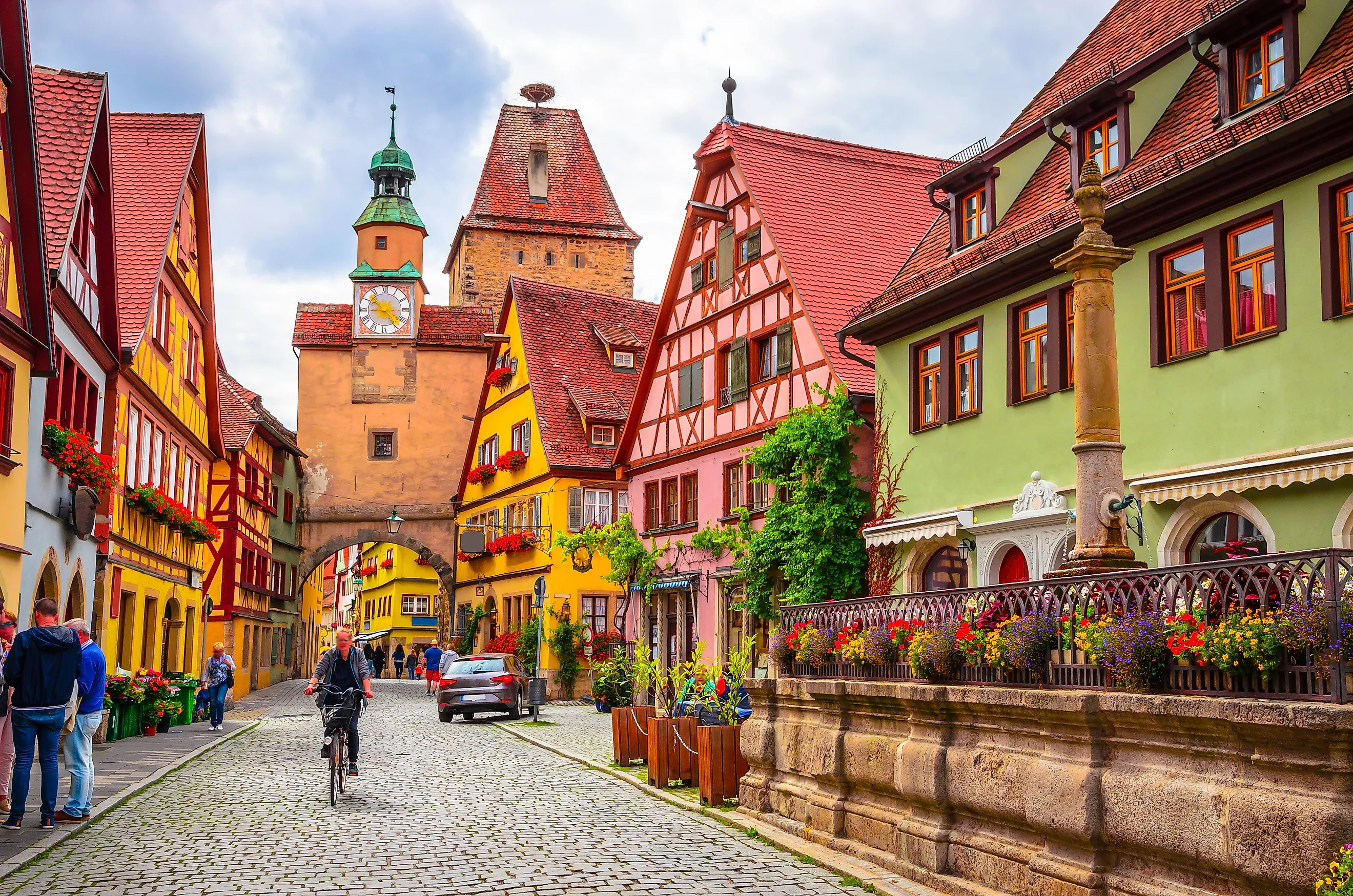
Rothenburg flourished as a free imperial city in the Middle Ages, then the Thirty Years' War and a 1634 plague outbreak left it too poor to grow, freezing the town in its 17th-century form. That stagnation is exactly why it survives today as the best-preserved walled town in the country, perched on a plateau above the Tauber River in Franconia. The complete circuit of medieval walls can be walked on a covered sentry path roughly 1.5 miles around, with the Röderturm tower open for the view down over the red rooftops. At the heart of the old town, the Plönlein, a crooked yellow half-timbered house wedged between two towers, is one of the country's most photographed corners. St. Jakob's Church holds a 500-year-old altarpiece carved by Tilman Riemenschneider, and the Medieval Crime and Punishment Museum lays out a thousand years of judicial history. After the day-trippers leave, the Night Watchman's Tour walks the empty lanes by lantern light.
Quedlinburg, Saxony-Anhalt

Quedlinburg sat at the center of the Ottonian dynasty in the 10th century, when King Henry I ruled from its castle hill, and centuries of later economic stagnation kept its medieval fabric intact. The town escaped serious bombing in World War II, leaving one of the largest old towns in Germany with roughly 2,000 half-timbered houses spanning eight centuries. The oldest of them, the Ständerbau on Wordgasse, dates to around 1310 and now holds a small museum devoted to the craft of timber framing. Above the tangle of cobbled lanes, the Stiftsberg carries the Romanesque Collegiate Church of St. Servatius, whose treasury holds Ottonian reliquaries and manuscripts studded with gems. The market square is anchored by an early Gothic town hall first mentioned around 1300, with a stone Roland statue out front marking the town's old trading rights. The whole ensemble earned a UNESCO World Heritage listing in 1994.
Monschau, North Rhine-Westphalia

Monschau grew rich on fine wool in the 17th and 18th centuries, then the Industrial Age passed it over, with no 19th-century railway to force demolition and rebuilding, so its streetscape has stayed nearly unchanged for 300 years. More than 300 listed half-timbered houses crowd the narrow valley of the Rur River in the North Eifel, their slate roofs and dark timbers reflected in the water below. The Rotes Haus, a red patrician mansion completed in 1768 for the cloth merchant Scheibler, still holds its original self-supporting oak spiral staircase and period rooms open to visitors. On the ridge above, the 13th-century Burg Monschau looks down the valley and hosts an open-air festival in summer. The Senfmühle has ground mustard by traditional stone methods since 1882. The view from the main bridge, with the castle on the ridge and its reflection in the Rur, is the image most people carry away.
Meersburg, Baden-Württemberg

Meersburg rises in two tiers above Lake Constance, an upper and lower town linked by a steep pedestrian street, and it has guarded this stretch of shoreline since the Prince-Bishops of Constance made it their seat in the 13th century. The Altes Schloss, often called the oldest inhabited castle in Germany, traces its central Dagobert Tower by tradition to the 7th century, and its 35 furnished rooms still hold armor, a knights' hall, and a dungeon. Next door, the Baroque Neues Schloss went up between 1710 and 1750, its grand staircase built to plans by Balthasar Neumann, with terraces looking out across the water toward the Alps. The poet Annette von Droste-Hülshoff spent her final years in the old castle and died there in 1848. Below the castles, half-timbered houses and two medieval gates line the lanes. The terraced vineyards that climb the slopes still produce the region's wine.
Beilstein, Rhineland-Palatinate

Beilstein earned the nickname "Sleeping Beauty of the Moselle" the hard way. Too poor and too remote to modernize, the little wine village slept through the industrial century with its medieval core untouched. Fewer than 150 people live in the village itself, yet it was granted town privileges back in 1309 and built to look like a town in miniature, which is why it is sometimes called a pocket-sized Rothenburg. Above the half-timbered houses stand the ruins of Metternich Castle, first recorded in 1268 and destroyed by French troops in 1689, with a pentagonal tower that can still be climbed for a wide view of the river valley. The Klostertreppe, a steep flight of steps lined with 18th-century timber-framed houses and wine taverns, is regularly named one of Germany's prettiest streets. At the top, the Baroque St. Joseph's monastery church holds the "Black Madonna of Beilstein," a Spanish statue that found its way here after the Thirty Years' War.
Dinkelsbühl, Bavaria

Dinkelsbühl lost its free-imperial-city status in 1802 and was bypassed by the 19th-century railways, and having survived both World Wars virtually unscathed, it now shows one of the best-preserved late-medieval townscapes in Germany. A nearly complete circuit of 14th and 15th-century walls, about 2.5 miles long, still rings the old town with four intact gate towers and more than a dozen surviving towers. Inside, the funnel-shaped Weinmarkt is lined with patrician houses whose gables date to the early 1600s. Strict local rules still mandate red roofs and forbid neon signs. St. George's Minster, a late-Gothic hall church finished in 1499, ranks among the largest anywhere in Germany, and climbing its Romanesque tower opens up the full sweep of red rooftops. Every July the town reenacts the Kinderzeche, a festival rooted in a legend that the town's children saved it from Swedish troops during the Thirty Years' War.
Schiltach, Baden-Württemberg

Schiltach sits at the meeting of two rivers in the Black Forest, a town that once lived by floating timber down the Kinzig and tanning leather on its banks. Founded by the Dukes of Teck in the 13th century and rebuilt in half-timber after a series of 16th-century fires, its old town has been a protected monument ensemble since 1971. The triangular Marktplatz slopes uphill beneath tightly packed timber-framed houses to the Renaissance town hall, which has stood at the top since 1593. Down by the water, the Schüttesäge Museum preserves an old sawmill with a working waterwheel and tells the story of the raftsmen who guided log trains to the Rhine. The Trautwein tannery, the last traditional craft tannery in the Black Forest, still works hides by hand. From the city bridge, the view up the Schiltach River past the layered gables is the one that ends up on postcards.
Duderstadt, Lower Saxony

Duderstadt was first recorded in 929 and grew into a prosperous trading town on the edge of the Eichsfeld, and its position later left it stranded for decades against the inner-German border, which spared it the pressures of postwar development. More than 600 half-timbered houses make up roughly 80 percent of the old town, strung along the Marktstraße between two great churches. At one end stands the Gothic St. Cyriakus, the "Eichsfeld Cathedral," and at the other the late-Gothic St. Servatius, with its Art Nouveau interior. Between them, the Rathaus counts among the country's oldest town halls, its foundations laid in 1302 and its rooms added on for centuries afterward. The town's best-known landmark is the Westerturm, a gate tower from 1343 whose spire twists at an odd angle, the subject of a local legend about a bargain with the devil. A three-mile earthen rampart still traces the line of the old defenses.
Planning a Visit
These eight towns spread across six German states, and no two share the same setting. Rothenburg and Dinkelsbühl sit within an hour of each other on Bavaria's Romantic Road and pair naturally into a single trip, while Meersburg and Schiltach anchor the south, one on Lake Constance and the other deep in the Black Forest. Quedlinburg and Duderstadt hold down the center and north near the Harz, and Monschau and Beilstein guard the western rivers, the Rur and the Moselle. The through line is preservation by circumstance rather than design, and the reward for the visitor is the same in each, with streets that have kept their shape for centuries, and the rare sense of stepping outside the present for an afternoon.