9 Most Walkable Town Centers In Germany
Germany's smaller towns often reward visitors who leave the car behind. Medieval landmarks frequently sit within compact historic centers where the walk between attractions becomes part of the experience. In some towns, a single street links the major sights. In others, stone lanes climb toward a castle or loop beneath intact fortifications. All nine towns below are small enough to combine short walking distances with attractive historic streetscapes that photograph especially well.
Quedlinburg

Quedlinburg's historic center is best explored from Market Square, where the Renaissance Town Hall and surrounding half-timbered buildings establish the character of the UNESCO-listed Old Town. From the square, walk southwest through the narrow lanes toward the Fachwerkmuseum im Ständerbau, housed in one of Germany's oldest surviving half-timbered structures. The route passes rows of crooked façades, small shops, and cafés, making the walk itself one of the town's main attractions.
Continue toward the Schlossberg, following the streets as they begin to climb above the lower Old Town. The final approach includes steps, but the reward is a broad view across Quedlinburg's rooftops. At the top, visit the Collegiate Church of St. Servatius, whose treasury and crypt reflect the town's importance during the early medieval period. The full walk between Market Square and Schlossberg remains compact enough to cover comfortably on foot while moving through several distinct layers of Quedlinburg's history.
Wittenberg

Wittenberg offers one of the clearest point-to-point walks in Germany because many of its most important Reformation sites line the same historic axis. Begin at the Luther House, where Martin Luther lived and taught, then head west along Collegienstraße. The street carries you directly through the historic center, passing shops, cafés, and university buildings on the way toward Market Square.
At Market Square, stop to see the Renaissance Town Hall and the monuments to Luther and Philipp Melanchthon. From there, continue west along Schlossstraße for only a few more minutes to reach the Castle Church. The church's bronze door bears the text of Luther's 95 Theses, while Luther and Melanchthon are buried inside. The route works especially well because there is no need to double back. The walk follows the same east-to-west corridor that connects Wittenberg's major Reformation landmarks, making the town center feel almost like an open-air historical timeline.
Nördlingen

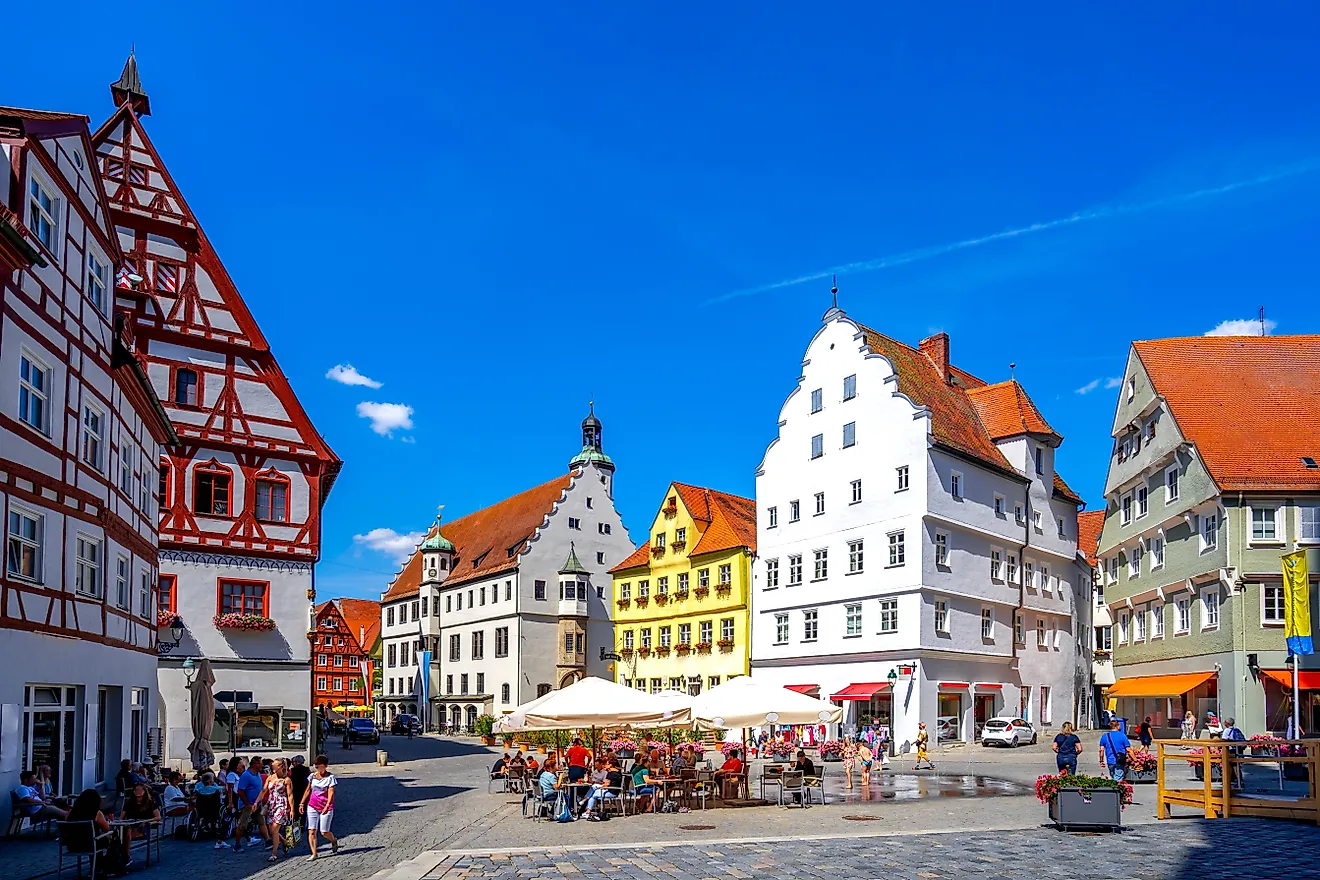
Nördlingen lets visitors experience its medieval center from both street level and above. Start at Market Square, then step inside St. George's Church, whose enormous late-Gothic interior dominates the center. Beside it rises the Daniel Tower, and climbing the stairs provides the best introduction to Nördlingen's unusual circular layout, which sits within the Ries meteorite crater.
Back at street level, walk outward through the medieval lanes toward one of the access points to the town wall. Unlike many German towns where only fragments of fortifications survive, Nördlingen's wall remains complete and walkable. Follow a section of the covered wall for elevated views over tiled roofs, towers, and narrow streets before descending again into the center. This route creates an especially satisfying progression. Visitors first see the town from its central square, then from the church tower, and finally from the fortifications that still encircle it.
Meissen

Meissen's center rewards walkers with a route that becomes more dramatic as it climbs. Begin at Market Square, surrounded by historic townhouses and the late-Gothic Town Hall. The Frauenkirche stands directly beside the square. Its tower contains a carillon made from Meissen porcelain, a fitting detail in the town that gave European porcelain its start. From here, follow Burgstraße uphill through the Old Town, where shops, cafés, and tightly packed historic buildings line the approach to Castle Hill.
Continue up the pedestrian lanes and steps until you reach the Albrechtsburg Castle and neighboring Meissen Cathedral. Albrechtsburg, constructed in the 15th century, is regarded as Germany's oldest residential castle and later housed the first European hard-paste porcelain manufactory. The cathedral's Gothic towers rise immediately beside it. After exploring both landmarks, pause at the viewpoints around Castle Hill for panoramas over the red-roofed center and Elbe Valley, completing a walk that progresses naturally from the marketplace toward its mountaintop landmark.
Celle

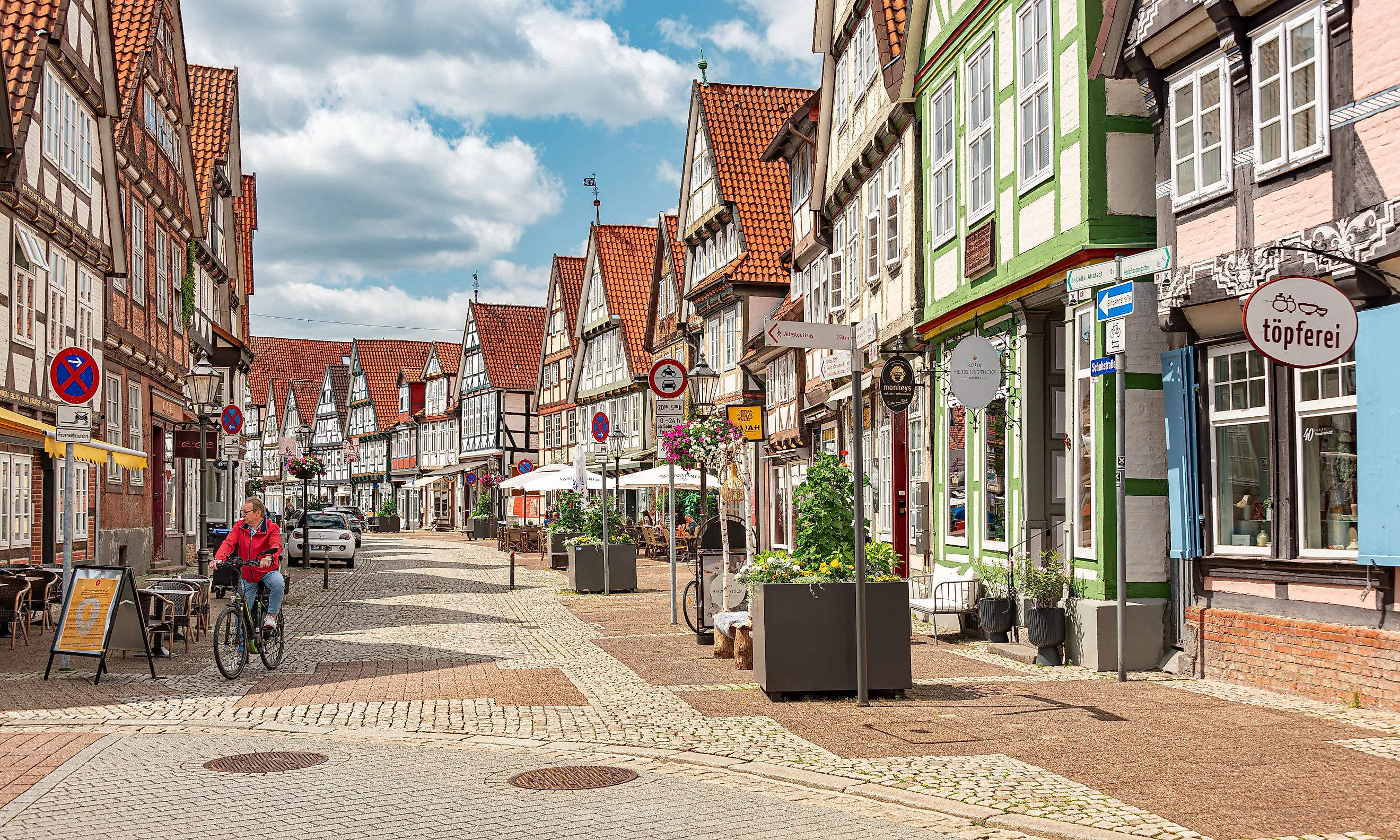
Nearly 500 restored half-timbered buildings make Celle's Old Town impressive at street level, while its compact layout puts several major attractions within an easy walk. Begin around Stechbahn and the market area, where colorful timber-framed houses surround one of the center's traditional gathering places. On Wednesday and Saturday mornings, market stalls add produce, flowers, baked goods, and other regional products to a tradition stretching back centuries.
From Stechbahn, walk a few steps to St. Mary's Church, then continue past the Bomann Museum toward Celle Palace. The former residence of the dukes of Brunswick-Lüneburg stands beside the Old Town, combining Renaissance and Baroque architecture and containing one of Europe's oldest surviving court theaters. Leave the palace grounds and head south through the center toward the French Garden, following the streets beyond the half-timbered core into landscaped greenery. Its lawns, paths, pond, and mature trees provide a relaxed finish after the architectural density of the Old Town, all without requiring transportation between stops.
Bad Wimpfen

Bad Wimpfen's hilltop center is small enough to cross on foot in minutes, yet its towers and surviving palace structures preserve the scale of an important medieval imperial town. Start at Market Square, where cafés and historic buildings provide an introduction to the Old Town, then walk toward the remains of the Staufer Imperial Palace. Constructed during the Middle Ages above the Neckar, the extensive palace complex once accommodated Holy Roman emperors and their courts.
Within the former palace precinct, head for the Blue Tower, built around 1170 and later used as a watchtower. Climb to the top for views across tiled rooftops, the Neckar Valley, and surrounding countryside. Back on the ground, continue east through the palace quarter toward the Red Tower, another surviving medieval defensive structure. The short route between the two towers passes stone walls, half-timbered houses, gateways, and viewpoints over the river valley, allowing visitors to experience much of Bad Wimpfen's medieval core without ever needing to leave the pedestrian-scale Old Town.
Fritzlar

Fritzlar's nearly traffic-free Old Town makes it easy to connect its medieval landmarks without leaving the historic center. Begin at Market Square, where tightly grouped half-timbered buildings surround the Rolandsbrunnen fountain. After exploring the square, walk east through the narrow streets toward St. Peter's Cathedral, whose origins are connected with the monastery founded here by St. Boniface in the eighth century. The present church incorporates Romanesque and Gothic elements accumulated over centuries.
From the cathedral, continue through the Old Town toward Fritzlar's surviving medieval fortifications. Sections of the walls and defensive towers recall a time when the town was protected by an extensive system of ramparts. Follow the fortifications toward the Grey Tower, one of Germany's tallest surviving medieval urban defensive towers. Visitors can climb through several floors devoted to local history before reaching views across the compact Old Town and surrounding countryside. From the tower, it is only a short walk through the half-timbered streets back toward Market Square, completing an easy circuit rather than requiring visitors to retrace the entire route.
Dinkelsbühl

Dinkelsbühl's preserved gates, walls, and colorful houses make its Old Town particularly suited to exploring on foot. Begin at Weinmarkt, where some of the town's most elaborate historic façades stand side by side. From the square, walk toward the nearby St. George's Minster, an imposing late-Gothic hall church whose tower and roofline dominate views through the surrounding streets.
After visiting the church, follow Segringer Straße west through the center. Shops, restaurants, and pastel-colored houses accompany the walk toward Segringer Gate, part of Dinkelsbühl's remarkably complete system of medieval defenses. The present Baroque gate dates to the 17th century, replacing an earlier structure damaged during the Thirty Years' War. From here, follow the fortifications toward another stretch of the town wall, where towers, gates, and green spaces frame the historic center. Looking back along Segringer Straße also provides a memorable view toward St. George's, visually connecting the final stop with the point near where the walk began.
Gengenbach

Gengenbach compresses the half-timbered architecture and narrow lanes associated with the Black Forest into a center that can be crossed comfortably on foot. Start at Market Square, dominated by the 18th-century Town Hall and surrounded by cafés and colorful historic buildings. The Town Hall becomes especially famous during Advent, when its 24 windows form one of the world's largest Advent calendars, but the square remains Gengenbach's principal gathering place throughout the year.
From Market Square, walk into Engelgasse, where closely packed timber-framed houses, flower boxes, and small courtyards create one of the Old Town's most distinctive streetscapes. Continue through the adjoining lanes toward the Upper Gate, a surviving part of Gengenbach's medieval defenses and one of the principal historic entrances into town. Rather than stopping there, loop back through the Old Town toward the Benedictine monastery and St. Marien Church, whose Baroque buildings provide a striking contrast with the half-timbered streets. The entire circuit remains compact, allowing visitors to move among market square, medieval lanes, fortifications, and ecclesiastical architecture in a single walk.
Town Centers Made for Exploring on Foot
Germany's smaller towns show why walkability is about more than short distances. In Quedlinburg and Dinkelsbühl, the streets between landmarks are lined with half-timbered houses that make the route an attraction in its own right. Wittenberg turns a straightforward walk along Collegienstraße and Schlossstraße into a journey through Reformation history, while Nördlingen lets visitors leave street level altogether and continue around its complete medieval wall.
Other centers use their landscapes to shape the experience. Meissen's route climbs from Market Square toward its castle and cathedral above the Elbe, while Bad Wimpfen pairs medieval towers with views over the Neckar Valley. Celle leads naturally from a busy market area and palace into the French Garden, and compact Fritzlar and Gengenbach make it possible to move among squares, churches, fortifications, and local businesses without needing a car. In each town, walking is not simply the easiest way to reach the sights. It is one of the best ways to experience the historic center itself.