The Oldest National Park East Of The Mississippi
Acadia National Park is the oldest existing national park east of the Mississippi River. Founded in 1919, it was the first national park created entirely from donated private land, established on the Atlantic coast of Maine. Located on Mount Desert Island, the park has been settled for more than 5,000 years by a mixture of Natives, French, English, and Americans. Although it is the oldest of the national parks of the East, its name wasn't originally Acadia, but rather after a famous Frenchman who helped America during the American Revolutionary War.
History
Archaeological finds reveal that Acadia was settled by Native American groups dating back more than 3,000 BC, as there were shells left behind here that would indicate human presence. These were the Wabanaki people, a term which encompasses several different tribes, including the Maliseet, Passamaquoddy, Micmac, and Penobscot.
The Wabanaki had been in Maine for at least 12,000 years and used birchbark canoes to travel to Acadia thousands of years later. Today, they refer to the island as Pemetic, which translates to either a range of mountains or the sloping land. Interestingly, records stated that Wabanaki wintered in the inland forest and went to the coast in the summer, but archaeological records showed that Natives actually spent winter on the coast to catch salmon and went inland in the summer. Some have suggested there were two separate groups that lived in both parts of Acadia.
The first well-documented European visit came in 1604, when French colonizer and explorer Samuel de Champlain reached the island. He called it Isle des Monts Déserts, the origin of the name Mount Desert Island. Within nine years, the French established a Jesuit mission on the island, but the mission would not last a year, as English Captain Samuel Argall raided and burned the settlement.
The land remained largely free of any major European settlements, other than a brief feudal estate run by Antoine Laumet in 1688, who would later go on to found the city of Detroit. The British would ultimately take control of the land in 1759 following British victory in Quebec over the French during the French and Indian War.
Although Governor Francis Bernard of Massachusetts tried to attract settlers with free land, the Revolutionary War interrupted any major settlement. In the end, it would come down to Americans who began coming to Mount Desert Island to fish and log in the early 1800s. Those loggers would create schooners, barns, hand tools, and other wooden goods. Farmers meanwhile grew wheat, corn, and potatoes on the soil.
The Protection Of Acadia

Much like Yellowstone National Park, it was the painters who first drew attention to the beauty of Acadia, such as Thomas Cole and Frederic Church, who painted scenes on Mount Desert Island, and Church's "Twilight in the Wilderness" is often linked to his time in Maine. Cole meanwhile painted idealized Greek scenes such as "Dream of Arcadia," referencing the Greek region of Arcadia, long imagined as a place where people lived in harmony with nature.
In the late 19th century, travelers began to arrive on Mount Desert Island, eager to enjoy its rustic charms. To accommodate these people, hotels and great estates were set up, including by major American businessmen such as the Rockefellers and the Vanderbilts.
Out of all the people who sought to preserve Mount Desert Island, the one name that stands out the most is George Bucknam Dorr. He lived from 1853 to 1944 and was born into wealth on both sides of his family. He used his wealth to purchase land throughout Mount Desert Island, with the goal of protecting it from gasoline-powered sawmills. He established the Hancock County Trustees of Public Reservations to acquire 6,000 acres. He also built a spring house on the island and carved the words "The Sweet Waters of Acadia" onto a rock.
He also made an effort to convince Congress to protect the lands, bringing maps and land titles to Congress from 1913 to 1916. This eventually gained the attention of President Woodrow Wilson, who created the Sieur de Monts National Monument in 1916. This coincided with the creation of the National Park Service in 1916 to centrally manage all national parks and monuments.
Dorr would continue to acquire more land until the official establishment of the island as a national park in 1919 under the name Lafayette National Park, after the Marquis de Lafayette, a Frenchman who served for the American cause during the American Revolution, and harkened back to the region's French history. It was also meant as a gesture of goodwill to the French, who were struggling against the Central Powers in World War I.
However, the name would not last. John Godfrey Moore's widow and daughters, staunch Anglophiles who held land on the Schoodic Peninsula, agreed to donate it on the condition that the name Lafayette National Park be changed. Dorr agreed, choosing Acadia, a term used by the French who settled in Maine, Canada, and Louisiana that still reflected the region's French roots.
Congress accepted both the land and the new name, and the expanded park became Acadia National Park in 1929.
Landmarks

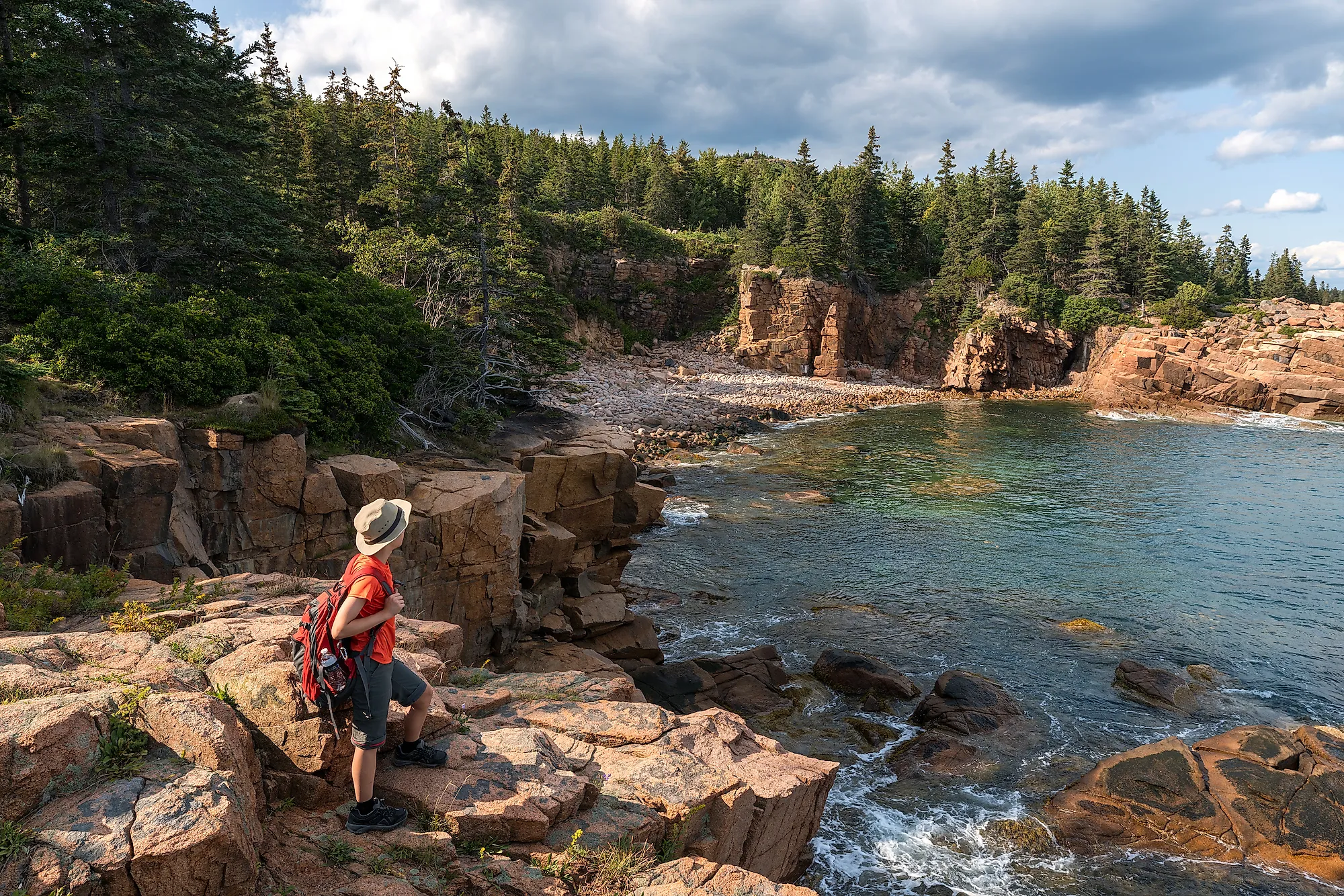
Acadia National Park has both a rocky shoreline and a wide variety of mountains. There are 26 mountains in the park. When Samuel Champlain first saw these mountains, he believed they were barren, hence the name Mount Desert Island. Dorr renamed these mountains to reflect both French and Native heritage, such as Penobscot, Dorr, and the tallest mountain, Cadillac, at 1,530 feet in elevation.
The land in Acadia has been buried multiple times, first by an ocean, then underneath glaciers during the last ice age. Between the mountains are high-elevation lakes and ponds, such as Sargent Mountain Pond, situated between Penobscot and Sargent Mountains. This pond is believed to be the first lake to appear in Maine after the last ice age, dating back 16,600 years.
The other major feature of this island is its coastline. It has 64 miles of coastline in total, but of that, 40 miles of it is rocky. Sand Beach is the park's main ocean swimming beach, while freshwater beaches can be found at Echo Lake and Lake Wood.
What Is The Second-Oldest National Park East Of The Mississippi?

The question of which is the second oldest national park east of the Mississippi is complicated. Everglades National Park received authorization to become a national park on May 30, 1934. However, it wouldn't be officially established until 1947, as it took 13 years to purchase the necessary land, including Royal Palm State Park, which was organized by the Florida Federation of Women's Clubs.
The Great Smoky Mountains National Park in Tennessee and North Carolina, meanwhile, was established as a national park weeks later in June 1934 after Tennessee and North Carolina transferred 300,000 acres to the federal government. The bill authorizing the park had been signed in 1926, eight years before the Everglades bill, making the Smokies the stronger claim to second place.
President Franklin D. Roosevelt would hold the opening ceremony for the park in September 1940, a full seven years before Everglades National Park opened.
This Oldest Park Still Stands Out
There are many reasons why Acadia National Park stands out. It's the only national park in Maine, and in New England more generally. It also regularly ranks among the most visited national parks. In 2025, it ranked seventh in terms of visits with 4.079 million visitors. It would not have become a park if not for the work of George Dorr and others who worked closely with him. By the end of his life, he had largely used all his fortune on the park, but he got to sit back and see his life's work, the protected mountains and shoreline of Acadia National Park.