11 Best Downtowns on the Pacific Coast
A good coastal downtown has to survive two things: the weather and the tourists. The ones on this list have managed both, mostly because they were built for something else entirely before anyone thought to visit them. These were shipbuilding towns, salmon canneries, lumber ports and Victorian boomtowns, and the streets that now hold galleries and oyster bars were laid out for hauling freight. That history is why the architecture is worth looking at, and why so many of these places have a working harbor sitting right behind the espresso bar. Running north to south from the San Juan Islands to the Central Coast, here are eleven downtowns on the Pacific Coast that earn the walk.
Friday Harbor, Washington

You arrive here by boat or by floatplane, which sets the tone before you have walked anywhere. Friday Harbor is the only incorporated town on San Juan Island, and its downtown runs a few short blocks uphill from the ferry dock, which means the entire commercial district is a ten-minute walk from where you step off the boat.

The Whale Museum was the first museum in the country dedicated to a species living in the wild, which tells you what the island cares about. The San Juan Historical Museum handles the pioneer side, and Downriggers puts fresh seafood in front of a harbor view. Kayak trips and whale-watching boats leave straight from the docks, so the town works as a base as much as a destination.
Anacortes, Washington

Most people treat Anacortes as the place you drive through to catch the San Juan ferry, which is their loss. Commercial Avenue runs through a downtown of brick storefronts on Fidalgo Island, and the town has covered dozens of its buildings with life-size photographic murals of the people who lived and worked here a century ago.

The Anacortes Museum and the Maritime Heritage Center cover the canning and shipbuilding years that built the place. Adrift Restaurant is the local institution for dinner, and the Anacortes Arts Festival takes over the main drag each August with live music and several hundred artists.
Port Townsend, Washington

Port Townsend is what happens when a town builds for a future that never arrives. In the 1880s it expected to become the major port of the Pacific Northwest and put up brick and stone commercial blocks to match. The railroad went to Seattle instead, the boom collapsed, and nobody had the money to tear any of it down.

The result is a National Historic Landmark District, one of only three Victorian seaports on the register, with Water Street still lined by the original storefronts. The Jefferson County Courthouse and the Rothschild House Museum are the architectural highlights, and the Wooden Boat Festival each September fills the harbor with vessels that match the buildings.
Astoria, Oregon

Astoria is the oldest American settlement west of the Rockies, founded in 1811, and its downtown along Commercial Street looks the part. The Liberty Theatre opened in 1925 and still runs. The Captain George Flavel House Museum, an 1885 Queen Anne built by a bar pilot who made a fortune guiding ships over the Columbia River bar, has the carved woodwork and stained glass that money bought.

The Columbia River Maritime Museum is the best of its kind on the coast, largely because the bar outside town has wrecked enough ships to fill it. Astoria Vintage Hardware and a run of cafes handle the browsing, and the Astoria Column, 164 steps up a hill above town, gives you the whole river mouth at once.
Seaside, Oregon

Seaside is the unapologetic one. This is Oregon's original beach resort, built when the railroad arrived in the 1890s. Broadway still runs arcades, candy shops and surf stores straight down to the Prom, a mile and a half of concrete boardwalk along the sand. Anyone looking for restraint should keep driving.

The Turnaround at the end of Broadway marks the official end of the Lewis and Clark Trail, with a statue of both men looking out at the ocean they walked across the continent to reach. The Seaside Aquarium has been running since 1937 and still lets you feed the harbor seals. Lewis and Clark Salt Works Park preserves the spot where the expedition boiled seawater for salt.
Cannon Beach, Oregon

Nine miles south of Seaside and about as different as two towns can be while sharing a county. Cannon Beach banned formula businesses and neon signage decades ago, which is why Hemlock Street is cedar-shingled galleries and independent restaurants rather than franchises.

Haystack Rock stands 235 feet offshore and is close enough to walk out to at low tide, where the tide pools hold sea stars and the puffins nest from spring into summer. White Bird Gallery has been showing work since 1971, the Cannon Beach History Center covers the logging and settlement years, and the Stormy Weather Arts Festival in November is timed for exactly the conditions the name suggests.
Eureka, California

Old Town Eureka is the most intact Victorian commercial district on the West Coast and hardly anybody talks about it. The historic district holds around 154 contributing buildings across First, Second and Third Streets, listed on the National Register in 1991, and the reason it survived is unglamorous: Eureka never had the fire or the redevelopment money that flattened comparable districts elsewhere.

The Carson Mansion sits at the eastern edge, built in 1886 by lumber baron William Carson and reckoned to be the most photographed Victorian house in America. It is a private club, so admire it from the street. The Clarke Historical Museum and the Morris Graves Museum of Art anchor the cultural side, Blue Ox Millworks still produces Victorian millwork with period machinery, and the boardwalk puts you on Humboldt Bay with the fishing fleet working in front of you.
Mendocino, California

Mendocino looks like New England because it was built by people from there. Founded as a logging town in 1851, its Main Street carries wooden Victorian storefronts and water towers on a bluff directly above the Pacific, and the whole thing is a historic district. Hollywood noticed a long time ago, which is why the town has stood in for Maine in more films than anyone has counted.

The Kelley House Museum and the Ford House Visitor Center cover the logging century. The Temple of Kwan Tai, built in the 1850s, is one of the oldest Chinese temples in California and a reminder of who else worked these mills. Mendocino Headlands State Park wraps around three sides of town, so the trail is always about two minutes from the shops.
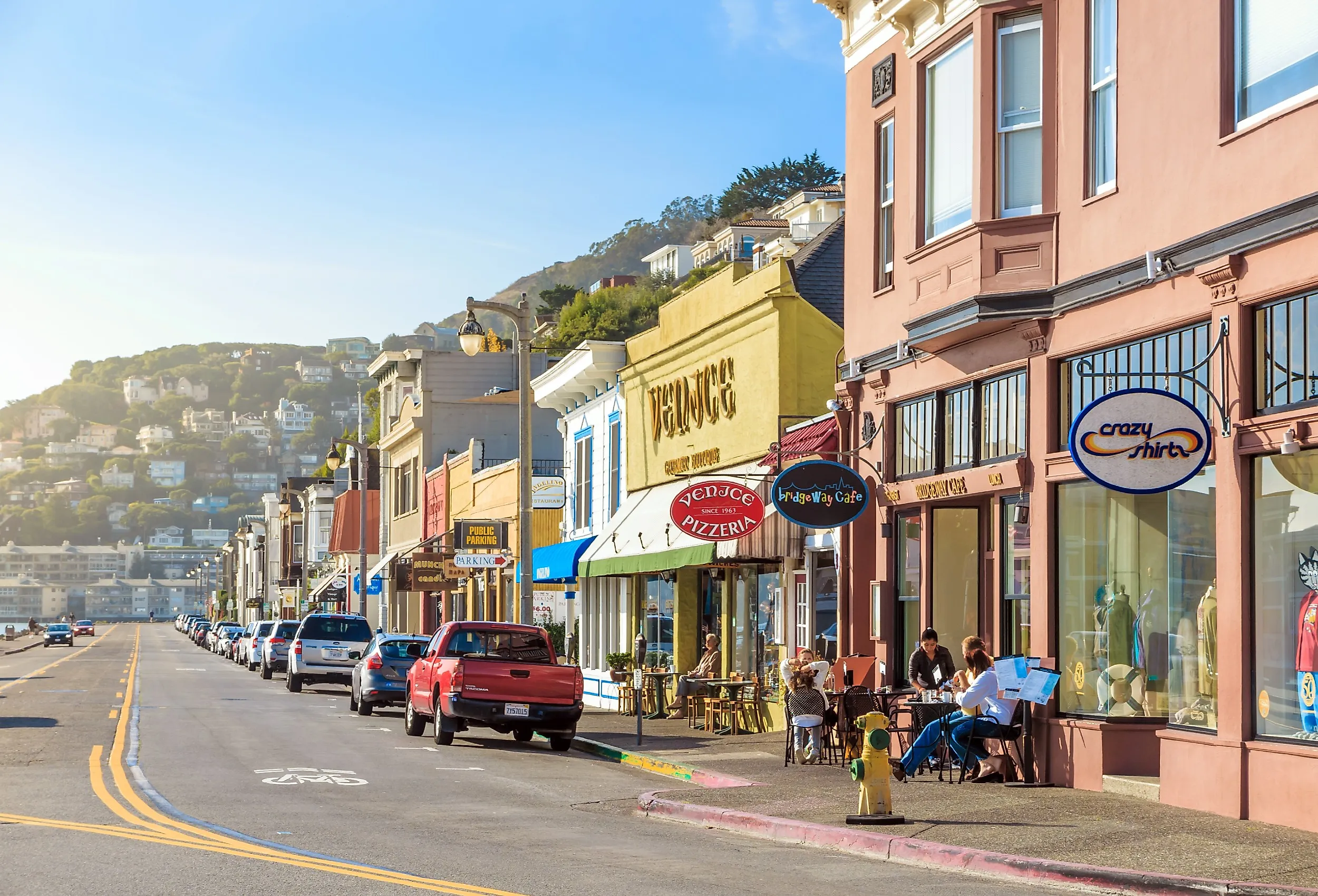
Sausalito, California

Sausalito spends its days looking at San Francisco across the water, which is a good position to be in. The town built Liberty ships during the Second World War at Marinship, and when the yard closed the workers who stayed turned surplus hulls and barges into the houseboat community that still floats in Richardson Bay.

Bridgeway is the main street, running along the water with galleries, seafood restaurants and views back toward the Golden Gate Bridge. The Bay Model Visitor Center is the sleeper attraction, a working hydraulic model of the entire bay and delta covering roughly two acres, built by the Army Corps in 1957 to test a scheme to dam the bay. The scheme died. The model is free.
Half Moon Bay, California

Half Moon Bay is a farm town that happens to be on the ocean, and Main Street reflects it. Cunha's Country Grocery has been serving the same community since 1927, the bakery is the other local fixture, and the storefronts around them are nineteenth-century buildings converted into boutiques and galleries.

The James Johnston House, an 1850s saltbox on a hill outside town, is the oldest building in the county and looks like it was airlifted from Ohio. October brings the Art and Pumpkin Festival, which draws hundreds of thousands of people for a weekend built around vegetables the size of small cars. Mavericks, the big-wave break that surfers travel the world for, is a couple of miles up the coast.
Cambria, California

Cambria splits into two downtowns, which is unusual for a town of 6,000. East Village holds the older buildings and the Cambria Historical Museum in an 1870s house, while West Village sits closer to the water with the galleries and tasting rooms. Both are on Main Street, about a mile apart, and locals will tell you which one they prefer.

The town was a mercury mining and ranching community before Highway 1 turned it into a stop. Robin's Restaurant has been doing farm-to-table since before the phrase existed, and Moonstone Beach is a short walk away with tide pools and the agates the beach is named for. Hearst Castle is eight miles north, which is why half the traffic is here.
What These Towns Have In Common
None of these downtowns was designed to be attractive. They were laid out to move lumber, fish, ships and ore, and the good-looking buildings went up because somebody made money doing it. What saved them was usually failure. Port Townsend lost the railroad, Eureka lost the timber money before anyone could modernize the waterfront, and Mendocino's mills closed while the storefronts were still standing. The towns that boomed and kept booming knocked their old buildings down. These ones could not afford to, and a century later that turns out to have been the right call.