What Happens If The Chicago Locks Are Opened
Chicago opens its locks and lets the river run into Lake Michigan, and the answer to what happens next is that the city deliberately contaminates its own drinking water supply to avoid flooding the Loop. It is not a hypothetical. It has happened roughly 50 times since 1985, most recently on July 2, 2023, after eight inches of rain fell on parts of the city, and the immediate consequence was a swimming ban at every beach in Chicago. The decision is made by a single agency in the middle of the night, usually within an hour or two, and it is described by the people who make it as a last resort for exactly the reason you would expect.
Here is what the locks do, what comes out when they open, and why the thing most Chicagoans believe about them is wrong. The short version is that the Chicago River only runs the direction it does because somebody is actively holding it there.
What The Locks Are Holding Back

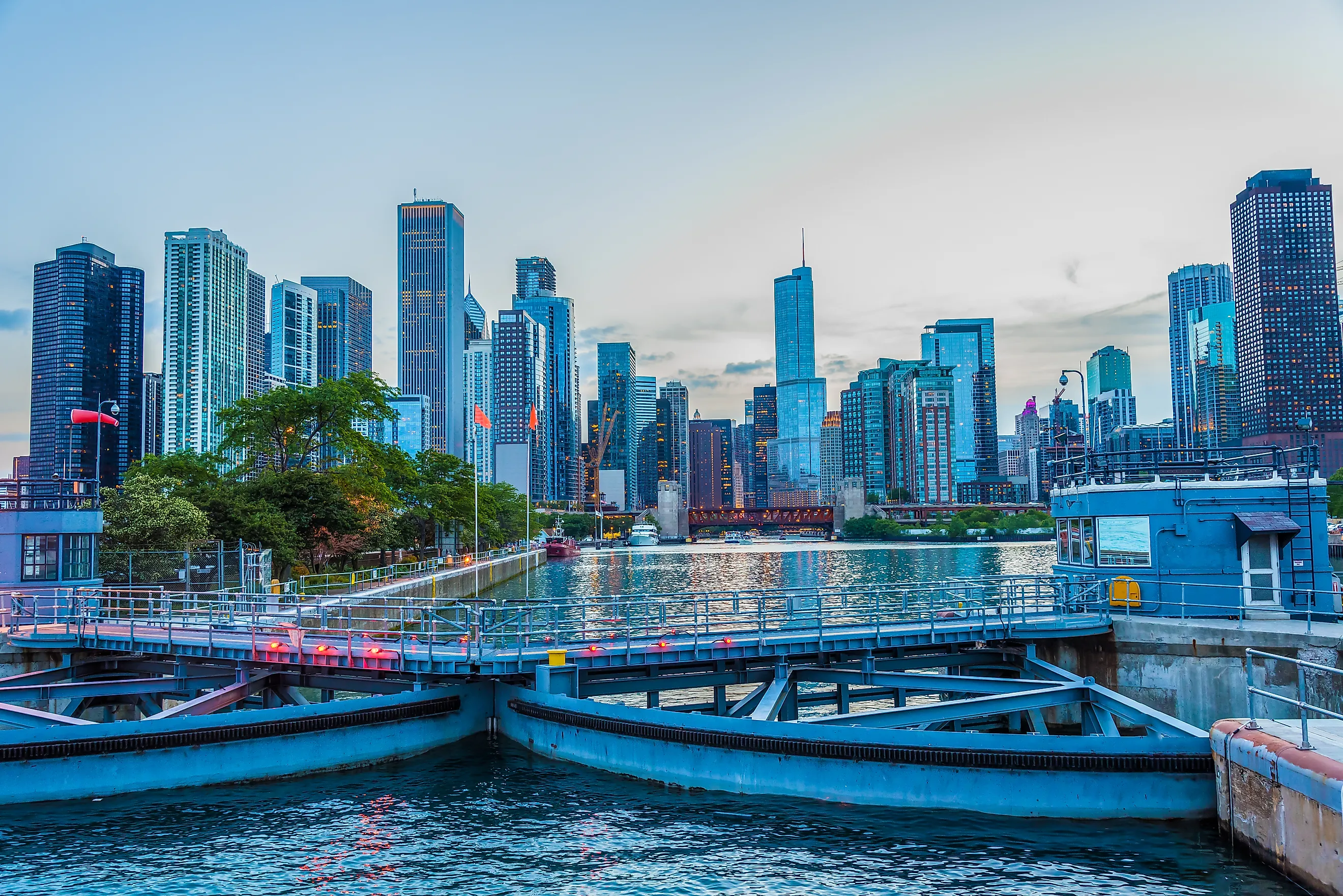
Three control structures manage the boundary between the Chicago river system and the lake: the Chicago Harbor Lock in downtown Illinois, the Wilmette lock to the north, and the O'Brien Lock on the Calumet to the south. The Harbor Lock was built between 1936 and 1938, primarily to limit how much Lake Michigan water Chicago was diverting rather than to keep river water out.
Their normal job is to maintain an artificial arrangement in which the river sits lower than the lake, so water flows from Lake Michigan into the river and then away toward the Mississippi basin. The locks are the wall that makes that slope possible, and the Metropolitan Water Reclamation District spends every day of the year maintaining it.
Why The River Runs Backwards
The reversal is the whole reason any of this exists. Chicago originally drained into Lake Michigan, which was also where it drew its drinking water, an arrangement that worked exactly as badly as it sounds. The Chicago Sanitary and Ship Canal opened in 1900 and solved it by digging a channel deep enough that the river ran the other way, carrying the city's waste toward the Illinois River and eventually the Mississippi.
The Sanitary District of Chicago was created in 1889 to manage it, which means the agency now called the MWRD predates the Environmental Protection Agency by 81 years. Chicago's water problem was being run as a public health emergency long before anyone had a federal framework for it.
It Has Happened About Fifty Times Since 1985
The MWRD keeps a list, and the pattern is irregular rather than rare. Some years have none at all, including 2012, 2018 and 2021. Other years have several, with 2011, 2017 and 2020 each seeing two separate events. The longest gap on record was a five-year stretch in the mid-1990s.
The trigger is specific. When water levels in the Chicago waterways rise above the level of Lake Michigan, the artificial slope disappears and the river starts trying to go where it originally went. At that point the agency has two options and no third one.
The Decision Itself
What it looks like in practice is an on-call meteorologist, radar, and gauges on the waterways, followed by a phone call in the small hours. During one 2011 event the Wilmette locks were opened at 2:30 in the morning and the downtown locks an hour later.
An MWRD spokesperson described the reasoning about as plainly as possible: it is a last resort, because the city gets its drinking water from Lake Michigan, so the entire point is to protect the lake. The choice on the table is flooding the Loop and thousands of basements, or accepting contamination of the water supply for a day or two.
What Actually Comes Out

This is the part that makes it serious. Chicago runs a combined sewer system, which means stormwater and sewage travel in the same pipes. In ordinary rain that is fine, because the combined flow goes to treatment. In extraordinary rain the volume exceeds what the system can handle, and the overflow has to go somewhere.
So the water that enters Lake Michigan when the locks open is not rainwater. It is combined sewer overflow, meaning stormwater diluted with untreated sewage, discharged directly into the lake a short distance from the intakes that supply drinking water to millions of people.
The dilution is enormous, which is the only reassuring thing about it, and the exposure is measured in hours rather than weeks. Lake Michigan is a very large body of water and Chicago is discharging into the edge of it during a storm, which is not nothing but is also not the 1890s.
The Beaches Close
The visible consequence arrives fast. After the July 2023 reversal, swimming was banned at every Chicago beach, and most reopened by late the following morning once bacterial counts came back down.
That is the usual pattern. A lock opening produces a short, sharp water quality event rather than a lasting one, and the city's monitoring is set up to catch it. It is still the only major American city that responds to a rainstorm by closing its entire lakefront.
It Does Not Stop Your Basement Flooding
Here is the widely held belief that is simply wrong, and it matters because it drives public pressure to open the locks sooner.
A great many Chicagoans think that opening the gates will drain the water out of their basements. It will not. As one former MWRD engineer explained, the water has to travel an enormous distance through the sewers and canals before it reaches the lakefront, so opening the locks earlier does not relieve a flooded basement in any useful timeframe. An extraordinary rain event overwhelms the system regardless of whether the gates are open.
The locks exist to prevent the river overtopping its banks, which is a different problem from water in a basement. Solving the first does very little for the second, and the two get conflated every time the city floods.
The Deep Tunnel Is What Delays It
The reason lock openings are occasional rather than routine is one of the largest public works projects in the country. The Tunnel and Reservoir Plan, universally called the Deep Tunnel, was commissioned in the 1970s and consists of 109 miles of tunnels up to 33 feet in diameter feeding enormous surface reservoirs.
The McCook Reservoir holds several billion gallons and the Thornton Composite Reservoir holds several billion more. During a serious storm the MWRD reports their fill levels the way other agencies report a flood stage, and a lock opening generally means the tunnels and reservoirs are already close to full.
TARP has substantially reduced how often the locks have to open, but it has not eliminated the need, because there is always a size of storm that overwhelms any amount of storage. The system buys time rather than removing the problem.
What Permanently Opening Them Would Mean

The other version of this question is what happens if the locks come out for good, and that turns out to be a far larger problem than a few hours of poor water quality.
The Chicago Area Waterway System is the only artificial connection between the Great Lakes and the Mississippi basin, which makes it the route invasive species use to move between two of the largest freshwater systems on the continent. Bighead and silver carp are established in the Illinois River and the entire apparatus of electric barriers, monitoring and the Brandon Road project exists to keep them from getting through.
The long-running policy debate actually runs the other way. Rather than opening the locks, several Great Lakes states have argued for hydrological separation, meaning permanently severing the connection Chicago built in 1900. That would solve the invasive species problem and create an enormous new one for Chicago's stormwater, which is why it has not happened.
The Underlying Trade

Every part of this comes back to a decision made in 1900. Chicago solved a public health catastrophe by sending its waste toward the Mississippi instead of into its own water supply, and it has been maintaining that arrangement by machinery ever since.
Opening the locks is that arrangement failing under load. For a few hours the river does what it did before 1900, the lake takes what the canal normally carries away, and the beaches shut until the numbers come back down. Then the gates close and the slope is restored, which is the part that is easy to miss: the Chicago River only runs the right way round when somebody is holding it there.