Where The Navy Parks The Ships It No Longer Uses
A retired Navy warship does not get thrown away. It gets parked. The Navy tows it to a harbor and ties it up beside other gray hulls, where it can float for a year or for well over a decade. Keeping those ships afloat runs into the billions. The bill for idle attack submarines alone is projected to reach $3.1 billion by 2030. One carrier sat for 17 years before it moved. Another was sold off for a single penny. Nuclear-powered ships wait in a line of their own, because their reactors have to come out first. How long any ship waits comes down to whether space has opened at the other end.
The Reserve Basin at the Philadelphia Navy Yard

The most visible of those harbors is a concrete-lined, three-sided basin at the old Philadelphia Navy Yard on the Delaware River, and drivers on I-95 can see it from the Girard Point Bridge near the stadiums. This fall it held 25 ships in 30 feet of still water. Four Freedom-class littoral combat ships are moored along the south side, and each of the four lasted only five to eight years in service. Retired guided-missile cruisers share the basin with them, along with four minesweepers carried in from Bahrain on a cargo ship.
Ships have not been leaving the basin any faster than new ones arrive. The frigate Klakring was towed out in August 2026 and sunk off Scotland the next month during an exercise called Atlantic Thunder. The cruiser Vicksburg left under tow for a Texas scrapyard at the end of September. The carrier John F. Kennedy stayed far longer, about 17 years in all, and spent a decade of that time in donation status while it was held for a possible museum. No museum took it.
The piers are now wanted for something else. Hanwha Philly Shipyard, which shares the old Navy Yard, finishes about one ship every eight months and wants the wharf space to work toward one every few weeks. A company executive argued that stripping spare parts from old hulls can be done in other places and does not require holding the pier.
Middle Loch, Pearl Harbor

Before a ship joins a reserve harbor, it has to be made safe to leave alone. When the cruiser Antietam was prepared for decommissioning at Pearl Harbor in 2024, workers removed all of its combustible liquids and blanked off the valves that connect to the sea so the hull would stay watertight. Antietam was decommissioned that September after 37 years of service and went to anchor at the inactive ships office in Middle Loch, an inner arm of the harbor where the cruiser Cowpens also waits.
Antietam's new job is to be a Logistic Support Asset, the Navy's term for a ship kept as a source of spare parts and equipment for ships still at sea. Navy maintenance rules require parts ships like Antietam to be kept dry with dehumidifiers and protected by cathodic protection, a low electric current that slows corrosion on a steel hull. Inspectors check the watertight integrity of those hulls every six months or every year, depending on the ship's category. Not every cruiser decommissioned here stays, though. Shiloh, retired at Pearl Harbor at the end of September 2026, is headed to Bremerton, Washington, as another parts ship.
Sinclair Inlet, Bremerton, Washington

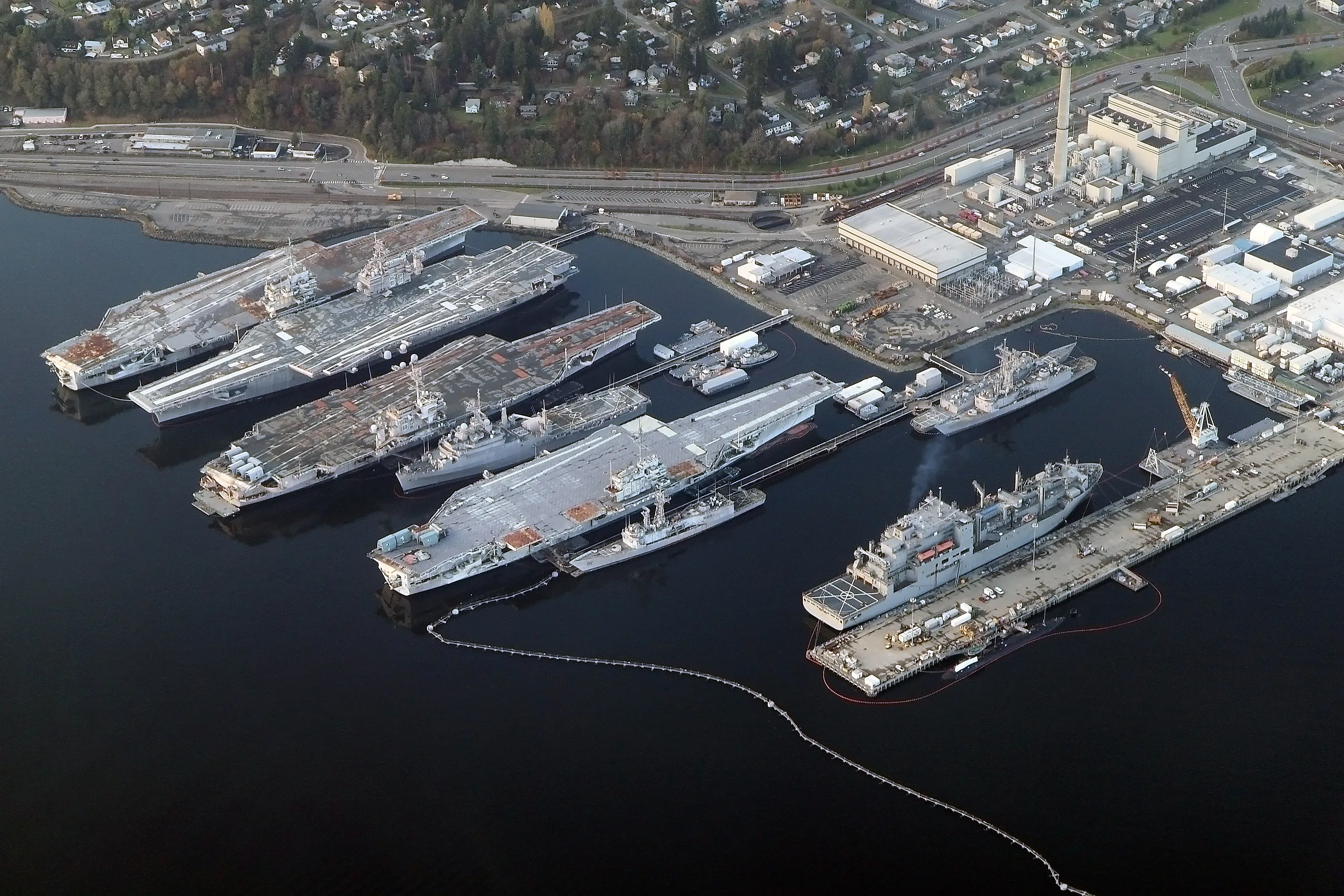
Shiloh's destination is Sinclair Inlet, where retired cruisers and littoral combat ships are moored beside Puget Sound Naval Shipyard in Bremerton, a ferry ride across Puget Sound from Seattle. The shipyard next to those moorings is the end of the nuclear line. It is the only place in the country that cuts retired nuclear submarines apart for recycling, a program the Navy began in 1990, and by 2023 it had removed the reactors from 123 submarines and eight cruisers. The attack submarine Alexandria reached Bremerton in July 2026, after 35 years in service, to begin its own turn.
A submarine has to be lifted out of the water in a dry dock before it can be taken apart, and dry docks are scarce. When a boat slated for decommissioning cannot get one, the Navy calls the delay "inactive idle." The Government Accountability Office reported in August 2026 that 15 attack submarines will spend time in that status between 2026 and 2030, adding up to more than 14,000 days of waiting. GAO tied much of the increase to the wave of Los Angeles-class boats now retiring. One of them, USS Pasadena, went idle at the start of 2025 and is not expected to get a dry dock at Norfolk Naval Shipyard in Virginia until November 2028, nearly four years later.
Trench 94 at the Hanford Site

The reactor compartment from each recycled submarine makes one more trip. After the fuel is removed, workers cut out the hull section that holds the reactor and weld steel plates over every opening. The sealed package weighs between 1,130 and 1,680 tons. Barges carry it 310 miles up the Columbia River to Richland, Washington, and they sail only in spring or fall, when ocean and river conditions allow. From the river, the package is hauled over land to Trench 94 on the Hanford Site, a disposal pit more than 50 feet deep and about the size of two football fields, where it stays for good. Compartments from the submarines City of Corpus Christi and Portsmouth arrived in October 2024 as the 143rd and 144th packages buried there since 1986.
Suisun Bay, California

Support ships often leave the Navy by a gentler route. Military Sealift Command ships that sailed with civilian crews are usually handed to the Maritime Administration, which keeps them in its Ready Reserve Force or prepares them for disposal. A few remain Navy property while the agency holds them in custody, so their fate still waits on a Navy decision. The fast transport Millinocket is one of them. It has been moored in the Suisun Bay Reserve Fleet near Benicia, California, since July 2025, in an anchorage that once held about 340 ships. The agency keeps two more Navy custody ships on Virginia's James River and near Beaumont, Texas, and it preserves its reserve hulls with the same dehumidifiers and cathodic protection the Navy uses.
Newport News Shipbuilding, Virginia

Nuclear aircraft carriers are the hardest case, and Enterprise is the first one the Navy has had to take apart. The carrier left active service in 2012 with eight reactors in four compartments, and shipbuilders at Newport News spent six years removing their fuel. The hull then stayed moored at the shipyard. Its reactors are not going to Hanford. Under the plan the Navy settled on in 2026, NorthStar Maritime Dismantlement Services will dismantle them with the rest of the ship in Mobile, Alabama, and send them to an authorized commercial radioactive waste site, under a $418.5 million contract with the work due by September 2030. Tugs pulled Enterprise out of Newport News on November 2, and it reached Mobile 11 days later. Counting that contract, retiring the carrier has cost the Navy about $1.3 billion.
The Navy is treating Enterprise as a trial run for the Nimitz class, and the first of those carriers is already close to retirement. USS Nimitz moved its homeport from Bremerton to Norfolk in 2026 and is scheduled to be decommissioned in March 2027, with its inactivation to follow at Newport News.
The Brownsville Ship Channel, Texas

Conventionally powered carriers make their last trip under tow, to the shipbreaking yards at the end of the ship channel in Brownsville, Texas, near the Mexican border. Kitty Hawk left Bremerton in January 2022. At more than 1,000 feet long and over 280 feet wide, it could not fit through the Panama Canal, so it was towed around South America through the Strait of Magellan and reached Brownsville at the end of May. John F. Kennedy had a much shorter trip. Its tow from Philadelphia in early 2025 covered 2,021 miles and took about two and a half weeks.
The Navy sold both carriers to International Shipbreaking Ltd. in October 2021 for one cent each. The price works because the company earns its money by selling the scrap metal. The port had received six aircraft carriers for recycling since 2014 before Kennedy arrived, and it said in 2023 that its three shipbreaking yards win about 85 percent of the Navy's and Maritime Administration's ship recycling work.
Off Pensacola, Florida

Some retired ships are turned over to coastal states as artificial reefs, one of the disposal options the Navy lists alongside scrapping and target use. The largest is the carrier Oriskany, sunk on May 17, 2006, off Pensacola, Florida, about 22.5 nautical miles southeast of Pensacola Pass. Preparing it took about three years and roughly $20 million, and the ship went under in less than 40 minutes. The wreck sits in 212 feet of water. The top of its island, the tower that rises above the flight deck, is about 84 feet down, close enough to the surface for divers to reach.
The Deep Pacific Off Kauai, Hawaii

Some retired ships end as targets. A sinking exercise lets crews test real weapons against a full-size hull. During the RIMPAC exercise in July 2024, the Navy and its partners sank the amphibious ships Dubuque and Tarawa in 15,000 feet of water more than 50 nautical miles off the northern coast of Kauai. Tarawa was struck by a Long-Range Anti-Ship Missile fired from an F/A-18F Super Hornet.
Tarawa had been decommissioned in 2009 and Dubuque in 2011, so each spent more than a decade in storage before its final tow. Federal rules require every sinking exercise to take place at least 50 nautical miles from land in water at least 6,000 feet deep, far below where any diver could reach the wreck.
A reserve harbor holds ships that are waiting on space somewhere else. In Philadelphia, the 25 hulls in the basin sit beside a shipbuilder that wants their piers to turn out new ships faster. Retired submarines wait on shipyard capacity, and Pasadena is expected to spend almost four years idle before a dry dock at Norfolk opens for it. Museums no longer offer much of a way out. The Navy's last ship donation was the destroyer Edson, which went to a museum in Bay City, Michigan, in 2012, and its donation office now lists no ships available.
For most hulls, the remaining exits are a sale to a shipbreaker or a final role as a reef or a target. Until one of those comes through, a parts ship stays moored with its dehumidifiers running, and an idle submarine stays crewed and maintained while it waits for a dry dock.