How Long It Takes A Barge To Travel The Whole Ohio River
A loaded fifteen-barge tow leaving Pittsburgh reaches the Mississippi in about eight days. Going back up takes closer to eleven.
That is 981 miles at an average speed slower than most people jog, through 20 locks, with the engines never switched off. It is also the most efficient way to move 22,500 tons of anything that exists in North America.
The Route Is Fixed And So Is The Maths

The Ohio begins where the Allegheny and Monongahela meet at Pittsburgh and runs 981 miles southwest to Cairo, Illinois. Across that distance it falls about 437 feet.

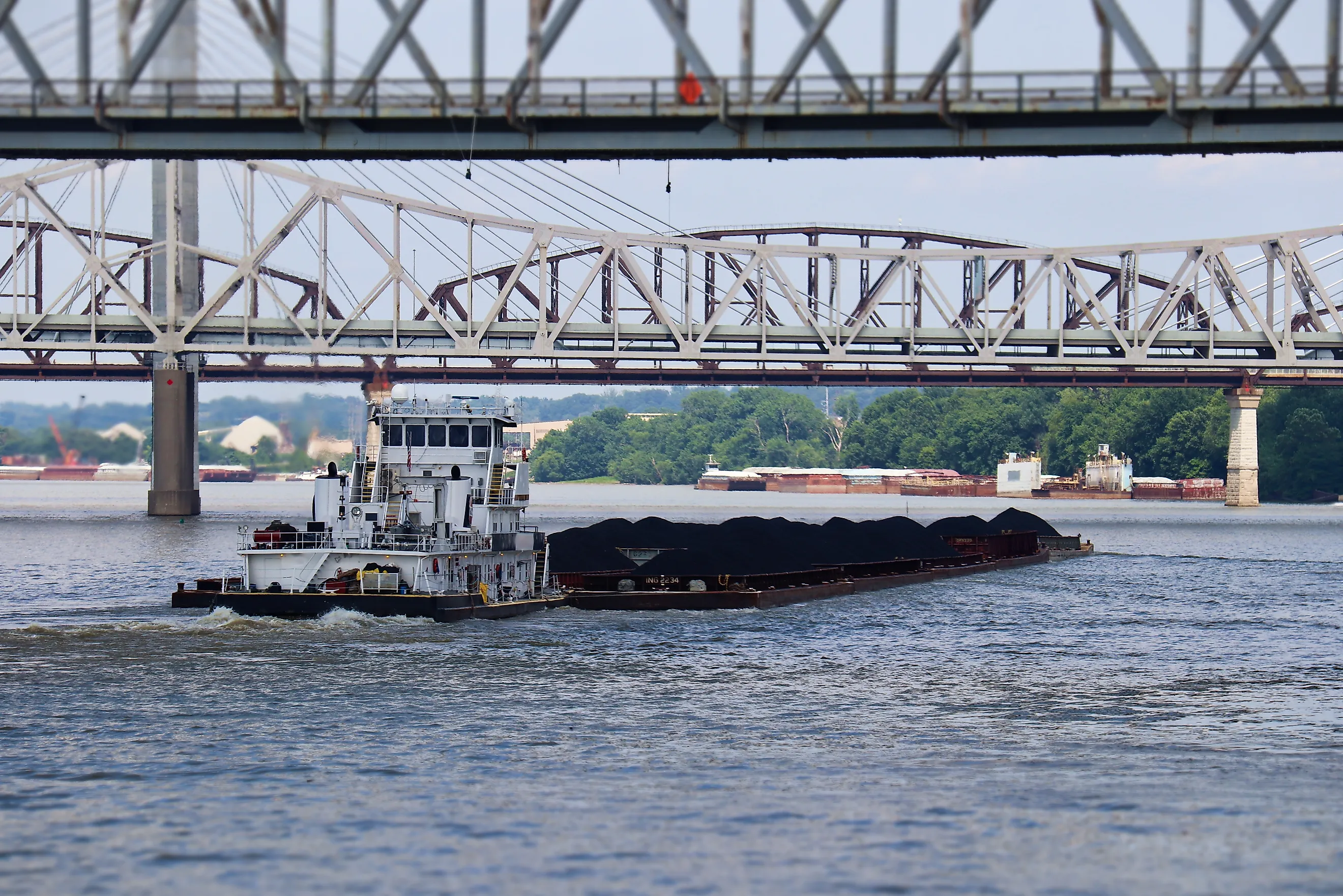
The Army Corps of Engineers puts average tow speed on the river at about 4.8 miles per hour loaded and 6.2 empty. Those are not typos. A fully loaded tow moves at roughly the pace of a brisk walk, and the current only helps so much when you are pushing 22,500 tons of coal.
Run the arithmetic at those speeds and 981 miles takes somewhere between 160 and 200 hours of actual movement. Then you add the locks.
Twenty Locks, And They Are Not Quick

Since canalisation was completed in 1929 the Ohio has not been a free-flowing river. It is 21 pools separated by 20 locks and dams, which works out at roughly one lock every 49 miles.
Most main chambers are now 1,200 feet long and 110 wide, which fits a standard fifteen-barge tow in a single pass. A straightforward lockage takes somewhere around 45 minutes to an hour from approach to clear.

Where the chamber is only 600 feet, the tow has to be taken apart. The towboat pushes half the barges in, locks them through, ties them off below, goes back for the rest, and reassembles the whole thing on the other side. That is a double lockage and it can take two hours or more.
Twenty lockages at an hour each is most of a day added to the trip before anything goes wrong.
Nobody Stops For The Night
This is the part that makes the numbers work. Tows run around the clock. Crews work in rotating watches, typically six hours on and six off, for hitches that commonly run 28 days on the boat.
The towboat carries a full galley, air conditioning and accommodation, and only stops for fuel, taking on somewhere between 5,000 and 15,000 gallons of diesel every five to seven days. There is no overnight tie-up, no port call, no waiting for daylight.
So eight days downbound means eight days of continuous movement, not eight working days. The clock never stops, which is the only reason a vessel averaging five miles an hour gets anywhere at all.
Upbound Costs You Three Extra Days

Going downstream the current is worth a couple of miles an hour. Going upstream you pay it back with interest, and a loaded tow pushing against the flow can drop to three or four miles an hour through the pools.

Add locking in the other direction and the return leg runs to ten or eleven days. A full round trip, Pittsburgh to Cairo and back, lands at somewhere near three weeks once you allow for loading and discharge at each end.
That figure has been stable for a long time. A 1956 account of the Ohio trade put the round trip at twenty days, back when double lockages were required every 21 miles. Bigger chambers made the locks faster, and bigger tows ate most of the gain.
Why Anybody Accepts Eight Days
Because of what fits on the barges. A single covered hopper carries about 1,500 tons, which is the load of roughly 15 rail cars or 60 trucks.
A fifteen-barge tow is therefore hauling the equivalent of 225 rail cars or more than a thousand lorries, pushed by one boat with a crew of eight or nine. No land transport matches that ratio. Nothing else on land comes close on fuel per ton-mile.

The Ohio moves more than 230 million tons a year on that basis, which makes it the busiest inland waterway in the country by tonnage, feeding the bigger river downstream. Cargo loading at terminals across Ohio, Indiana and Kentucky is not in a hurry. They are in a budget.
What Actually Blows The Schedule

Eight days is the good version. The things that break it are mostly locks.
Passing Louisville and the McAlpine chamber is routine until it is not. A chamber taken out of service for maintenance or a mechanical failure forces every tow through the auxiliary, which is usually the small one, which means double lockages and queues. Delays of ten hours at a single bottleneck are normal when that happens, and the backlog takes days to clear.

Water does the rest. High water can close locks outright or make bridges impassable with a loaded tow. Low water forces operators to light-load the barges, which means more trips for the same cargo. Ice shuts things down in the upper river, and fog stops navigation anywhere.
The navigation season runs around 355 days, so the river is almost always open. Almost is doing some work in that sentence.
The Last Mile

At Cairo the Ohio meets the Mississippi, and the junction is visible as a colour change where blue-green water runs alongside brown. The Ohio usually arrives carrying more water than the river it joins.
For most tows that is not the destination but a turn. Cargo continues south toward Memphis, Baton Rouge and the Gulf, or north up the Mississippi, and the eight days from Pittsburgh is just the first leg.
Which puts the whole thing in perspective. A tow that left the Point on the first of the month is passing Cairo around the eighth, and if it is bound for New Orleans it has another week to go. The cargo is not late. This is simply how fast the river moves things, and it has been roughly this fast for seventy years.