Which State Has More Venomous Snakes: Texas or Louisiana?
Gulf Coast heat keeps snakes active for long stretches of the year, and the wetlands and woodlands of Texas and Louisiana provide plenty of cover to hunt, hide, and breed.
Both states share the same headline players: pit vipers like rattlesnakes, copperheads, and cottonmouths, plus the brightly banded coral snake with its neurotoxic venom. The difference comes down to habitat variety. Texas stretches from desert rock to pine forest to coastal marsh, allowing more venomous species to overlap in one state, including a deep bench of rattlesnakes. Louisiana’s landscape is dominated by bayous and lowland forests, supporting fewer venomous species overall. Lining them up side by side shows how geography decides the count, and the risk.
Snakes in Louisiana

Louisiana is home to about 48 snake species, though the exact number varies by source, with some listing just over 50. Non-venomous snakes include scarlet snakes, rough green snakes, speckled kingsnakes, and Louisiana milk snakes. These reptiles appear in a wide range of colors and patterns, from pale greens to dark, striped, or spotted, and may be short and stout or long and slender. Each species prefers its own mix of climate, hiding places, and geological features.
Seven of Louisiana's snake species are venomous. Because they can resemble harmless snakes, knowing how to recognize them is an important part of avoiding or quickly treating a potential bite.
Snakes in Texas

Texas is home to roughly 105 snake species, more than double the total found in Louisiana. These range from tiny snakes that disappear into thick grasses to large, imposing individuals that no one wants to stumble upon unexpectedly.
Non-venomous snakes in Texas include Texas rat snakes, western coachwhips, garter snakes, and Texas indigo snakes. They occupy a variety of habitats, from shorelines and wetlands to open fields, city edges, and tall grass. Although they may bite when handled or startled, their bites usually cause only mild, localized reactions.
Fifteen snake species in Texas are considered venomous, including several rattlesnakes, copperheads, cottonmouths, and the Texas coral snake.
Venomous Snakes in Both Texas and Louisiana
Pit Vipers
Pit vipers are a group of venomous snakes that includes rattlesnakes, copperheads, and cottonmouths, all of which occur in both Louisiana and Texas.
1. Rattlesnakes

Louisiana has historically had three native rattlesnake species: the eastern diamondback, timber rattlesnake, and pygmy rattlesnake, although eastern diamondbacks are now extremely rare in the state and may no longer have established populations there.
Eastern diamondbacks are the largest venomous snakes in North America. They are recognized by their dark brown to black diamond patterns and typically grow 3-6 feet long, with some individuals reaching about 7 feet. They favor dry habitats such as dunes, sandhills, and prairies. Timber rattlesnakes range from light tan to dark brown and can be identified by the blackish "V" shapes pointing toward the tail; they frequent woodlands and rugged terrain, including rocky cliffs. Pygmy rattlesnakes are small, usually silver to gray with dark spots and sometimes a faint orange stripe; they reach a maximum length of about 25 inches and prefer dense ground cover for concealment.
Texas is home to numerous rattlesnake species. Two of these are massasaugas: the western massasauga, which is light gray with brown blotches, and the paler desert massasauga. These snakes tend to inhabit grasslands, marshes, and swamps.
Altogether, there are 10 species of rattlesnakes in Texas, including western and desert massasaugas, western diamondbacks, timber rattlesnakes, several rock rattlesnakes, Mojave rattlesnakes, and prairie rattlesnakes. The Western Diamondback is known for its bold brown diamond pattern. Timber rattlesnakes have broad, dark crossbands and favor wooded or wet environments. Mottled rock rattlesnakes show mottled markings between their crossbands and live in mountainous regions. Banded rock rattlesnakes occur only in the far western tip of Texas, as do Mojave rattlesnakes, which closely resemble Western Diamondbacks. Prairie rattlesnakes are greenish or gray with round blotches and typically hide in grassy areas.
2. Copperheads

Copperheads are found in both Texas and Louisiana and are especially fond of rocky and wooded areas. They display varying shades of red and brown crossbands and can differ in length, though most adults measure between 20 and 30 inches. In Texas, the main types are southern copperheads, broad-banded copperheads, and Trans-Pecos copperheads, while Louisiana is home primarily to eastern copperheads.
3. Cottonmouths

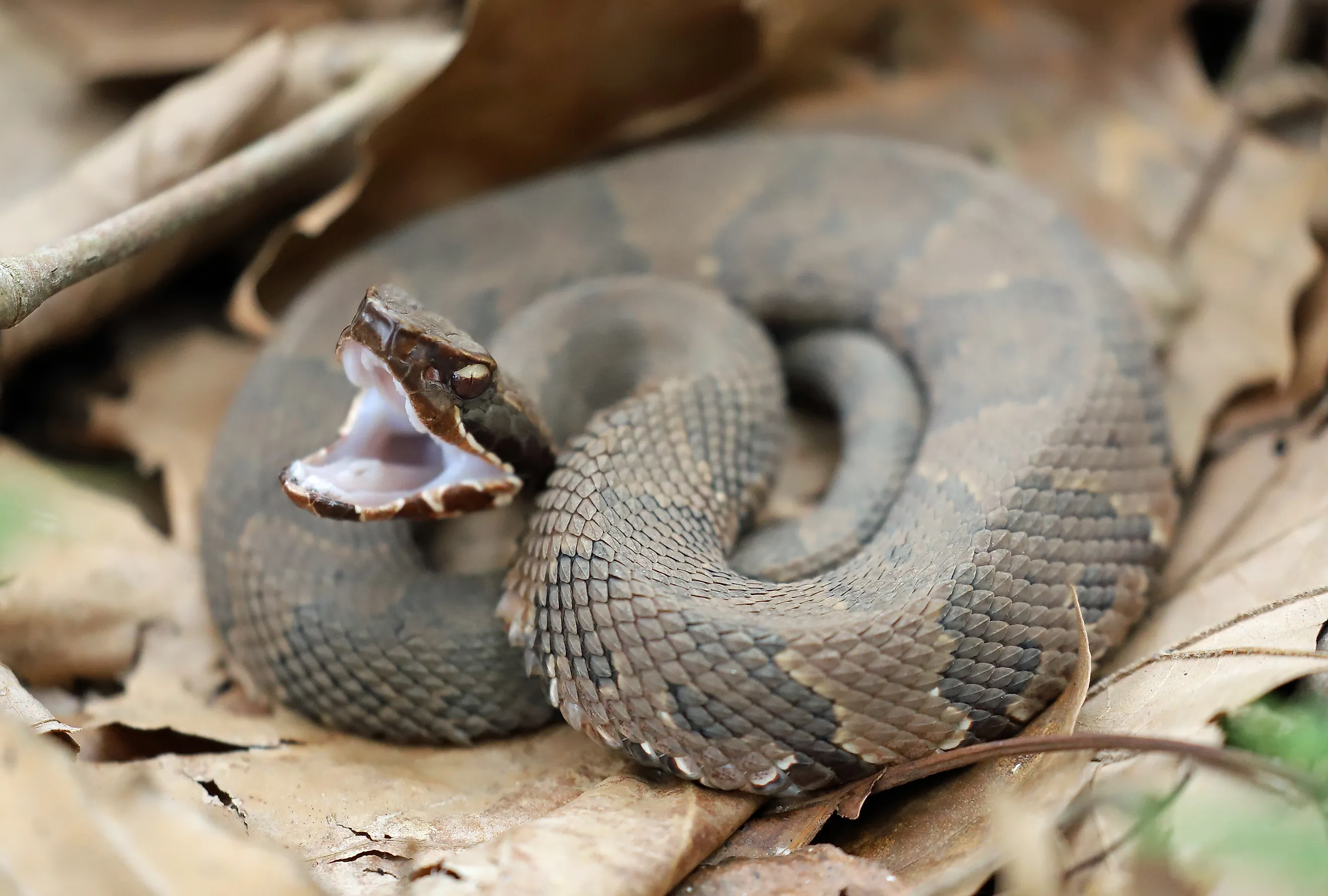
The cottonmouth (Agkistrodon piscivorus), also called a water moccasin, has a large, triangular head and an olive-green to dark brown body. It is strongly associated with water and often lives in swamps, bayous, rivers, and lakes, where it may be seen basking or hunting along the shoreline. The name "cottonmouth" comes from the bright white tissue inside its mouth, which is flashed as a warning display when the snake feels threatened.
Coral Snakes

Louisiana is home to two coral snake species, the Texas coral snake and the harlequin (eastern) coral snake, and both can be mistaken for harmless lookalikes, which makes accurate identification especially important. The Texas coral snake is recognized by its thick black bands, thin yellow bands, and bold red bands. The harlequin coral snake, also known as the eastern coral snake, may appear slightly darker overall but shares the same banded pattern.
In Texas, the only native coral snake is the Texas coral snake.
First Aid
It's important to know what to do if a venomous snake bites you. Immediately after being bitten, call 911 or a poison control center and get to a medical facility as quickly as possible. Do not try to suck out the venom, cut the wound, apply ice, or use a tourniquet; instead, keep the affected limb as still as you can and remove any tight clothing or jewelry. If it can be done safely, try to take a photo of the snake or note its size, color, and markings for later identification. Symptoms of a venomous bite can include swelling, dizziness, nausea, intense pain, muscle aches, changes in breathing and heart rate, and bleeding. More serious complications may involve severe tissue damage that could require amputation, serious infection, cardiac arrest, and respiratory failure. The most effective treatment for a serious snake bite is antivenom administered by a medical professional.
To reduce your chances of encountering a snake, avoid typical hiding spots such as forest debris, junk piles, and narrow crevices. Keep your yard well maintained, and supervise children and pets closely when hiking or playing outside.
It may be surprising to learn which state has more venomous snakes. Texas outnumbers Louisiana in venomous species, with Texas having 15 and Louisiana seven. When you compare overall snake diversity, about 105 species in Texas versus roughly 48 in Louisiana, it becomes clear why the odds of meeting a snake are higher in Texas. Regardless of which state you call home or plan to visit, understanding these remarkable animals and knowing how to respond to an encounter is the best way to stay safe.