Lost Technologies of the Roman Empire
Technologies of the Roman Empire were both highly innovative and practical. Often, Roman craftsmanship demonstrated stunning creativity, massive feats for a culture which came into being before the birth of Christianity. Here we'll explore technologies from the Roman Empire that were essentially lost to history, leaving us to try to piece back together how, or in the case of the Roman dodecahedron, why, they were created in the first place. We'll also include some honorable mentions of technologies not fully lost, but subsumed into greater advancements still in use today.
Roman Concrete

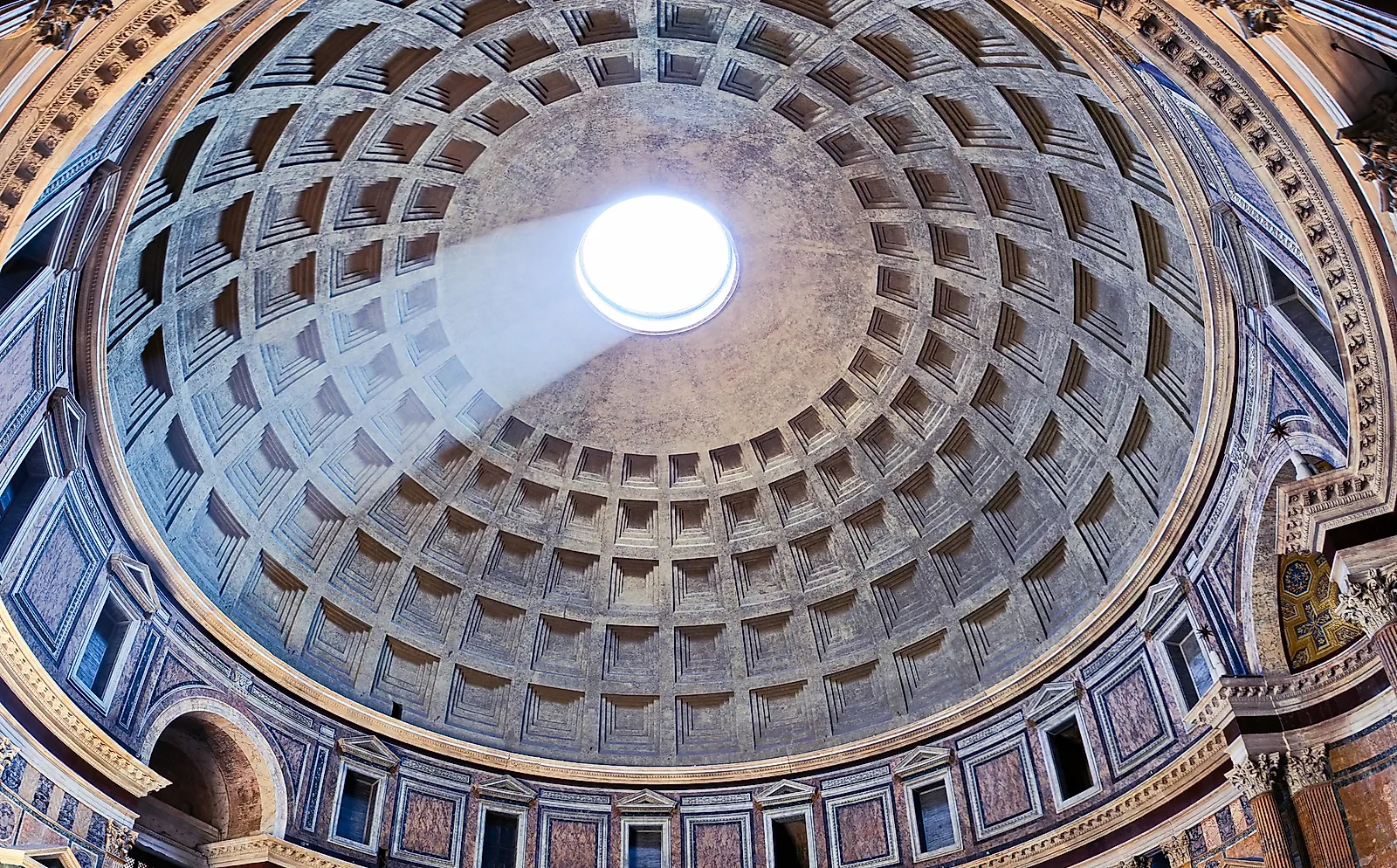
Among Rome's most remarkable and most thoroughly lost innovations was "opus caementicium", Roman concrete. Unlike the concrete used in modern construction, which begins to crack and degrade within decades, Roman concrete has endured for two millennia. The Pantheon's unreinforced dome, the largest of its kind in the world, still stands without the steel reinforcements modern engineers would consider essential. Roman harbor walls, submerged in seawater for 2,000 years, have only grown stronger with time.
The secret lay in a precise combination of volcanic ash, known as pozzolana, harvested from deposits near the Bay of Naples, mixed with seawater and lime. When combined, these materials triggered a slow chemical reaction, producing interlocking mineral crystals, aluminous tobermorite, that filled microscopic cracks and reinforced the structure from within. The Romans likely stumbled upon this formula empirically rather than through scientific understanding, refining it over generations of construction.
When the Roman Empire declined, so did the knowledge required to produce this material. Medieval builders had access to Roman structures but could not replicate them, relying instead on inferior alternatives. The formula was not merely forgotten, it was invisible. No Roman texts described the chemistry involved, because the Romans themselves did not understand it in those terms. It was only in 2017 that a team of researchers led by geologist Marie Jackson finally identified the mechanism behind the concrete's self-healing properties, publishing findings that the construction industry is only now beginning to apply. For over a thousand years, humanity built in the shadow of Roman structures it could see but not reproduce, perhaps the clearest definition of a lost technology.
The Roman Dodecahedron

Of all the artifacts recovered from the Roman Empire, few are as quietly bewildering as the Roman dodecahedron. These small, hollow objects, typically cast in bronze, occasionally in stone, have twelve flat pentagonal faces, each pierced with a circular hole of a different diameter, and small knobs protruding from each corner. They are precise, deliberate, and unmistakably crafted with care. Approximately 130 have been discovered across the former Roman Empire, concentrated in Gaul and the Germanic provinces, and dating broadly from the 2nd to 4th centuries CE.
What makes them uniquely "lost" is not that the objects disappeared, but that their purpose did. Not a single Roman text mentions them. No mural depicts them in use. No burial site contextualizes them alongside related tools or objects that might suggest a function. They exist in an informational vacuum that has frustrated archaeologists for centuries.
Theories are plentiful and contradictory. Some researchers have proposed they were surveying instruments, used to calculate distances or determine optimal sowing dates by aligning the holes with the sun. Others suggest they served as candleholders, military rangefinders, or dice. A persistent modern theory holds that the varying hole sizes were used as gauges for knitting gloves, though evidence remains anecdotal. Religious or ritualistic use has also been proposed, which would explain the absence of written records if the objects were considered sacred or secret.
The dodecahedron stands apart from other lost Roman technologies in a singular way: while Roman concrete or watermill systems were lost through the collapse of infrastructure and knowledge networks, the dodecahedron may represent knowledge that was never written down at all. Whatever it was used for, that use was either so commonplace it needed no documentation, or so restricted that documentation was deliberately withheld. Either way, the knowledge died with the people who held it, leaving behind only the object itself, perfectly preserved.
Roman Watermills

The watermill is often imagined as a medieval invention, a fixture of feudal villages grinding grain for local lords. In fact, industrial-scale water-powered milling was pioneered centuries earlier by the Greeks and Romans, and the scale of what they achieved would not be matched again for over a thousand years after Rome's fall.
The Greeks developed early horizontal waterwheel mills around the 3rd century BCE, but it was the Romans who transformed the concept into something approaching industrial infrastructure. The most striking evidence of this is the Barbegal mill complex in southern France, constructed around the 2nd century CE near the city of Arles. Built into a hillside, Barbegal featured a cascade of sixteen overshot waterwheels arranged in two parallel channels descending the slope. Powered entirely by gravity-fed water, the complex could produce an estimated 4.5 tons of flour per day, enough to feed approximately 12,500 people. It was, by any measure, an ancient factory.
Smaller Roman watermills were similarly sophisticated, with vertical wheels, gearing mechanisms, and millstones refined for efficiency. The Romans deployed these across the empire, particularly to supply grain to large military garrisons and urban populations. The engineering knowledge required, managing water flow, constructing reliable gear trains, maintaining the machinery, represented a deep and specialized body of knowledge.
When the empire fragmented in the 5th century CE, that expertise fragmented with it. Large centralized food production collapsed alongside the administrative systems that had organized and sustained it. The watermills themselves fell into disrepair, their components rotting or repurposed. Medieval Europe did eventually redevelop the watermill, but beginning again largely from scratch, the industrial sophistication of Barbegal was not approached until the later medieval period, and was only fully understood by historians once the buried remains of Roman mills were excavated and studied in the 20th century. For centuries, communities ground grain by hand that Rome had once milled by the ton.
Roman Glassblowing

Before Rome, glass was a luxury reserved for the privileged few. Egyptian and Mesopotamian craftsmen had produced glass objects for thousands of years, but the process was laborious, the results thick and imprecise, and the cost kept glass beyond ordinary reach. Then, around the 1st century BCE, most likely in the Syrian-Palestinian region on the eastern edge of the Roman world, an anonymous craftsman discovered that gathering molten glass on the end of a hollow iron tube and blowing air through it would inflate the material like a bubble, thin and shapeable with extraordinary control. The technique reached Rome swiftly, and what followed was a revolution in material culture.
Roman glassblowers refined the technique into an art form of remarkable complexity. They developed mould-blowing, pressing inflated glass into decorated moulds to produce identical forms at scale. They created cage cups, known as diatreta, in which an outer lattice was painstakingly undercut from a single glass blank until it surrounded the inner vessel while remaining connected only by tiny bridges. Objects so demanding that modern glassmakers have struggled to reproduce them even with contemporary tools. The Portland Vase, with its layered cameo relief of white figures cut over a deep cobalt body, remains one of the most technically accomplished glass objects ever made.
When Rome collapsed, the networks sustaining this craft collapsed with them. The specialized knowledge of colourants, precise temperature control for layered work, and accumulated workshop technique belonged to a culture of patronage and long-distance supply chains the post-Roman world could not maintain. Medieval European glass was functional but crude by comparison. Venetian glassmakers on Murano later reconstructed many advanced techniques independently, but they were reinventing rather than inheriting. Some Roman methods were only understood once archaeologists excavated workshop sites and analysed surviving vessels with modern spectroscopic techniques. The diatreta in particular remained essentially unrepeatable for most of history. What a Roman craftsman could apparently produce to order, the modern world has only barely managed to reconstruct at all.
Not Lost, But Repurposed
The Cursus Publicus

Before UPS, there was the cursus publicus (the public way), one of the world's first postal systems. Created in 20 BCE by Emperor Augustus, the system helped establish greater control over Rome's vast empire by facilitating delivery of government documents like taxes or decrees. Needless to say, it relied heavily on another fundamentally Roman contribution to technology, the Roman road, along with horses and oxen to bear the load.
In its early stages, couriers would pass off mail like a baton, but over time, infrastructure improvements and refinements like systems for exchanging horses allowed the same messenger to take correspondence from beginning to end, preserving more information about the mail for the deliveree. The system, which would be echoed in the United States Postal Service and Royal Mail, lasted for about three centuries, and the Tabula Peutingeriana, based on a map dating from around 400 AD, lists more than 500 Roman cities where mail was delivered.
The cursus publicus was strictly for government officials. Civilians could only use it with official permission handed down from the Emperor himself, perhaps because the cursus publicus also functioned as an intelligence agency. Though the routes were often traveled on foot, the ideal means of transport was by horse, and often couriers were accompanied by soldiers for protection from would-be bandits.
Screw Press

The screw press was designed to extract liquid from grapes and olives, essential for Roman daily life. Olives were important to the Romans' diets, as a primary source of needed calories and fat, and a vital supplement for essential vitamins. Wine was always a staple in the Roman Empire. Wild grapes on the Italian Peninsula may have been farmed as early as the Bronze Age (3300 - 1200 BCE), and some evidence supports that winemaking started there during the middle to late Bronze Age. Greater wine production occurred as early as the 7th century BCE. Before larger pressing mechanisms, juice was extracted from the grapes with treading floors. People would simply stomp on the fruit, and the liquid would pass through holes in the floor and collect below.
Yet the Romans wanted to boost their wine and olive oil production, and presumably, remove feet from the equation. By creating the screw press, they could increase production for general regional consumption, while expanding their wealth through exportation. Presses delivered heavy and uninterrupted pressure that human hands alone could not provide, increasing the rate of extraction, while also serving as storage space for grapes and olives.
Villagers built the screw presses and made them from their regional wood and stone. There were variations of these machines based on the skills of the creators and the materials on hand. Screw presses are rarely preserved because most were made from wood. Furthermore, no drawings of the presses exist from the Romans, but Latin descriptions of them endure from famous Roman author Pliny. The Romans used screw presses up until the 5th century CE, a classic example of how technology develops to suit the particular needs of a given culture. Centuries later, the screw press would be repurposed into the printing press, one of the most influential technologies of all time.
The Hypocaust

The winter months would undoubtedly bring chilly temperatures to the Roman Empire, especially up north in present-day Britain. The Romans employed methods to keep spaces warm, like building rooms facing west to absorb more sunlight during the cooler months. But they realized they could engineer a new system that made them warmer.
One of the earliest forms of central heating technology was the hypocaust. The Roman architect and engineer Vitruvius explained the hypocaust system in the 1st century BCE, but it may have existed in the Roman empires as early as the 4th century BCE. In Ancient Greek hypo means “under” and caust means “burnt.” With the hypocaust, there was an open, base floor space (like what may be known today as a basement) beneath the occupied space. This base floor had several pillars that held up the floor above. Connected to this base floor was a furnace. The furnace would heat up this open space which would then heat the rooms above it.
In addition to the furnace sending hot air throughout the base floor, there were channels in the room walls to further distribute the hot air. These channels were lined with tiles and acted like chimneys, as they forced smoke and gases to escape while also heating the walls. These vertical ducts may have also been constructed in diagonals and different routes up the walls to help with heat distribution. Private houses and bath houses used the hypocaust. The wealthier citizens had these systems since they could afford the fuel and labor costs needed for the systems to function.
Though central heating lived on, it appears the hypocaust system was not used after the Roman Empire declined. The hypocaust was complex: the fires needed continuous attention to get rooms heated at the right temperature and not too hot for the floor to be stood on. The architecture needed correct materials and dimensions for even temperatures and no cracks anywhere in the structures. The Romans put much planning into the hypocaust with using merely fire and architecture.
Conclusion
It's amazing to imagine a civilization thousands of years older than our own which held knowledge beyond our current understanding. Some of these Roman inventions have yet to be bested, while others laid the groundwork for profoundly influential technologies we rely on today. These creations were the result of a culture which blended art and science to a high degree, and likely relied more heavily on intuition and imagination than is commonly done today. The results speak for themselves.