How Many People Lived In The Roman Empire?
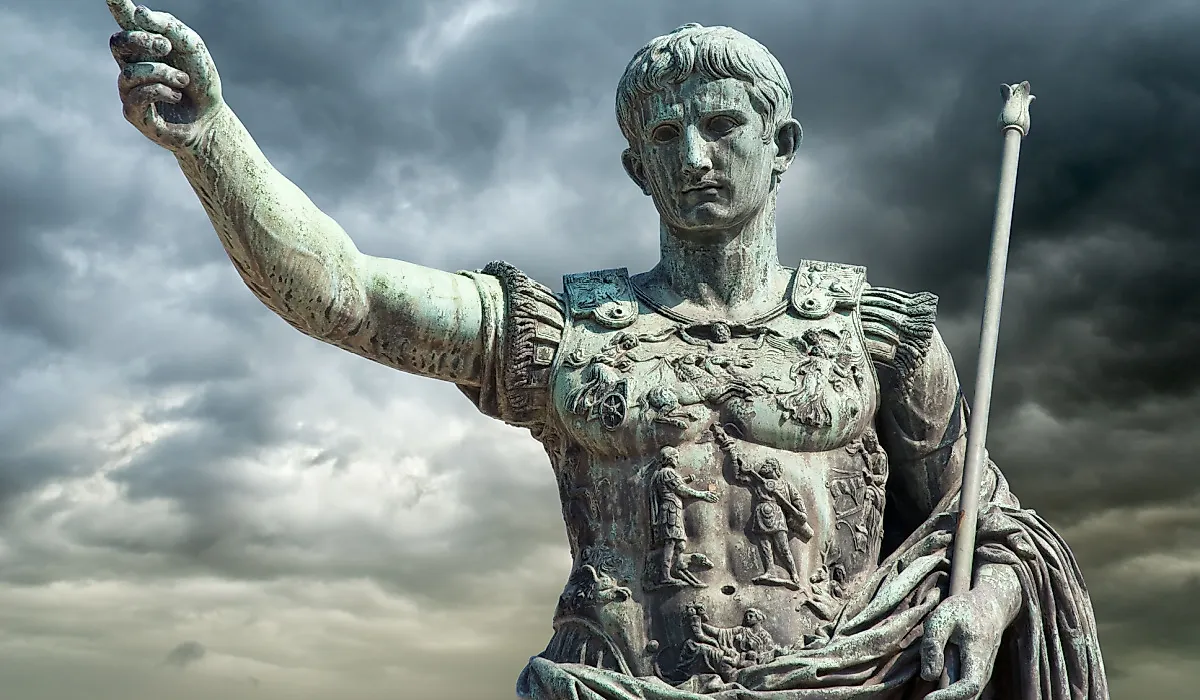
Gaius Octavius, formally known as Augustus, came into power as the founder of the Roman Empire after his great-uncle Julius Caesar was assassinated in a famed story of betrayal and the corruption of power. Many recognize these names from one of William Shakespeare's plays, yet this empire's story proved striking enough that we still debate its rise and fall today. Modern estimates place the empire's population between 59 million and 76 million at its peak. Reaching that estimate meant reconstructing the lives of everyone the empire's own record-keepers left out.
How We Estimate

To reach the aforementioned population range, archeologists and historians used a multitude of tools and quantitative methods to pinpoint an accurate answer. First, they had to establish the true duration of Roman rule. At its peak, the Roman Empire spanned three continents and nearly 2 million square miles across Europe, Africa, and Asia. During what was coined the "Crisis of the Third Century", Rome faced attacks on opposite sides of its realm: the Persian Sasanian Empire pushed in from the east (modern-day Syria and Turkey), while Germanic tribes pressed the northern frontier (modern-day Germany and the Balkans). Emperor Gallienus was caught in an impossible conundrum, and the vast distances combined with slow travel led local regions to act independently, decentralizing the government as smaller rulers emerged. The empire's final division came in 395 AD, splitting the state into two: the Western Roman Empire, based in Italy, and the Eastern Roman Empire, or Byzantine Empire, based in Turkey. Although academics separate the two, its people still considered themselves part of the original Roman Empire.

The population of the Western Roman Empire at the time of the split was about 22 million, while the Eastern Roman or Byzantine Empire stood at about 34 million. The Western Roman Empire collapsed by 476 AD, while the Eastern Roman Empire endured until 1453.
Counting Ancient Populations

Counting ancient populations is a complex task, even with modern technology. Unlike our current government's use of a national census system, birth registries, and similar records, many ancient societies lacked the need, much less the ability, to count their subjects. If they did, it was only inclusive of those considered of value, meaning adult males or landowners with a level of aristocracy. Peasants, women, children, slaves, and other undocumented subjects were an invisible population, and once historians considered them in the equation, modern calculations exploded by tens of millions. As for the things the Romans tried to preserve in archives and libraries, most were destroyed in natural and human disasters such as floods and invasions. One of the more well-known examples of this occurred in 390 BC during the Sack of Rome, known as the "reset button" for Roman history, when an army of Gauls led by Brennus looted the original city of Rome and burned nearly everything to the ground. The destruction resulted in the loss of nearly all of the state's historical records, priestly annals, state archives, and other crucial documents. This is why a lot of what we know about Rome prior to this period is widely referred to as mythology, since scholars had to piece it back together using word-of-mouth. Another major contributor to the disagreement is the "Augustus Census Mystery", referring to the change in Roman enumeration records when Emperor Augustus took power and ordered three separate, empire-wide censuses throughout his roughly 40-year reign. Prior to his reign, the last census had reported about 900,000 citizens. After Augustus' first census, that number exploded to more than 4 million.

Eventually, what is now considered the "correct" population is mostly a result of numerous reconstructions that combined methods like evaluating archeological evidence and analyzing grain shipments. Excavated sites within former cities told archeologists a lot about how many homes existed and how densely the neighborhoods were built. Tax and military records helped estimate household sizes and population trends, as well as the average size of legions and the number of soldiers within them. Even food supply and consumption are used to estimate the population count, seeing that Rome frequently imported large quantities of grain from North Africa. Scholars broke that down using the knowledge of how much grain the average Roman used annually, then worked backward to calculate how many people the imported sustenance was meant to feed. Burial sites provided great insight as researchers studied familial burial patterns, grave numbers, and mortality rates. These tactics and many others could not produce an exact headcount on their own; instead, researchers compared dozens of unique sources and used the data that consistently fell within the same range. It is the collective body of evidence built from that work that allows scholars and interested parties alike to make remarkably informed estimates.
An Estimate That Keeps Evolving
Demographic reconstruction shows how much effort goes into evaluating the numbers behind ancient civilizations. Every figure we have reflects the patient work of generations of historians. The accepted estimate may still shift as archaeologists uncover new evidence and refine old models. What stays constant is the scale of the task: counting a population that was never fully recorded in its own time.