Five Days at Four mph on an English Canal Boat Is Pure Relaxation
Britain built the world's first national canal network, and 2,000 miles of it survive today as one of the country's most relaxing holiday options. To prove the point, four old friends, two of us complete beginners, spent five days aboard a narrowboat on the Shropshire Union Canal, cruising from Autherley Junction on the edge of Wolverhampton to Market Drayton and back. No license, very little experience, and an itinerary we made up as we went.
It proved to be the ultimate catch-up and get-to-know-you trip. I've known Toby and Jon since school, and Ade since my days in London trying to break into the music biz. It was Ade who had the talent and who came close to making it big, opening for acts like Erasure, while I settled for a career as a writer.
Ade was the new face in the group, as he'd only ever met the others fleetingly, but he soon became the guy who got the music playing, adding a dynamic and perspective the rest of us appreciated.
Here's how the trip unfolded, and why first-timers have nothing to fear from England's slowest form of travel.
A Crash Course in Canal Boating

The decision to get together over a canal trip rather than a walking holiday was an easy one for us. Jon and I still needed to be connected to the internet to get a little work done, although not much was achieved, as it turned out, so the boat's promise of Wi-Fi was appealing.
Having a place to stow our gear, food supplies, and our preferred beverages was a real convenience. We each had plenty of space to store our belongings and only had to unpack once.
We booked our trip through Drifters, a consortium of independent canal boat holiday companies, and supplied by Napton Narrowboats, a firm whose Autherley Junction base occupies the point where the Shropshire Union Canal meets the Staffordshire and Worcestershire Canal.
It was one of the most historic sections of Britain's canal system, and, we hoped, one of the quietest. We were right on both counts.
With nothing more than a loose itinerary that we hoped would get us as far as Market Drayton before turning back, we converged there at 2 p.m. for the boat handover and tuition, a process that took up to an hour.
If boating is new to everyone in your crew, take full advantage of it. Staff will walk you through steering, mooring (aka, the art of docking), working the locks, and the less glamorous essentials such as clearing the weed hatch, something we had to do frequently.

We, however, were able to play the "experienced skipper" card as two of our crew had been canaling before. The rest of us, myself included, were complete newbies. So it wasn't long before our elected skipper, Toby, had us cast off, and by the end of five days on the water, we all felt comfortable handling the locks and piloting the boat.
Nervous first-timers should know two things. First, canal boats are sturdy steel tubes that are pretty much indestructible. Sure, you'll bang into things, as scrapes and scratches on your boat's paintwork will attest, but these hardy vessels shrug such knocks off, and there will be some, as if nothing happened.
The speed limit on the canals is four mph, so most of the time you're traveling at little more than walking pace.
Why Britain Built 2,000 Miles of Canals

The United Kingdom was the first country to develop a nationwide canal network, and it played a central role in the Industrial Revolution. The Sankey Canal, the first British canal of that era, opened in 1757, followed by the highly profitable Bridgewater Canal in 1761.
Most of the system was dug between the 1770s and the 1830s, a period known as the golden age of canal building, when horse-drawn boats moved raw materials to factories and finished goods to market more cheaply than any road could.
At its peak, the network stretched to nearly 4,000 miles until railways, and later trucks, took the freight away. Miles of canals were abandoned or built over, and by 1962 the system had shrunk by more than half to its present-day total of 2,000 miles.

What saved the remainder was leisure. A restoration movement in the late 20th century had waterside areas regenerated, and by the early 2000s there were more boats on the canals than during the Industrial Revolution.
Since 2012, the network in England and Wales has been cared for by the Canal & River Trust, a charity responsible for 2,000 miles of canals and navigable rivers, along with 1,581 locks, 2,970 bridges, and 281 aqueducts.
Now, there are over 35,000 canal boats on this historic network today, 1,000 of them holiday hire narrowboats, which is where people like us come in. You don't need a license to helm one, tuition is included in the hire cost, and hundreds of routes are suitable for beginners.
The Shropshire Union Canal

The stretch we navigated is part of one of the last great canals ever built in England. The southern section of the Shropshire Union, engineered by Thomas Telford, opened to traffic in 1835 as the Birmingham & Liverpool Junction Canal, a 39-mile link from Autherley Junction to Nantwich that gave the industrial West Midlands a direct route to the River Mersey at Ellesmere Port.
In the mid-1840s, it merged with other waterways to form the Shropshire Union Railways & Canal Company, one of the few companies to build both canals and railways.
However, because it came late, Telford drove it in near-straight lines across the countryside on huge embankments and through deep cuttings, rather than winding along the contours as earlier canals did. The full canal runs 66 miles from Autherley Junction to Ellesmere Port.

Our out-and-back cruise to Market Drayton covered 53 miles and 12 locks, all of them single narrow locks, which makes life easier for a novice crew. The first lock comes at Wheaton Aston, two hours out from the boatyard, and the five-lock Tyrley flight lowers the canal into Market Drayton at the far end.
In between, the route crosses the Stretton Aqueduct, a cast-iron span Telford built over the old Roman road now known as the A5, and passes through Cowley Tunnel near Gnosall, a short bore cut through solid rock.
Ade had been losing sleep over having to tackle the canal's locks, and had consumed several YouTube videos on the subject. He even insisted on wearing a life jacket whenever we used one. He was, however, relieved to find out they were simpler and safer to use than anticipated.
Simply put, locks are what make a canal system work and consist of chambers with a pair of gates at each end letting boats move between two stretches of canal at different heights.

You open the paddles with a windlass, a cranked iron key supplied with the boat, letting water in or out until the level inside matches the level you're heading for, then swing the gates open, motor in, close them behind you, and repeat at the other end.
The whole business takes 10 or 15 minutes and needs one person on the boat and at least one on the bank. After the second or third go, it became second nature, and even Ade started looking forward to the next one.
Knowing that in its working years this was a busy freight corridor added to the experience. Working boats were horse-drawn, with mules and pairs of donkeys pressed into service, too. You can still see where a century of towropes cut grooves into the cast iron posts Telford fitted to protect the corners of his bridges.
Today the traffic is holidaymakers, anglers, and towpath walkers, and the canal's long quiet reaches between villages are exactly what make it such a good beginner's waterway.
Ditch the Itinerary

We decided from the get-go not to stick to any hard and fast itinerary, and that turned out to be one of the greatest pleasures of a canal boat trip. We went as far as we wanted, stopped pretty much where we wanted, and somewhere near the halfway point of our time aboard we simply turned around and puttered back.
The boat was to be our accommodation, kitchen, bar, and transport all at once. We had nowhere else to be but on the water.
Our first stop was an overnight mooring on a quiet wooded stretch just a few miles into the trip. Mooring these long, lazy boats is easy. The bow is piloted close to the shore, a crew member jumps off, drives a mooring spike into the canal bank, and secures the boat's bow rope to it. The process repeats at the other end, and voilà, you're moored for the night.
Skipper Toby made full use of the galley to whip up one of his always-delicious pastas. We ate dinner al fresco at the stern of the boat with nothing but a gentle breeze and good banter for company. It was sublime, and it set the tone for the whole five-day adventure.
It's the peace and quiet that stays with you. Canals let you tie up in the middle of fields or forests, next to pubs, or in town centres.
Even in a town, once the engine's off, the loudest thing around is usually a duck or the soft putt-putt of another boat passing by. It's immensely relaxing, satisfying, and all at a pace that has a curious effect on time. Our four nights and five days felt like far longer, but in the best possible way.
Gnosall Heath and Market Drayton

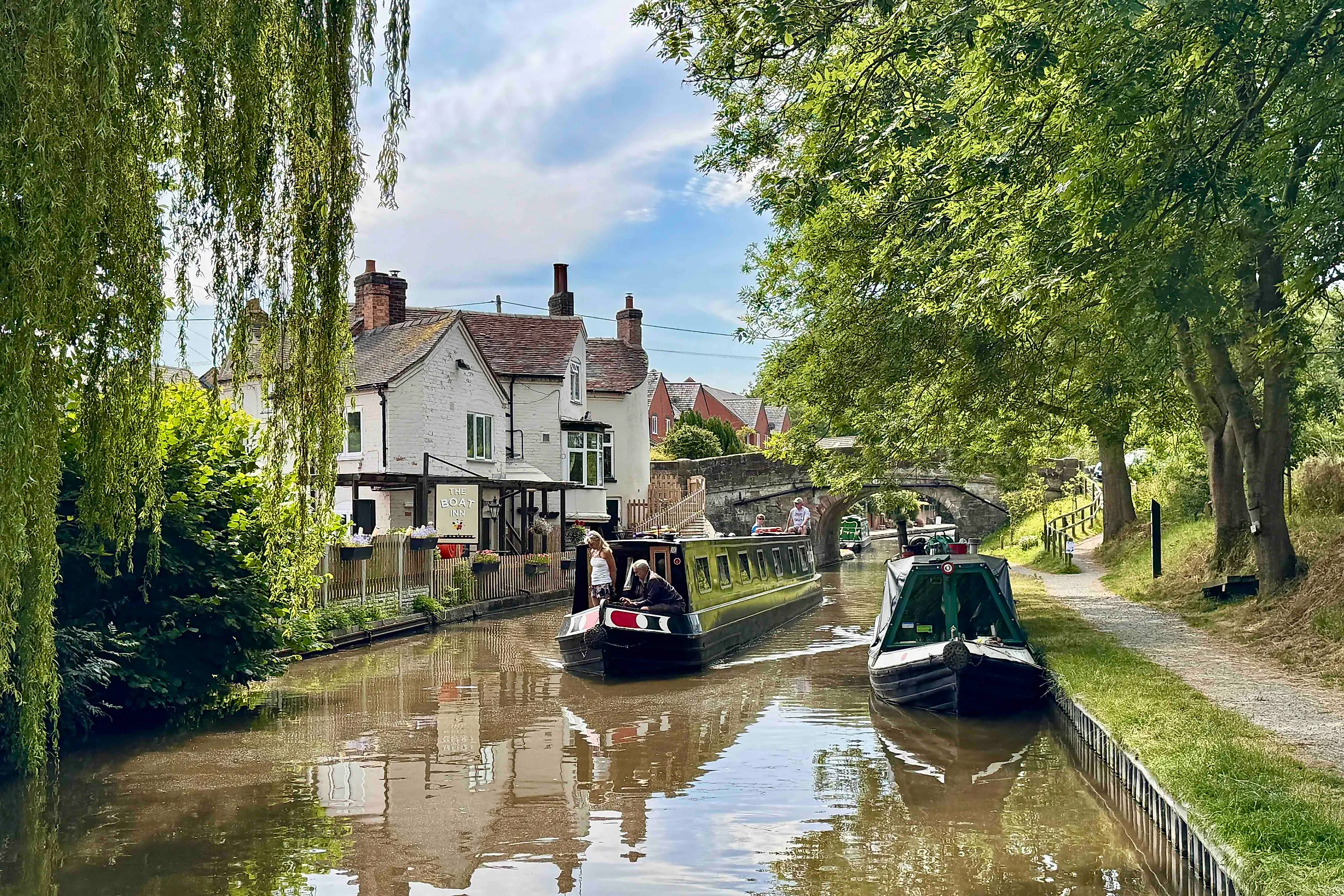
Gnosall Heath, the canal-side half of the Staffordshire village of Gnosall (pronounced "Nozzle"), was a place we stopped at twice. On our first full day, we moored for a canal-side pub lunch at The Boat Inn, which stands beside Bridge 34 with benches and tables set on the bank of the canal.
Originally a horse staging post for flyboats, the express horse-drawn craft that worked the Shropshire Union, its canal-side setting was perfect for a pint and some natter about the route ahead. We liked Gnosall Heath enough to return.
On the homeward leg we moored here again and stayed the night, this time popping into The Navigation Inn for a drink before bedding down. It was the kind of repeat visit the out-and-back nature of canal cruising makes easy.
Places passed on the way up become welcoming watering holes on the way back, and mooring somewhere familiar at the end of a day's cruising has its own appeal.

Though we didn't really know it until we got there, which is just one of the special charms of a canal boat trip, Market Drayton was to be our turnaround spot.
A Shropshire market town reached after our second night aboard, it has been trading under royal license since 1245, when Henry III granted a charter for a market. That street market still fills Cheshire Street alongside an indoor market hall every Wednesday.
Our best meal of the trip, apart from Skipper Toby's, of course, came at the Wharf Tavern, a canal-side pub at Goldstone beside Bridge 55 on the run into Market Drayton. It serves home-cooked meals in generous portions, with gardens and moorings.
We spent a night in Market Drayton before pointing Rebecca back the way we'd come, which is the standard rhythm of a return cruise: reach your farthest point, enjoy it properly, then retrace your route with the benefit of experience.
Catching up in Brewood

Brewood, a South Staffordshire market town pronounced "Brood," was the find of the trip. We moored here to meet Jilyan, an old school friend I hadn't seen for many years, over lunch. The choice of Lazy Days Café, which served fresh coffee, cakes, and hot lunch, was a good one, and it was delightful hearing and sharing what we'd all been up to in the past decades.
Afterward, we explored this pretty town, making the walk from the canal time well spent. St Mary and St Chad, a Grade I listed church with a chancel dating from the 13th century, was open, so we were free to wander. The interior is remarkable, and the highlight is the set of four alabaster tombs of the Giffard family of nearby Chillington Hall. The oldest belongs to Sir John Giffard, who died in 1556, and shows him in Tudor armour flanked by his two wives, with their many children carved around the tomb.

St Mary's Catholic Church, overlooking the Shropshire Union at the western edge of the village, is also worth a look. For me, the attraction was the fact it was designed by Augustus Pugin, the Gothic Revival architect best known for the Palace of Westminster where the British government meets.
I'd toured the Houses of Parliament several weeks before with Ade, and seen many examples of his work during my extended travels across the UK, including in Reading. However, this 1844 church is, in my opinion, one of the prettiest things he's designed.
Speedwell Castle, a mid-18th-century Gothic house on the marketplace that has been described as a "delectable folly," is worth seeking out and certainly photo-worthy. Exploring a town on foot after hours on the water is an interesting diversion in itself, and Brewood is a good one to do it in.
A Boat Called Rebecca

Our boat, Rebecca, came fitted out like the rest of the Napton fleet, with radiator central heating, hot water, and showers. It also came with a well-equipped galley including a fridge, a cooker, and ample cookware.
As for sleeping, the folks at Napton give you choices as to configuration, so we went with the four double bed option, ensuring we all had plenty of space to spread out.
That flexibility is worth noting before you book, as it changes how many people a boat comfortably takes. Every bed except the saloon double converts between one double and two singles, which gave us four cabins.
Our group of four adults had a cabin each, with two full bathrooms, so you know there was never a wait.

Fuel's included in the hire price rather than charged on return, as are Wi-Fi and parking at the base for the length of your trip. Rebecca came with a supply of essentials including tea towels, oven gloves, washing-up liquid, matches, cleaning spray, hand soap and spare bin bags, and Napton lends helmsman waterproofs.
Toby had been appointed chef as well as skipper, which turned out to be a good call, since canal boating isn't a democracy. Not only was he a capable pilot, but he also made full use of that galley, and even doubled as entertainment officer by some-what patiently teaching us how to play Progressive Rummy.
Our skipper even took one for the team by volunteering to jump into the hold to clear the weeds that wrapped themselves around the propeller shaft, a common occurrence on the shallow canals. It was a little trickier than it looked, and I'm sure Toby could have done without our sniggering at seeing him up to his ankles in bilge water.
Jon, Ade, and I stuck to more menial tasks like washing up and handling the locks, a division of chores that seemed to suit everybody, although I did whip up a breakfast on the last morning.

Sitting at the stern eating our meals outdoors, we chatted about nothing and everything at the same time. From the weather (heck, we were in England after all) to Ted Lasso, the World Cup, and to who had the best "bumping into something" experience while piloting the boat. Ironically, that was skipper Toby who somehow managed to hit a garden fence.
Bonding as amateur shipmates in a place we'd never have been able to see without the canal to get us there, all added up to make this a trip to remember. And Rebecca was the glue that will forever bind us together.