Britain’s Own Bayeux Tapestry Is in Reading, and It’s Free
Britain has been buzzing for months about the return of the Bayeux Tapestry, the nearly 1,000-year-old embroidery that records the Norman Conquest and the Battle of Hastings. Probably created in Canterbury in the 1070s by Anglo-Saxon embroiderers working for Odo of Bayeux, half-brother to William the Conqueror, it crossed the English Channel soon afterward. It remained in Normandy, little known outside Bayeux, for the next nine centuries. That will all change on September 10, 2026, when it goes on display at the British Museum in London on a ten-month loan. The first release of tickets, costing up to £33 for adults for a 40-minute slot, sold out in a day. Yet just 25 minutes west by train, Reading Museum in Berkshire has housed a full-size Victorian replica, and it costs nothing to see.
The same museum also displays local Roman finds, exhibits from Huntley & Palmers (at one time the world's largest biscuit company), along with stone carvings from what was once one of Europe's largest royal monasteries. I spent a couple of days exploring Reading and its remarkable reproduction of the Bayeux Tapestry. Seeing it cost me nothing, and there was no time slot and no queue.
Britain's Bayeux Tapestry

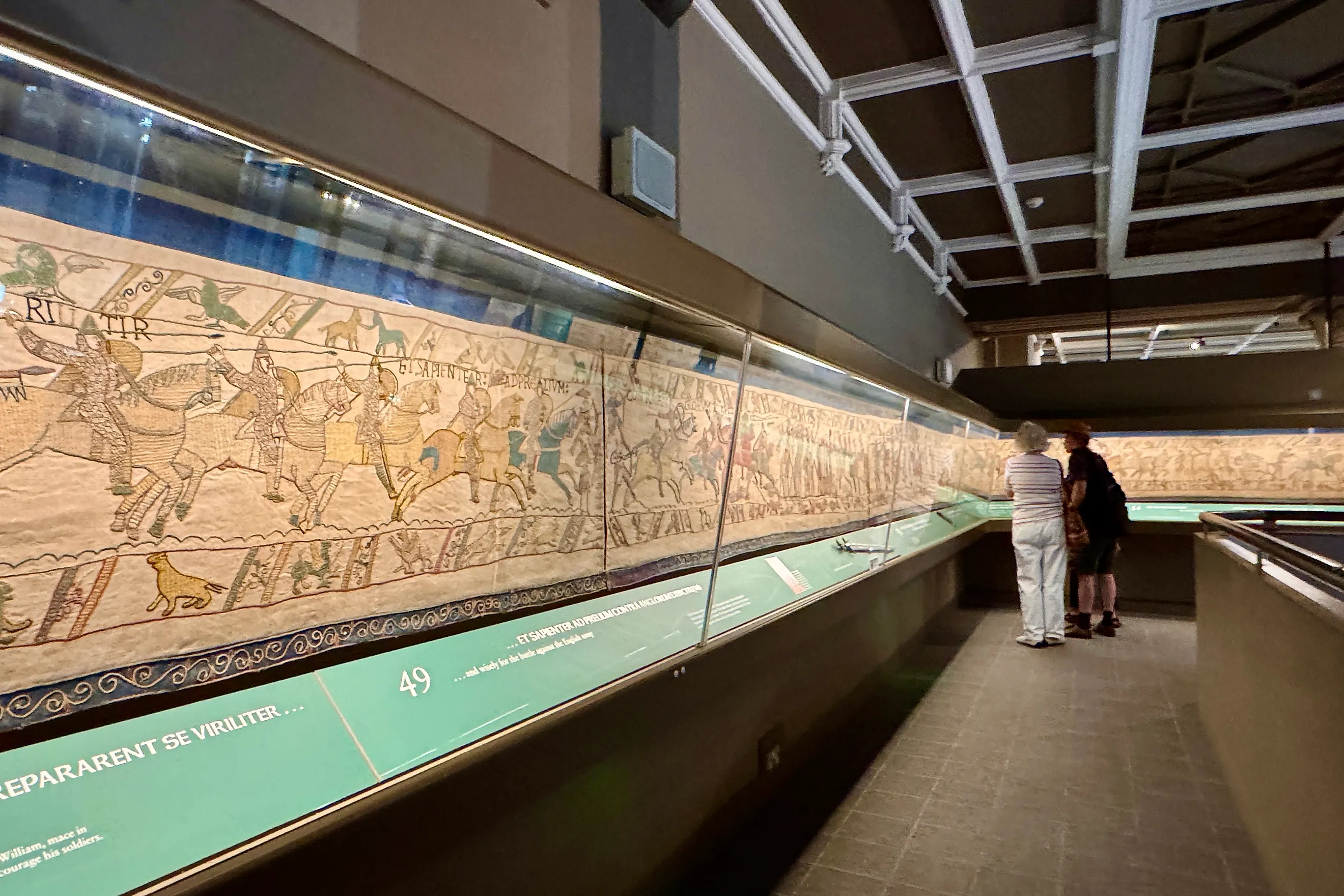
Reading Museum's Bayeux Gallery takes up much of the museum's upper level, allowing you to follow the replica in one continuous line. Measuring the full 230-foot length of the original, it was made in 1885 by 35 skilled female embroiderers and covers the events leading up to and including the Battle of Hastings in 1066. The familiar scenes are all here, among them the appearance of Halley's Comet and the death of King Harold, shown with an arrow in his eye.
The project was the idea of Elizabeth Wardle, a skilled embroiderer who visited Bayeux in 1885 and resolved to make a full-size copy "so that England should have a copy of its own". The embroiderers worked from hand-coloured photographs taken between 1872 and 1874, and each stitched her name beneath the section she completed, giving the Reading copy a blue lower border the medieval original doesn't have.

An amusing difference that's pointed out in the accompanying text reflects the prudishness of Victorian-era England. While the borders of the original now on display in London include several naked men, the Reading version puts one of them in underwear. The women behind the reproduction are usually blamed for this, but it turned out that the underwear had been painted onto the photographs by male staff at the South Kensington Museum (now the V&A) before they were lent out.
If you also have a ticket to see the original Bayeux Tapestry at the British Museum, I suggest you see Reading's copy of it first. Seeing the replica end to end without the ticking clock gives you the whole narrative before your 40 minutes with the original.
From Roman Empire to Biscuit Empire

The museum does a good job of showcasing Reading's Roman roots. In its Silchester Gallery, I saw one of the most important Roman collections in Britain, all of it excavated at Calleva Atrebatum, the Roman town near the village of Silchester. Star objects include the Silchester Eagle, a bronze figure unearthed in 1866, the Silchester Horse, and several Roman mosaics.
Another Reading claim to fame was its role as the country's biscuit capital. In addition to the nearly 300 decorative biscuit tins on display in the Huntley & Palmers Gallery, the story of "Biscuit Town" is told through old advertising material, oral histories and photographs, and the earliest surviving film of a British factory. Individual objects I found interesting included a biscuit supplied to Captain Scott's Antarctic expedition and a thumb piano made from a recycled Huntley & Palmers tin.
I learned that at its height, the firm employed more than 5,000 people and was making 400 varieties of biscuits by 1903. So famous and respected a brand was it that the Queen Mother toured the factory in 1955 and was shown replicas of her own and her daughter's wedding cakes.
Reading Abbey

After getting my fill of the tapestry at an unhurried pace (there's a lot of detail and accompanying info to digest), I took time to learn about what was going on in Reading during this period. The big story was Reading Abbey, founded by King Henry I, the youngest son of William the Conqueror, in 1121.
Built of imported stone from Normandy and the Cotswolds, it served as a royal residence, became Henry I's burial place in 1136, and hosted a sitting of Parliament in 1453. The abbey also served as a place of pilgrimage, with the hand of the apostle St James the Great being the star attraction after being gifted by Henry I's daughter, the Empress Matilda, in 1133.

The museum's Story of Reading Gallery does an excellent job of laying out this history, covering the town from its 6th-century origins onward. You'll also see a full-size reconstruction of part of the abbey cloister that incorporates original Romanesque carvings, a 12th-century book from the abbey library, and a set of 10 paintings of key moments in the abbey's history, commissioned in 1909.
While all that survives today is largely the rubble core of the south transept, chapter house, dormitory and refectory, it's still possible to garner a sense of the abbey's scale with a stroll through Reading's Abbey Quarter. A highlight of the area is the Abbey Gateway, one of only two abbey buildings to survive the dissolution intact. Jane Austen was enrolled at the Reading Ladies' Boarding School here and was taught in the room above the archway.
Where to stay

I spent two nights at The Roseate Reading, a plush, historic hotel that's just a five-minute walk from the museum. Its location on the south side of Forbury Gardens, the town's central park, places it in the heart of the Abbey Quarter, steps from the abbey ruins and its gateway.
The building went up in 1911 as Shire Hall for Berkshire County Council, and its Purbeck marble hallways and vaulted ceilings are original. The hotel's old elevator shaft now houses an impressive Italian glass chandelier of 86,000 beads that runs the full height of the building. Ask to take a peek at the old council chamber, an elegant space popular for weddings, with its original fireplace and carved doors intact. There's even a private cinema capable of seating 30 guests.
The Reading Room, the hotel's restaurant, is first-rate and available for breakfast, lunch, and dinner. If you're there in the warmer months, outside seating is available in the Secret Garden, a quiet little oasis that's perfect for a drink or al fresco dining. Accommodations are spread between the boutique-style rooms in the original building and a former apartment block that features spacious modern suites with kitchen and dining areas, as well as air conditioning.
Tips and Tactics
Getting There: Trains from London Paddington reach Reading in 25 minutes, and the museum is less than a two-minute walk from the station.
Admission: Free, with a suggested donation of £5 per adult.
Tapestry Tours: Staff-led tours are available Tuesdays, Thursdays, and Saturdays. Book online to secure your spot. I looked around on my own instead, though a volunteer was stationed in the gallery and happy to point out things I might otherwise have missed.
Town Tours: I had a fun three-hour walking tour with Terry's Reading Walkabouts. Led by the affable Terry (of course) Dixon, this informative excursion took in the major attractions as well as several lesser-known but equally interesting spots.