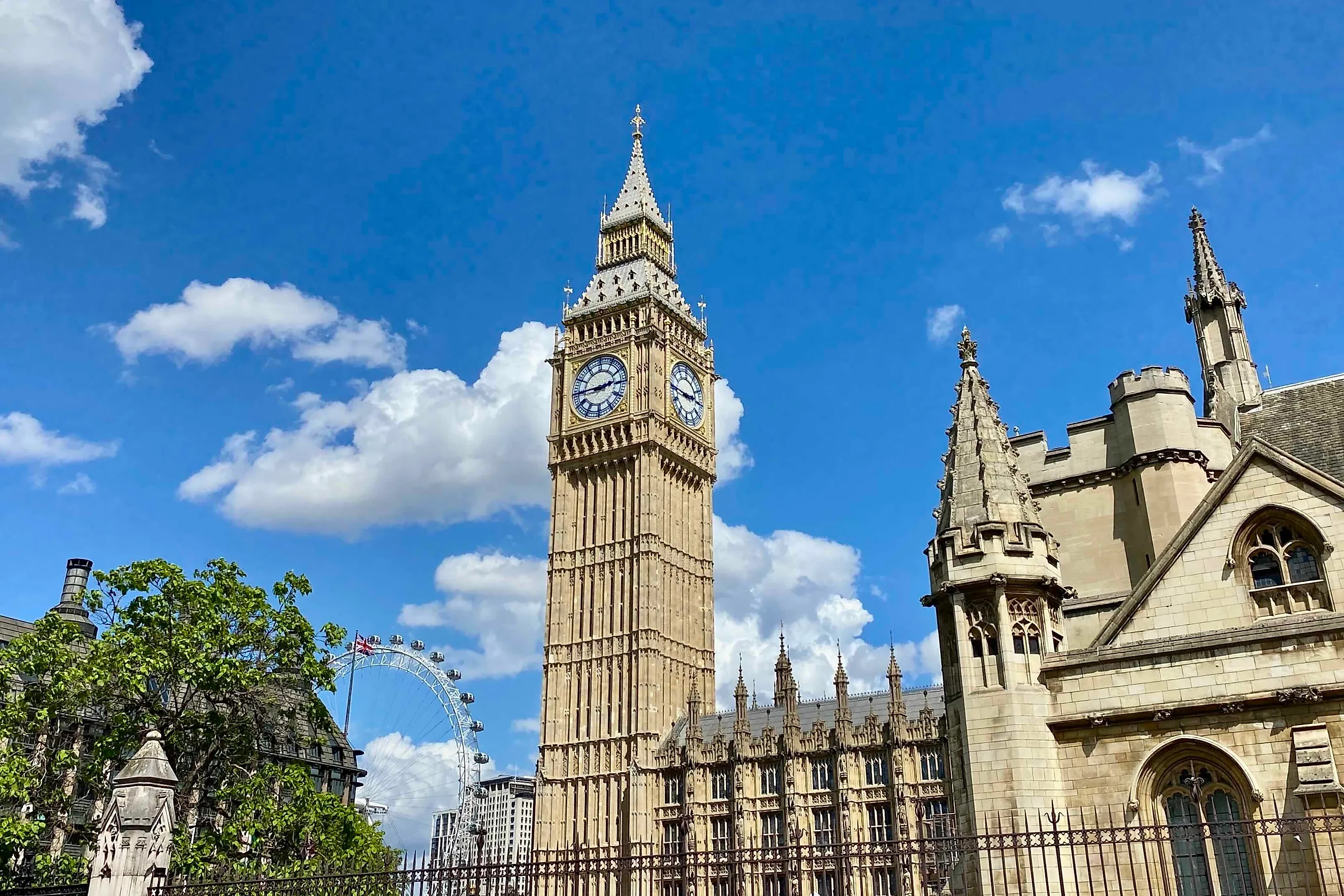
Touring London's Historic Houses of Parliament
As British as Yorkshire pudding and pubs, London's Houses of Parliament are one of the world's most recognizable landmarks. And for visitors to the nation's capital, a guided tour of this majestic UNESCO World Heritage Site is the hottest ticket in town.
Officially known as the Palace of Westminster, I found out that tours of this vast complex offer a rare glimpse into the workings of Britain's Parliament, one of the oldest on the planet. Along the way, I followed ceremonial routes and learned of rituals used by both the British Monarchy and those who keep the engine of parliamentary democracy functioning.

I also learned how the country's democracy has survived everything from civil war to gunpowder plots down the centuries.
Guided tours cover the building's most important spaces, from medieval Westminster Hall through St. Stephen's Hall and the Central Lobby, to the chambers of the House of Lords and the House of Commons. And they're immensely popular, so book tickets as far ahead as you can...and prepare to be impressed.
Westminster Hall

Booked as a birthday treat by great friends in London (thanks, Jen and Ade!), our tour began in Westminster Hall. The oldest part of the Palace, it's the first space you'll encounter after passing through security at the Cromwell Green Entrance. Once checked in, we were provided headsets tuned into the commentary of our tour guide. Without them, our guide's fascinating insights would have been lost in the hubbub of this vast (and busy) working space.
Our guide, Ruby, was superb. Not only was she entertaining, but her knowledge of the history and traditions of Britain's top tier of government was also impressive. Starting with Westminster Hall, she told us how it was built between 1097 and 1099 for King William II, the son of William the Conqueror. It was at the time the largest hall in England, covering approximately 1,547 square meters (about 17,000 square feet) of floor space, with walls more than six feet thick.

Its purpose 900 years ago was simple: to impress the King's subjects with the scale and authority of the Crown. And it still impresses. Look up, and you'll see the largest medieval timber roof in Northern Europe. Commissioned in 1393 by King Richard II, this unique hammerbeam roof spans nearly 70 feet without a single internal support column. The hammerbeams themselves are decorated with 26 carved angels bearing shields displaying the royal coat of arms, featuring the fleur-de-lys of France and the three royal lions of England.
We also learned that Westminster Hall witnessed some of the most important moments in British history. The trial of Guy Fawkes took place here in 1606 following his failed plot to blow up Parliament, and King Charles I was tried and condemned to death within these walls in 1649. In more recent times, it has also been used for lying-in-state ceremonies, including those of King George VI, Winston Churchill, and Queen Elizabeth II.
St. Stephen's Hall

From Westminster Hall, a flight of steps passes under New Dawn. This striking glass and light installation celebrates the 150th anniversary of the campaign for women's suffrage that led to women having the right to vote.
From here, we entered St. Stephen's Hall, a space rich with political history. It's a strikingly elegant place and stands on the site of the former Chapel of St Stephen, which served as the debating chamber of the House of Commons for nearly 300 years after the chapel was dissolved in 1547.

Destroyed in a devastating fire in 1834, the rebuilt space features impressive marble statues of notable parliamentarians. The walls feature eight large paintings known as the Building of Britain murals, depicting key events from British history. The 10 stained glass windows on either side are also worth seeing and display 150 shields of arms representing Britain's boroughs, cities, and towns.
It was in St. Stephen's Hall that I finally got to see the Dearsley Window. I had asked Ruby to point out these stained-glass panels, and she obliged. Added in 2002 to commemorate the suffragettes and to replace windows damaged during World War 2, they were paid for by Norah Dearsley. The window (and Norah) has long been a family mystery, and we've still not been able to determine a family connection... though, of course, I'd like to believe there is one.
The Central Lobby

Next up: the Central Lobby. The symbolic heart of the Palace of Westminster, this octagonal hall is situated beneath the Central Tower and connects the House of Lords to the House of Commons.
As Ruby told us, the Central Lobby served not only as the center of Parliament, it also symbolically marked the epicenter of the British Empire. Standing dead center in the cavernous space beneath its great chandelier, she emphasized how this "neutral" place was also where the public can come to meet or "lobby" their Member of Parliament, a centuries-old practice that gave rise to the term "lobbying."
It's worth noting that photos aren't permitted in the Central Lobby or the areas where members of parliament work and debate, including the House of Commons and the House of Lords.
The House of Commons
Phones and cameras tucked away, our tour continued in the Members' Lobby, the working anteroom to the Commons Chamber. Before entering, Ruby points out the bronze statues of four prominent 20th-century Prime Ministers positioned strategically around the Lobby: David Lloyd George, Winston Churchill, Clement Attlee, and Margaret Thatcher.
Pay attention to the archway next to Churchill. Leading from the Lobby into the Chamber, the Churchill Arch was rebuilt after incendiary bombs hit the Palace, completely destroying the Commons Chamber. It was Churchill himself who suggested that the bomb-scarred stones of the original archway be left in place as a reminder of the war.
As we enter, Ruby points out the fact that the doors beneath the arch also bear scars. These are marks left over the years by Black Rod, the official who knocks three times on them to summon Members of Parliament to the Lords Chamber for the State Opening.
The Commons Chamber itself seems cramped and plain in design. Even though there are around 650 Members of Parliament, Churchill deliberately chose to have seating for only around 450 installed. The reason, we were told, was straightforward enough: the great politician felt a tightly packed chamber would ensure debates were intense enough that everyone had to pay attention.
The House of Lords
Passing back into the Central Lobby, we stroll through the Peers' Lobby and the Prince's Chamber before arriving at the House of Lords Chamber. The Prince's Chamber, a small anteroom themed around Tudor history, features a large white marble statue of Queen Victoria flanked by the figures of Justice and Mercy. Be sure you take a pause to look at the oil portraits of Tudor monarchs, as well as the 12 bronze bas-reliefs depicting scenes from the period.
Seen right after the rather austere Commons, the lavishness of the House of Lords is striking. Dominated by deep reds and gold throughout, the ornate gilded Royal Throne sits on a raised dais at one end. It's here King Charles sits during the annual State Opening of Parliament, delivering a speech outlining the government's agenda.
In front of the Throne, the Woolsack, a large red cushion, is where the Lord Speaker sits. We learned it was introduced in the 14th century to symbolize the economic importance of the wool trade to England, and to this day, it's stuffed with wool sourced from across the British Commonwealth.
Planning Your Visit to the Houses of Parliament

As I discovered, a tour of the Houses of Parliament is a wonderful way to learn how British democracy has shaped so much of the world we live in.
Tours are available most Saturdays throughout the year, and on weekdays during parliamentary recesses at Easter, summer, and Christmas. Two options are offered: a 90-minute self-guided audio tour in several languages, with a separate English-only version for kids; and the English-language guided tour I took, which lasts 90 minutes.
A few other things worth noting:
- Arrive at least 20 to 30 minutes before your scheduled time to allow for airport-style security screening.
- The nearest Underground (or "Tube") station is Westminster on the District, Circle, and Jubilee lines, and just a two-minute walk away. Multiple bus routes stop nearby.
- The Jubilee Cafe serves snacks, sandwiches, and cream teas.
- There's also a gift shop selling official Parliament merchandise.
- Restrooms are located next to the gift shop.
- Tickets can be booked online at parliament.uk or in person at the ticket office at the front of Portcullis House, Victoria Embankment, London. Booking in advance is recommended to guarantee entry. UK residents can also request a free guided tour by contacting their local Member of Parliament.

When your tour's over, don't leave Westminster Hall (the tour's start and finish point) without first grabbing a selfie on the replica Houses of Parliament bench. It's a great reminder of a memorable tour... especially if you're accompanied by a great friend.